

_1745823981883.webp)

Email:benson@guangdongmorui.com
Whatapp:8613530341575
Add: No.3 Xuwu Road, Baoan District, Shenzhen, China.
industrial ultrafiltration systems supplier
Industrial Ultrafiltration Systems You Can Rely On for Wastewater Management Worldwide
You're a procurement manager in South America, Southeast Asia, Europe, the Middle East, and Africa. Your job is to secure dependable water treatment infrastructure. For that work, industrial ultrafiltration systems from a reliable industrial ultrafiltration systems supplier are a critical technology investment. They rely on advanced semi-permeable membranes to physically remove suspended solids, pathogens, and high-molecular-weight organics from process water. As a core part of modern industrial water cycles, this technology acts as a firm barrier against contaminants. It helps treated water meet the strict demands of sensitive industrial applications and environmental discharge standards.
Plants in Southeast Asia and South America often deal with high organic loads in textile and dyeing wastewater. Membranes foul fast, so systems shut down more often. Procurement teams also have to navigate complex international regulations. If recognized certifications like CE or ISO are missing, project approvals can get stuck. Operating costs are another tough issue. In dry regions of Africa and the Middle East, high energy use and low water recovery rates can quickly cut into a treatment plant's profits. Then comes the hunt for an industrial ultrafiltration systems supplier with a verified 20-year track record and global logistics capability. That step often makes it harder to get dependable technical support.
Founded in 2005, Guangdong Morui Environmental Technology Co., Ltd. supplies engineered industrial ultrafiltration systems designed to clear these exact operational hurdles. Our systems are tuned for dyeing wastewater treatment, a sector that demands exceptional filtration precision and chemical resistance. With the MR-UF-20TH model, facilities can run a high-efficiency recovery process that sharply lowers the environmental footprint of heavy industry. These industrial ultrafiltration systems operate within a stable pressure range of 0.1-0.3Mpa. They pair high-flux performance with mechanical durability, so they hold up over the long term in varied climates.
Those technical strengths shape how the systems perform:
- Specialized Dyeing Wastewater Application: The MR-UF-20TH is set up to handle the complex dyes and chemical surfactants found in textile effluent. This prevents premature membrane degradation.
- International Compliance Standards: Every Morui industrial ultrafiltration system is made under ISO, CE, and ROHS certifications. These systems meet the strict safety and quality requirements of the European and South American markets.
- High Resource Recovery: With a recovery rate of 70% to 90%, these systems help industrial plants reclaim most of their process water and cut raw water intake costs.
- Energy use stays low. The system pulls only 4kw/hour, and that alone holds costs down at plants where power is expensive or in short supply.
- Pressure stays low and steady. Transmembrane pressure sits at 0.1-0.3Mpa, which is easier on the hollow fiber membranes and gives the modules a longer service life.
Procurement teams should go through the full technical datasheets and past project performance logs. That is how they confirm whether these systems fit the water chemistry in a given region. Expert consultation is also available to match system setups to local discharge limits and the space each facility has.
High-recovery membrane technology gives industrial plants a sustainable way to stay within regulations while keeping total operating costs in check.
Related Products
About Guangdong Morui Environmental Technology Co.,Ltd
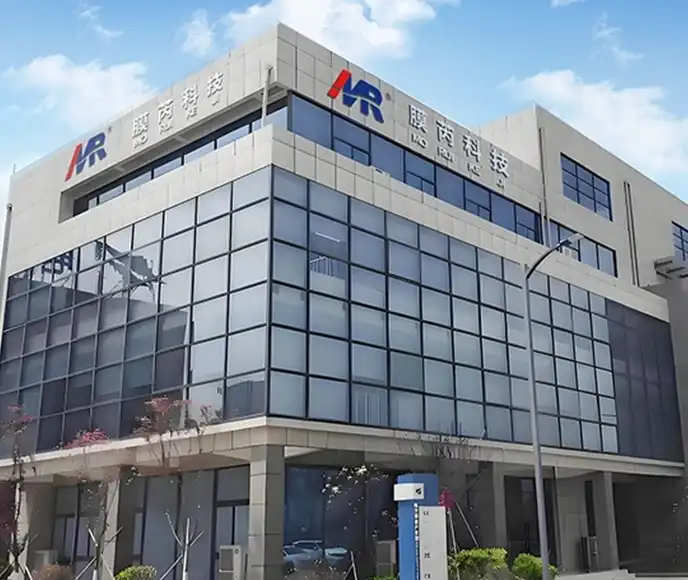
Guangdong Morui Environmental Technology Co.,Ltd has been building high-performance industrial ultrafiltration systems since 2005. We bring almost 20 years of water treatment experience to every project. Today, we serve industrial customers in South America, Southeast Asia, Europe, the Middle East, and Africa, and as an industrial ultrafiltration systems supplier, we have earned a strong global reputation for reliable filtration.
Our engineers take on the hard stuff, especially wastewater from textile and dyeing plants. Our flagship industrial ultrafiltration systems, like the MR-UF-20TH, come from an industrial ultrafiltration systems supplier that knows the demands of the job. They hit a 70-90% water recovery rate and draw just 4kw/hour. The advanced membrane technology uses 0.01-micron pores. That means we can remove bacteria, viruses, and suspended solids effectively, and it creates a stable physical barrier for industrial reuse.
Quality and authenticity guide everything we do. Morui holds ISO certification, and our equipment meets CE and ROHS standards without exception. We run strict quality control at every step of manufacturing. That helps our systems work reliably at low transmembrane pressures (0.1-0.3Mpa) and greatly extends the life of downstream components.
We support our global partners with a full range of technical services. These include remote debugging, on-site training, and maintenance guidance shaped around what each regional market needs. Guangdong Morui stays committed to being a trusted partner in water treatment. We offer sustainable, cost-effective filtration technology that helps projects succeed over the long term.
Industrial Ultrafiltration Systems Built for Sustainable Water Management
I. Where These Systems Get Used
In industrial water treatment, an ultrafiltration system really has just one main job: separating liquids from solids. Guangdong Morui Environmental Technology Co.,Ltd, a trusted industrial ultrafiltration systems supplier, designs and builds these systems for plants that need water quality to stay steady, run after run. The main uses are below:
- Textile and dyeing wastewater. These streams have strong color and a complex mix of compounds, so many plants call on an industrial ultrafiltration systems supplier to help deal with them. Treatment brings them within discharge limits. It can also clean them enough for reuse inside the plant.
- RO pre-treatment. Colloidal fouling is the issue here. When ultrafiltration runs ahead of the Reverse Osmosis membranes, it keeps them clean. That extends the working life of high-pressure systems.
- Process water purification. It removes bacteria, viruses, and suspended solids for food, beverage, and electronics manufacturing.
II. The Problems Customers Run Into
In South America, Southeast Asia, and the Middle East, industrial operators run into their own mix of environmental and regulatory hurdles.
- Strict discharge limits: The EU Water Framework Directive and local environmental rules require steady removal of high-molecular-weight organics. Miss that target and you face heavy fines. Or a shutdown.
- Harsh operating conditions: Membranes foul fast in regions such as Africa and the Middle East. High ambient heat is one cause. Feed water that keeps shifting in quality is another. Downtime soon follows.
- Energy and maintenance costs: Electricity prices keep climbing. That makes traditional filtration hard to defend on cost alone. So plants favor more automation and less manual work.
III. Morui's Industrial Ultrafiltration Solution
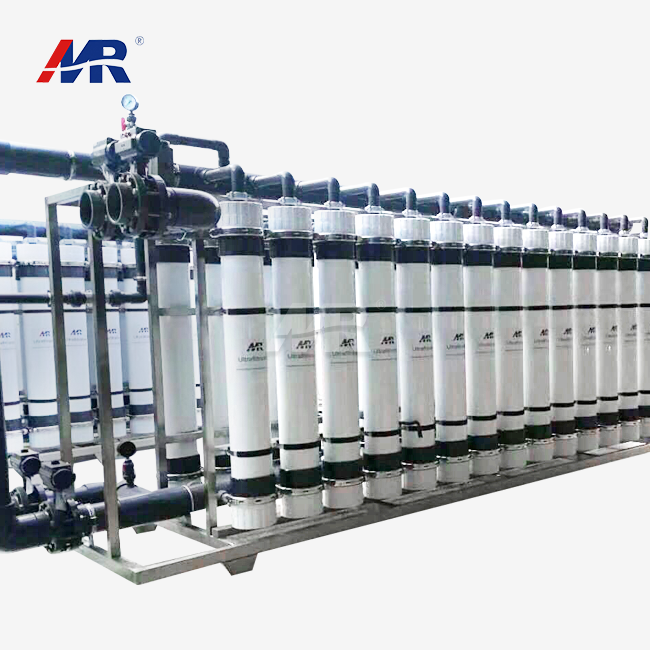
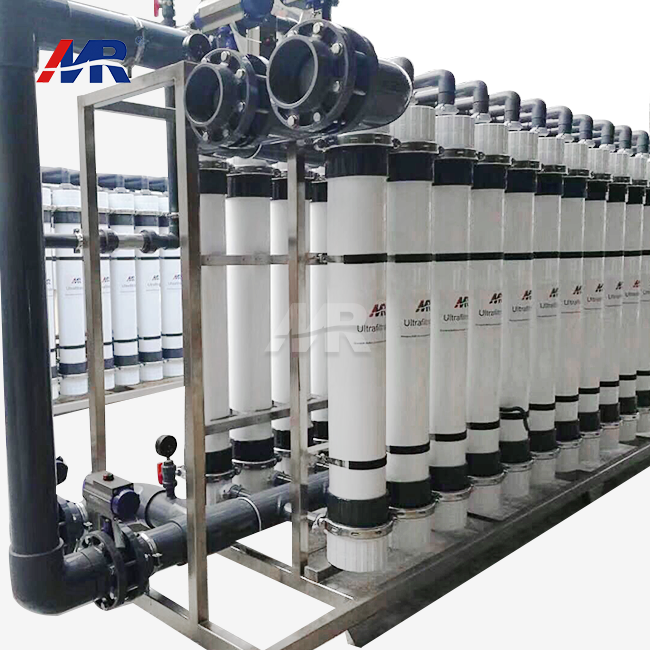
We're Morui Environmental Technology. Ultrafiltration has been our focus since 2005, and we use a modular approach. A systematic physical barrier method turns raw, contaminated water into high-quality process water. ISO-certified manufacturing combines with advanced fluid dynamics to deliver Plug-and-Play turnkey systems. They install fast and keep working over the long run in demanding industrial settings.
IV. System Design: Main Components
The MR-UF-20TH model is the core of our technical setup. It's tuned for dyeing wastewater:
- Pre-treatment unit: Multi-media or disc filters trap the large particles. That keeps the ultrafiltration membranes protected.
- Ultrafiltration Module: These PVDF membranes are built for high performance. Their pores measure 0.01 to 0.1 microns. The module runs at low pressure: 0.1 to 0.3 MPa. That means every bit of energy does as much work as possible.
- Control and Automation: Built-in PLC systems track trans-membrane pressure (TMP) and flow rates. Power use stays steady at 4 kW/hour.
- CIP (Clean-in-Place) Module: Automated chemical cleaning cycles bring flux rates back. That matters most when dyeing processes cause heavy fouling.
V. Benefits You Can Measure
- High Recovery Rate: Water recovery runs between 70% and 90%. That cuts the cost of buying raw water by a wide margin.
- Low Energy Footprint: Fine-tuned hydraulics keep power use to roughly 4 kW/hour at a 20-ton capacity.
- Superior Rejection: The system takes out 99.9% of bacteria and viruses. That holds the Silt Density Index (SDI) below 3.
- Global Compliance: The systems are fully certified to ISO, CE, and ROHS. They meet international safety and quality standards.
- Smaller footprint. Our skid-mounted modular design takes up to 30% less space to install than conventional systems.
VI. Deployment and Global Service
We stay with you for the whole lifecycle. It begins with the first water analysis and a design built around your needs, then carries through manufacturing and global logistics. If you are in Southeast Asia or South America, our technical support covers:
- Remote monitoring and diagnostics, so we keep on-site visits to a minimum.
- Fast spare parts supply, because we already have regional supply chains in place.
- On-site commissioning and staff training, so your local team can run the system on its own.
VII. A Typical Application
A large dyeing plant in Southeast Asia was battling high chemical costs and effluent quality that kept swinging. After the plant installed the MR-UF-20TH solution, it saw:
- We reuse 85% of dyeing wastewater, and that figure holds steady.
- Chemical coagulant use is down 40%.
- Everything we discharge meets local Grade-A standards, every time.
- It takes 18 months or less for water savings to pay back the investment.
VIII. Technical Consultation
We can send you detailed engineering specs and project reports for your region. Use them to choose a system and run an ROI analysis. Our specialist engineers can also put together custom flux calculations based on your feed water chemistry and production needs.
Integrated membrane technology works as a reliable physical barrier. It blocks contaminants and keeps volumetric efficiency high in tough industrial settings.
FAQs
1. How can I verify the reliability and technical capability of a manufacturer when sourcing industrial ultrafiltration systems?
When evaluating a supplier for industrial ultrafiltration systems, you should prioritize three key indicators: industry experience, international certifications, and technical transparency. A reliable manufacturer like Guangdong Morui Environmental Technology Co., Ltd., which has been established since 2005, demonstrates long-term stability in the water treatment sector. Look for essential certifications such as ISO 9001 for quality management, alongside CE and ROHS compliance, which ensure the equipment meets rigorous safety and environmental standards for global markets like Europe and Southeast Asia. We recommend requesting specific case studies or performance data for models like our MR-UF-20TH to verify that the system can handle your specific feed water conditions. If you are unsure about a supplier’s authenticity, ask for their factory export records and technical certifications to ensure they have the engineering depth to support your project.2. What are the typical energy consumption and recovery rate expectations for industrial ultrafiltration systems in wastewater recycling?
Modern industrial ultrafiltration systems are designed to balance high output with energy efficiency. For a standard high-efficiency unit like the MR-UF-20TH, the power consumption is typically optimized at around 4kw per hour for a 20-ton capacity, making it a cost-effective solution for large-scale operations. Recovery rates—the percentage of treated water recovered from the total feed water—usually range between 70% and 90%, depending on the quality of the raw wastewater. To achieve these results, the systems operate at a low transmembrane pressure (TMP) of 0.1-0.3Mpa. This low-pressure operation not only reduces electricity costs but also minimizes the mechanical stress on the membranes. We suggest consulting with our technical team to calculate the precise energy-to-recovery ratio based on your specific industrial influent characteristics to maximize your ROI.3. For dyeing wastewater treatment, what specific technical parameters should be prioritized when selecting industrial ultrafiltration systems?
Dyeing wastewater is characterized by high organic loads and suspended solids, which can lead to rapid membrane fouling. When selecting industrial ultrafiltration systems for this application, you must focus on the membrane’s physical barrier capability and its resistance to chemical cleaning. Our specialized solutions for dyeing wastewater utilize advanced configurations that maintain a stable 70-90% recovery rate even under challenging conditions. It is crucial to ensure the system can operate within a stable pressure range (0.1-0.3Mpa) to prevent the compaction of pollutants onto the membrane surface. Additionally, verify that the system design allows for periodic chemically enhanced backwashing (CEB) to restore flux. For textile or dyeing projects in regions like South America or the Middle East, we recommend a pilot test to confirm that the Molecular Weight Cut-Off (MWCO) of the system effectively targets the specific dyes and auxiliaries present in your effluent.4. How do international standards like CE and ROHS impact the deployment of industrial ultrafiltration systems in Europe and Southeast Asia?
Compliance with international standards is vital for ensuring that industrial ultrafiltration systems are legally compliant and safe for operation in diverse markets. For projects in Europe, the CE mark is a mandatory requirement, indicating that the machinery meets health, safety, and environmental protection standards. Similarly, ROHS compliance ensures that the components, particularly electronic controls in the 4kw power system, are free from hazardous substances. In Southeast Asia and the Middle East, these certifications serve as a benchmark for quality and reliability, often required by local regulatory bodies to approve water treatment installations. While these standards provide a baseline, you should always confirm specific local environmental discharge regulations with your project manager. Guangdong Morui provides full documentation for ISO, CE, and ROHS to facilitate smooth customs clearance and local site inspections for our international clients.5. What maintenance protocols are required to prevent membrane fouling in industrial ultrafiltration systems operating in high-turbidity environments?
To ensure the longevity of industrial ultrafiltration systems, especially in regions with variable water quality like Africa or South America, a robust maintenance protocol is essential. Fouling—the accumulation of particles like silt, bacteria, and organics on the membrane—is the most common challenge. We recommend a three-step maintenance approach: first, implement regular hydraulic backwashing to physically dislodge surface contaminants; second, utilize air scouring if the system configuration allows; and third, perform Chemically Enhanced Backwash (CEB) using agents like Sodium Hypochlorite to address organic fouling. Monitoring the Silt Density Index (SDI) of the feed water is also critical, as ultrafiltration typically aims to reduce the SDI to below 3 to protect downstream processes. With proper maintenance and pre-treatment, high-quality membranes can last 3 to 7 years. For customized maintenance schedules based on your local water analysis, please contact the Guangdong Morui technical support team.
Best Selling Products
Related Blogs
Related Search
Email:benson@guangdongmorui.com
Whatapp:8613530341575
Add: No.3 Xuwu Road, Baoan District, Shenzhen, China.