

_1745823981883.webp)

Cost estimates for 50m3/hour reverse osmosis water treatment units
The budgeting of 50m3/hour reverse osmosis equipment begins with a pair of numbers. An industrial skid may cost $50,000 to $150,000. An ultrapure RO plus edi system might cost $400,000 to $800,000 or more. What fills that gap? This tutorial explains. You’ll find pricing tiers, add-ons for installation and compliance, and the annual operational expenses. You will also understand why the pricing is more sensitive to changes in feed water quality than flow rate. We created it for plant owners, engineers, and finance managers who must approve a budget. Utilize it to compare quotations line by line and prevent unexpected expenditures after ordering.
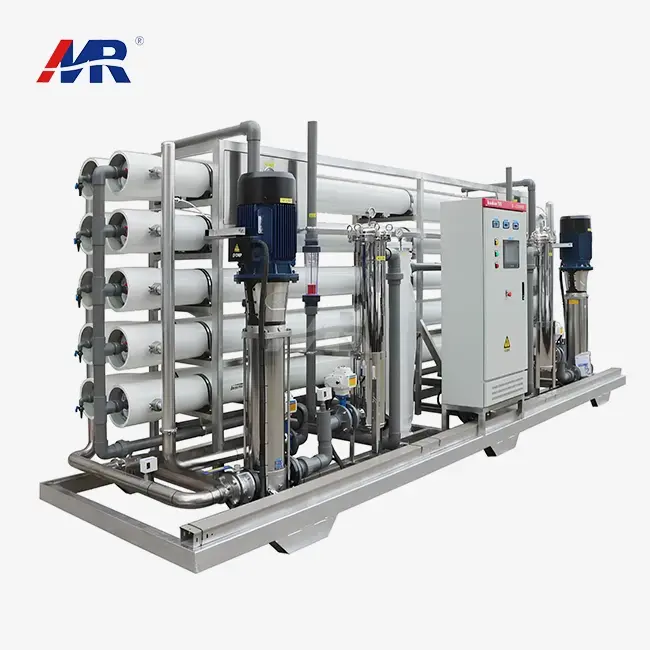
Morui is a 50m3/hour reverse osmosis equipment manufacturer with its own membrane factory and engineering team. Send your feed water analysis and permeate target to benson@guangdongmorui.com. Our engineers will return an itemized quote for 50m3/hour reverse osmosis equipment that matches your site. Include your daily water demand, and we will size the pretreatment for you.
What Does a 50m3/Hour RO System Cost?
The price of 50m3/hour reverse osmosis equipment depends on the treatment goal more than on flow. A single-pass skid for brackish or process water sits at the low end. A double-pass or RO plus EDI system for boiler feed, pharma, or electronics sits at the top.
What Is 50m3/Hour Reverse Osmosis Equipment?
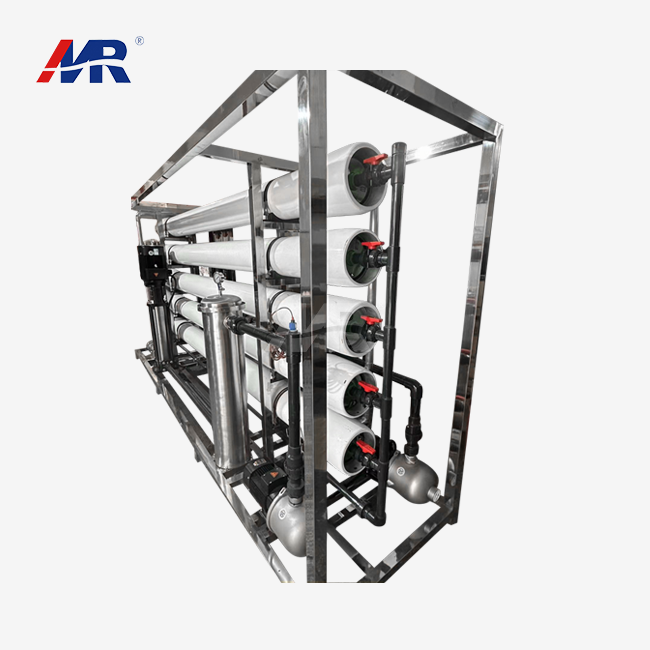
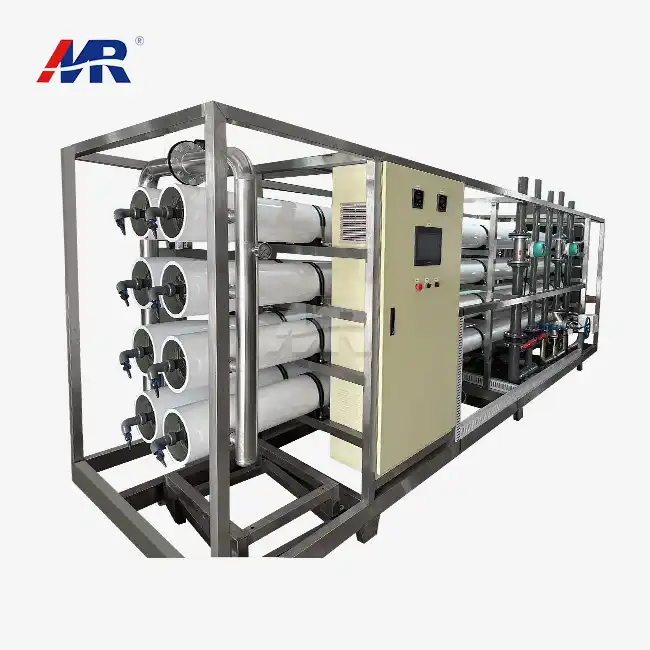
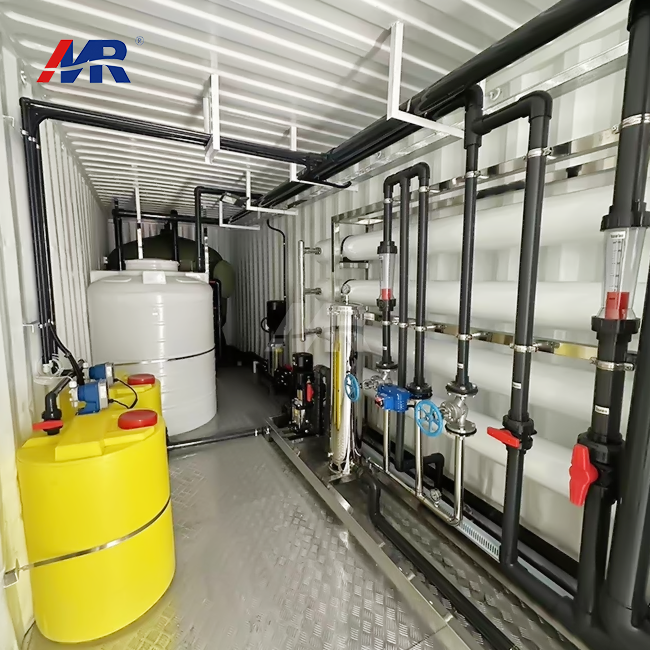
50m3/hour reverse osmosis equipment is a packed membrane system that yields 50 cubic meters of processed water, or as engineers call it, permeate, per hour. That’s 1,200 cubic meters a day when fully loaded, or around 317,000 gallons a day. The technology eliminates dissolved salts, organics, and micro-organisms from the feed. A full set comprises pretreatment, high-pressure pump, membrane pressure vessels, PLC control panel, and storage tanks. The most important aspect influencing system design in the FilmTec design guide is fouling propensity. This is why pretreatment is included in every sound quotation.
How Much Does Each Configuration Cost?
The table groups typical budgets by configuration. Prices cover the equipment skid, not installation or civil works.
Table 1. Typical equipment budgets for 50m3/hour RO systems (USD) | |||
Configuration | Typical budget | Best fit | What drives the price |
Standard single-pass skid | $50,000 to $110,000 | Manufacturing, cooling make-up, irrigation, general process water | FRP vessels, basic PLC, standard pretreatment |
Upgraded single-pass skid | Up to $150,000 | Food and beverage, mining, municipal supply | Stainless steel 304 or 316 parts, more automation, larger pretreatment |
Ultrapure RO plus EDI or mixed bed | $400,000 to $800,000 or more | Boiler feed, pharmaceutical, electronics | Extra RO pass, polishing stage, validation documents |
A 2021 review in Membranes found that complete brackish plants cost USD 500 to USD 2,947 per m3/day of capacity. At 1,200 m3/day, that works out to $600,000 to $3.5 million. The review includes additional scope items, so treat it as a full-plant ceiling, not a skid quote for 50m3/hour reverse osmosis equipment.
Why Does the Price Range Look So Wide?
The range seems large because customers want multiple results at the same flow rate. A crop watering plant requires less salt removal and easy controls. A plant feeding a boiler requires extremely low conductivity all the time. Various outcomes need various pretreatment, RO passes, polishing, and monitoring. The important step is to define the quality of permeate you want. Once you do, the price range of 50m3/hour reverse osmosis equipment decreases rapidly.
What Factors Affect 50m3/Hour RO Pricing?
There are 6 things that will affect a quotation more than anything else: feed water salinity, pretreatment scope, materials, automation, membrane brand, and certification. RO cost is sensitive to salinity and fouling potential, according to a Texas Water Development Board assessment. Each element affects the ultimate pricing of reverse osmosis equipment 50m3/hour.
How Does Feed Water Quality Change the Price?
Low TDS Well Water: Multimedia Filter, Cartridge Filter, and Antiscalant Dosing. Add activated carbon, softening, or ultrafiltration. Surface water or high-iron water. Each extra level increases skid cost and the floor space. Before quoting 50m3/hour reverse osmosis equipment, ask your provider for a silt density index (SDI) and TDS test. A quotation without testing is a conjecture.
Do Materials, Automation, and Membranes Matter?
Yes. FRP vessels are cheaper than stainless steel 316, yet for certain chemical jobs you may require steel. High-rejection TFC membranes cost more upfront and safeguard permeate quality. A PLC with a touchscreen adds a little to the price and reduces operator mistakes. The number also moves with pumps and valves. Morui provides Createc instruments and specifies Shimge water pumps and Runxin valves, so purchasers obtain matching parts from a single source. The service life of your 50m3/hour reverse osmosis equipment increases with each update, as does the price.
How Do Recovery Rate and Energy Use Change the Cost?
Recovery is defined as the amount of feed that passes through to become permeate. A 50 m3/h unit with 75 percent recovery requires 66.7 m3/h of input and rejects 16.7 m3/h. Higher recovery reduces feed and reject quantities. It also increases the possibility of scaling and pressure demand. Morui’s reverse osmosis system (50m3/hour) is rated at up to 75 percent recovery and 0.8 to 1.2 kWh/m3. The plant consumes 40 to 60 kW at such settings. That load accounts for a large chunk of your annual power cost. Require all bidders to provide recovery and kWh/m3 in their quotes for 50m3/hr reverse osmosis equipment.
How Does 50m3/Hour RO Compare With Smaller Units?
Scale changes more than output. Table 2 shows how feed flow, reject flow, and power rise with capacity at 75 percent recovery. Figures assume 20 operating hours a day and 0.8 to 1.2 kWh/m3. Small units often use more energy per cubic meter, so read their power numbers as a floor.
Table 2. Capacity comparison at 75 percent recovery | ||||
Permeate (m3/h) | Daily output at 20 h (m3) | Feed flow (m3/h) | Reject flow (m3/h) | Power draw (kW) |
5 | 100 | 6.7 | 1.7 | 4 to 6 |
10 | 200 | 13.3 | 3.3 | 8 to 12 |
25 | 500 | 33.3 | 8.3 | 20 to 30 |
50 | 1,000 | 66.7 | 16.7 | 40 to 60 |
A 50 m3/h unit needs a feed supply of 66.7 m3/h. Check that your well or main can deliver it before you order 50m3/hour reverse osmosis equipment. Larger systems spread fixed costs such as frames, controls, and commissioning across more output. The Texas report found that operation and maintenance costs show economies of scale. Morui makes its own membranes and runs a group with more than 14 branches, 500 employees, and 20 engineers.
When Does One 50 m3/h Plant Beat Two Smaller Trains?
Some purchasers divide 50 m3/h into two 25 m3/h trains. They employ redundant trains, so that one may be running while the other is being cleaned or repaired. The Texas report: economies of scale are one huge train, lowering frame, control, and piping cost per unit of production. If downtime brings your manufacturing line to a halt, choose two trains. If you can schedule cleaning when demand is low, go with one train. For 50m3/hour reverse osmosis equipment, both layouts may utilize the same design base; thus, ask for quotations for both and compare.
What Capacity Does a 50m3/Hour RO System Deliver?
At full load, the system provides 1,200 m3/day of permeate. At 75 per cent recovery, it requires 66.7 m3/h of feed and rejects 16.7 m3/h as concentrate. Plan for a drain or reuse route for that reject stream. The Texas study identifies concentrate disposal as a component of RO costs and adds that some cost models remove it. Consider 50m3/hour reverse osmosis equipment as a system with an outflow, not only an intake.
In certain plants, reject water has some usefulness. Concentrate may be used for cooling towers, washdown, and landscape irrigation if the salt level is suitable for the purpose. Before designing the reuse line, check local discharge regulations. Early planning allows 50m3/hour reverse osmosis equipment projects to get beyond the permit stage.
Where Do Plants Use This Capacity?
Three instances illustrate the range. A permeate tank may provide blending, rinsing, and boiler make-up to a beverage facility. The permeate may be used as feed for polishing stages that generate boiler water for a power plant. A mine may treat brackish site water and recycle it in mineral processing. Municipal operators also install 50m3/hour reverse osmosis systems for small towns or for mixing with network water. They verify permeate against national criteria based on the WHO drinking-water requirements.
How Do You Size Storage and Peak Demand?
Start with your true daily water usage, not the nameplate capacity. The facility generates 1,200 m3 a day during 24 hours of operation. 1000 m3 is produced at 20 hours. Rarely is there a moment during a shift when the demand for water is constant. A permeate tank levels the peaks so the RO unit operates at a constant flow rather than beginning and stopping. Steady operation is gentler on membranes and pumps. When requesting an estimate from a vendor for 50m3/hour reverse osmosis equipment, provide them with your hourly demand curve.
Which 50m3/Hour RO Configuration Fits Your Plant?
Pick the configuration for the water you want, not the water you have. Morui’s typical 50m3/hour reverse osmosis machine works at 50 m3/h with a recovery up to 75 percent and a power consumption of 0.8 to 1.2 kWh/m3. It has high-rejection TFC membranes and a PLC touch screen. The pretreatment is tailored to your feed water. “The footprint is small, and it’s low maintenance. Water undergoes pretreatment, high-pressure pumping, RO filtering, optional post-treatment, and finally storage and distribution. Check product information at moruiwater.com.
How Does Water Move Through the System Step by Step?
The raw water enters a feed tank. Suspended particles are removed by a multimedia filter, whereas chlorine that would destroy TFC membranes is removed by activated carbon. Antiscalant dosage and a cartridge filter provide membrane protection against scale and small particles. A high-pressure pump then pumps water through the pressure pipes where the membranes reject salts. Permeate is sent to storage, and an optional post-treatment step, such as pH correction or UV, concludes the process. Concentrate leaves via a regulated drain or reuse line. Each stage in 50m3/hour reverse osmosis equipment has a specific task, and eliminating one frequently shows up as fouling later.
Single-Pass Skids for Brackish and Process Water
Single-pass skid for brackish water, cooling make-up, washing, and general process usage. In food and beverage plants, they apply post-treatment such as UV or ozone before filling. It is used by mining operations to reuse process water and reduce input volume. This category represents the $50,000 to $150,000 budget in Table 1. It is suitable for most common industrial uses for reverse osmosis equipment of 50 cubic meters per hour.
Double-Pass and EDI for High-Purity Water
Very low conductivity is needed for boiler feed, pharmaceutical filtered water, and electronics washing water. Those tasks include an additional RO pass, EDI or mixed bed polishing, and validation. That explains the $400,000 to $800,000+ range. Research on major Canary Islands plants demonstrates that particular energy consumption is reduced using energy recovery equipment and high-efficiency pumps. At 50 m3/h, ask your provider whether either one pays back for your salinity. Morui constructs 50 m3/hour reverse osmosis equipment for both tiers and links it to its group services in seawater desalination, drinking water, and industrial wastewater.
What Are the Main Costs Beyond the RO Unit?
The skid is only one line in the budget. Installation, validation, pretreatment, power, and consumables add to it. Table 3 shows each item with an example. The example assumes a $100,000 skid running 8,000 hours a year, which produces 400,000 m3, with power at $0.10 per kWh.
Table 3. Cost items beyond the RO skid | ||
Cost item | Typical range | Example for this plant |
Installation and commissioning | 15% to 25% of equipment price | $15,000 to $25,000 |
GMP or similar validation, if required | 10% to 15% overlay | $10,000 to $15,000 |
Pretreatment | Varies with TDS and SDI | Quote after water analysis |
Electricity | 0.8 to 1.2 kWh/m3 | $32,000 to $48,000 per year |
All operating costs (energy, chemicals, filters, labor) | $0.20 to $0.70 per m3 | $80,000 to $280,000 per year |
Use Table 3 as a planning tool and not as a final quotation. Each row will change your tariff, operating hours, and water quality. Multiply your yearly production in cubic meters by your local cost per cubic meter and add installation. Your finance team has a range of models before the bids come in. It also allows you to compare any 50m3/hour reverse osmosis equipment offer against your own data.
Consumables are scheduled to repeat. Cartridge filters are changed every 1-3 months. Chemical cleaning is performed every 3-6 months. Membrane elements endure 2-5 years. A 2024 study of a seawater plant in the Maldives revealed that changing membranes every four years resulted in the lowest cumulative cost over a period of 12 years. It was said that membrane longevity depended on feed quality, flux, and fouling. Budget this with the 50 m3/hr reverse osmosis plant from day one.
How Do Costs Add Up Over Ten Years?
Take the $100,000 skid from Table 3. Operating costs of $80,000 to $280,000 per year add up to $800,000 to $2.8 million over ten years. That equals 8 to 28 times the skid price. The purchase price matters, but operating cost decides the total. A cheaper skid with higher energy use or shorter membrane life can lose its savings within a few years. Ask for a ten-year cost model for 50m3/hour reverse osmosis equipment before you pick a winner.
How Can You Compare 50m3/Hour RO Supplier Quotes?
Scopes vary, and hence the quotes for the same flow rate are frequently wildly different. It’s fair because of the four inspections.
- Match the scope line-by-line. List what each quotation contains: pre-treatment, pumps, pressure vessels, membranes, controls, installation, commissioning, spare parts. A low total frequently conceals missed pretreatment or starting effort. Get a scope sheet from each bidder. Check off each gap in a single worksheet. You may make a decision when you compare totals.
- Compare foundation for design. Get the design recovery, membrane flux, and feed water analysis behind each price. The FilmTec guideline links cautious flux and good pretreatment to reliable performance. If a bidder can drive recovery higher, they can afford to bid cheaper now and bill you more later in cleaning and membrane replacements. Please provide me with the report for the membrane design software.
- Check brands and spare parts. Uptime is a function of pumps, valves, instruments, and membranes. Morui has combined its own membranes with water pumps from Shimge, valves from Runxin, and instruments from Createc, so that all spare parts and service issues go to a single provider. Whichever brand you pick, get model numbers, spare parts lists, and projected lead times in writing before you sign.
- Request cost per cubic meter with assumptions. Request energy use in kWh/m3, cleaning chemicals, filter replacements, and labor, all at a set power tariff. The Membranes assessment provides you with a sanity check of USD 0.39 to USD 0.66 per m3 for plants of 10,000 to 70,000 m3/day. Question any number far outside your own range.
Apply these checks to all bidders, including Morui. If a provider can answer all four in writing for 50m3/hour reverse osmosis equipment, they have often done the engineering work.
Which Red Flags Show Up in Weak Quotes?
Look out for four red flags. No feed water analysis is included in the quotation. The recuperation is better than your water support. The brand and model of the membrane are undisclosed. No line item for installation, commissioning, and training. Any one of them may quote a low price and a hefty bill later on. Ask the bidder to correct any spelling mistakes. A supplier that refuses to sign a detailed scope sheet for 50m3/hour reverse osmosis equipment tells you something about the project ahead.
What Should You Check Before Ordering a 50m3/Hour RO Unit?
Want to purchase 50m3/hour reverse osmosis equipment? Do five tests first. Test feed water for TDS, SDI, iron, hardness, and chlorine. Give the target permeate in conductivity, or the standard you must fulfill, such as national drinking-water laws based on WHO recommendations. Make sure your electrical service can handle a 40-60 kW typical load. Design a drain or reuse route for 16.7 m3/h concentration. Find out who makes spare membranes and how soon they ship.
Many purchasers are concerned about hidden prices and delivery risk. Both are reduced with a documented scope sheet, milestone-related payment plan, and a factory test report. Obtain this documentation from all suppliers, including ourselves. Armed with these, 50m3/hour reverse osmosis equipment is a choice you can justify to your finance team and your operators.
Which Documents and Tests Should Come With the Order?
Ask for a pipe and instrument diagram, electrical single-line diagram, and membrane projection report. Before shipping, ask for a factory acceptance test and check what is included. Agree on a launch strategy that identifies who commissions the plant, who educates operators, and how long the assistance lasts. If your budget permits, provide a spare parts list of cartridge filters, O-rings, and one pair of membranes. These papers are useful for keeping 50m3/hour reverse osmosis equipment projects on track and simplifying subsequent audits, particularly in pharmaceutical and food facilities.
What Feed Water Data Should You Send With Your Inquiry?
Please include a current lab report showing TDS, pH, hardness, iron, silica, chlorine, and turbidity. Add if you have the SDI. Indicate whether the source is well, river, municipal main, or process water. Enter your daily demand, hours of operation, power supply voltage, and permeate quality required. Using this data, our engineers can size the pretreatment and price the reverse osmosis equipment at 50m3/hour without guesswork.
Timing is also a factor. Set dates for delivery, installation, and start-up in the contract. - Link payments to milestones like factory test and commissioning. Clear dates improve your production planning and make sure 50m3/hour reverse osmosis equipment orders stay on schedule.
Conclusion
Plan the budget. There are 3 levels. The RO skid, the add-ons, and the running cost. A typical plant is around $50,000, while ultrapure plants are more than $400,000. Add 15 to 25 percent for installation and $0.20 to $0.70 per cubic meter to operate it. Compare scope, not totals. This discipline means 50m3/hour reverse osmosis equipment becomes a predictable expenditure and not a surprise.
Begin your project with three activities. Test your feed water, set your permeate objective, and receive itemized quotations. Morui can assist with all three. Send your data to benson@guangdongmorui.com and our engineers will size 50m3/hour reverse osmosis equipment for your location.
FAQ
1. How much does a 50m3/hour RO system cost?
A standard skid of 50m3/hour reverse osmosis equipment costs about $50,000 to $150,000. An ultrapure RO plus EDI plant costs $400,000 to $800,000 or more. Installation adds 15 to 25 percent.
2. How much power does a 50m3/hour RO plant use?
At 0.8 to 1.2 kWh per cubic meter, 50m3/hour reverse osmosis equipment draws about 40 to 60 kW at full output. Your tariff then sets the yearly electricity bill.
3. Why do the membranes need replacement, and how often?
Fouling and scaling wear membranes down, so plan replacement every 2 to 5 years. In 50m3/hour reverse osmosis equipment, feed water quality and flux decide the real interval, as the Maldives study shows.
4. Can one unit meet pharmaceutical or boiler feed standards?
Most of these jobs need an extra RO pass, EDI, or mixed-bed polishing, and validation. That moves the budget into the $400,000 to $800,000 tier.
5. What recovery rate should I expect?
Morui designs 50m3/hour reverse osmosis equipment for recovery up to 75 percent. The scaling tendency of your feed water sets the safe limit for your site.
6. What feed water data do I need for a quote?
Send TDS, pH, hardness, iron, silica, chlorine, turbidity, and SDI from a recent lab report. Add daily demand and your permeate target. This data lets an engineer size 50m3/hour reverse osmosis equipment correctly.
7. Do I need a backup train?
A backup train helps when downtime stops production. Two 25 m3/h trains let one run during cleaning. If you can schedule cleaning, one 50 m3/h train costs less to buy and install.
Request Your Itemized 50m3/Hour Quote From Morui
Morui ships 50m3/hour reverse osmosis equipment with pretreatment, installation, and commissioning in one package. Send your feed water analysis and permeate target to benson@guangdongmorui.com. Our engineers will reply with an itemized quote that shows every cost line. Buyers who want 50m3/hour reverse osmosis equipment for sale from a single supplier can also request a site visit plan and a spare membrane list.
References
1. DuPont Water Solutions, FilmTec Reverse Osmosis Membranes Technical Manual (Form 45-D01504), accessed 2026. Used in the definition section and in the quote comparison. https://www.dupont.com/content/dam/dupont/amer/us/en/water-solutions/public/documents/en/RO-NF-FilmTec-Manual-45-D01504-en.pdf
2. Membranes (MDPI), Economics and Energy Consumption of Brackish Water Reverse Osmosis Desalination: Innovations and Impacts of Feedwater Quality, 2021. Used in the price tiers, cost factors, and operating cost sections. https://www.mdpi.com/2077-0375/11/8/616
3. Texas Water Development Board, Desalination for Texas Water Supply, accessed 2026. Used in the pricing factors, scale comparison, and capacity sections. https://www.twdb.texas.gov/publications/reports/contracted_reports/doc/2000483328.pdf
4. World Health Organization, Guidelines for drinking-water quality, 4th edition incorporating addenda, 2022. Used in the use-case and pre-order checklist sections. https://www.who.int/publications/i/item/9789240045064
5. Water (MDPI), Cost Studies of Reverse Osmosis Desalination Plants in the Range of 23,000-33,000 m3/day, 2024. Used in the high-purity configuration section. https://accedacris.ulpgc.es/handle/10553/129736
6. Maldives National University, Evaluation of effectiveness of cleaning-in-place of membranes and optimum period of membrane replacement on a seawater reverse osmosis plant, 2024. Used in the operating cost section and FAQ. https://saruna.mnu.edu.mv/handle/123456789/16073
About the author: Renjie Kuang, Senior Water Treatment Process Engineer. Renjie designs and reviews reverse osmosis systems for industrial, municipal, and commercial projects at Guangdong Morui Environmental Technology Co., Ltd. His work covers pretreatment layout, membrane selection, and commissioning for brackish water, process water, and boiler feed duties across Asia, South America, and Africa. He helps buyers read quotes with confidence.
 VIEW MOREwaste water treatment system
 VIEW MORE8040 reverse osmosis membrane
 VIEW MORE30m3/hour ultrafiltration equipment
 VIEW MOREDTRO plant
 VIEW MOREMBR membrane
 VIEW MOREreverse osmosis water treatment equipment
 VIEW MORE8m3/hour two pass reverse osmosis system
 VIEW MOREcontainer reverse osmosis equipment
