



Ultrafiltration Skid: What Capacity Does Your Plant Need?
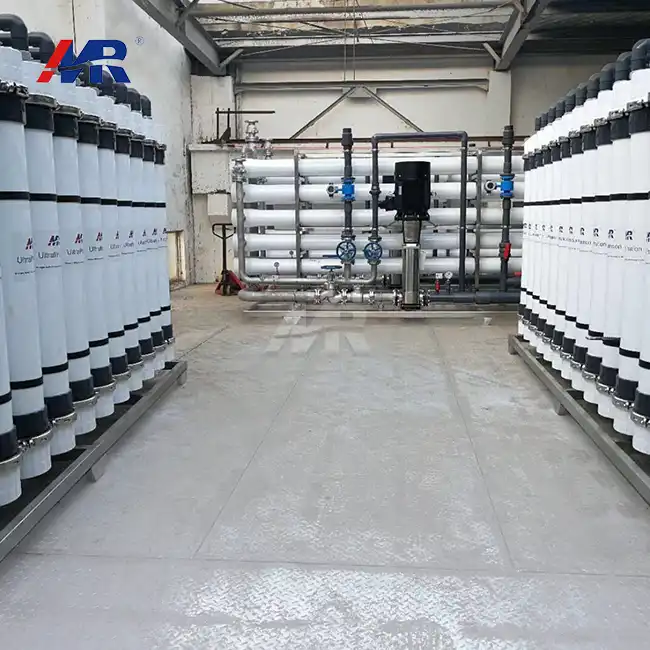
Match the unit to peak permeate demand, not to the number on the catalogue page. I size every ultrafiltration skid the same way: take the highest hourly flow the plant must deliver, divide it by the share of the day the equipment actually produces water, then check the answer against real feedwater quality and a realistic membrane flux. A 100 m³/day duty seldom lands on a 100 m³/day nameplate. Backwash, chemically enhanced backwash, cleaning cycles, and standby time all take a bite out of production. Do that arithmetic early, and the skid runs quietly for years; skip it, and you buy fouling, downtime, or membranes that sit idle.
Start With Your Plant's Actual Water Demand
Average Flow, Peak Flow, and Daily Production
The average hourly flow is found by dividing the daily demand by the working hours. Peak flow does different things. The reason it's higher than the mean is because of shift starts, watering windows, plant washdown, and higher demand in the summer. I ask clients for three numbers: the m³/h that is most common, the m³/h that is highest, and the m³/day. This is because suppliers give prices in any way that looks good on paper. It's not the same project to need 480 m³/day spread out over 24 hours for a plant that only needs it for 16 hours and needs 38 m³/h at its busiest. You can compare them fairly if you write down both numbers on the sheet of data.
The Sizing Formula I Use on Every Project
Required UF capacity = peak water demand ÷ expected system availability. There is never a rate of 100% availability. There are different types of backwash, forward flush, backwash with chemicals, clean-in-place, and regular maintenance that you can count on. If they are run well, most plants land between 88% and 94% of the time. With 20 hours of activity and 90% availability, a task of 100 m³/day will add up to 5.6 m³/h of net permeate. The feed pump needs to be able to handle 6.6 m³/h, which is found by dividing the recovery by 0.85 for an 80–90% machine. Before any money changes hands, that one step stops most plans that are too small.
Feed, Permeate, Reject, and Recovery
There are three important flows. What the membrane is stopping goes away as reject; what goes into the Ultrafiltration skid as feed goes in as permeate. Return sets the ratio, and the MR-UF-30TH works at 80% to 90%. In other words, a plant that needs 30 m³/h of filtrate feeds about 34–37 m³/h. It stays small, but it's not free. It needs a healing step, a drain, or a return line. UF hollow fibers work with a low pressure of 0.2 to 0.3 MPa, so they don't need a lot of power. You can compare the quote if you list all three flows in the question.
Evaluate Feedwater Quality Before Selecting Capacity
Parameters That Move the Flux Number
How much flow a membrane can hold can be changed by things like soap and grease, temperature, pH, the number of microbes, and the amount of dissolved solids in water (SDI). The time between backwashes is shortened when turbidity is high. It's hard to clean fibers that are covered in oil and grease. When water is cold, its viscosity goes up, which makes output go down. One example is that a membrane that works best at 25 °C doesn't work as well at 5 °C. The hardness and pH of the water cause scaling during chemically enhanced backwash. Increasing the stated capacity won't help with this. A flow rate was raised by 30% to account for dirty feedwater, but that money should have been used for preparation instead.
Match Pretreatment to Your Water Source
For surface water, you usually need screen, disk, or sand filters. There are times when coagulation is needed before the membrane. For secondary effluent from cities, you need to screen, equalize, and plan for when the load changes. Industrial wastewater may need to first be cleaned up and the pH adjusted to get rid of the oil. Food plants often add an extra screen made for grains in the product. Most of the time, coarse screening is used to prepare saltwater, and chlorination and dechlorination can be controlled. Different kinds of raw water leave behind different kinds of fouling. That signature, not a design from somewhere else, should make the cleaning train react.
Design for the Coldest Day, Not the Best Day
People who sell membranes say that flow happens at a normal temperature. There aren't many plants that run there. Prepare based on the site's water temperature at its coolest point each month. Then, don't use a regional average to prove the number; use a lab analysis that is special to the spot. In the winter, surface water in the northern US can stay below 5 °C for weeks. Also, an Ultrafiltration skid that was made based on summer data doesn't work when demand is high. It's important to know how often the plant needs to be cleaned because scale potential and fouling rate show how often it needs to be cleaned. The amount of water the plant makes during the day depends on how often it needs to be cleaned.
How an Ultrafiltration Skid Works and What It Compares To
Process Flow From Raw Tank to Product Outlet
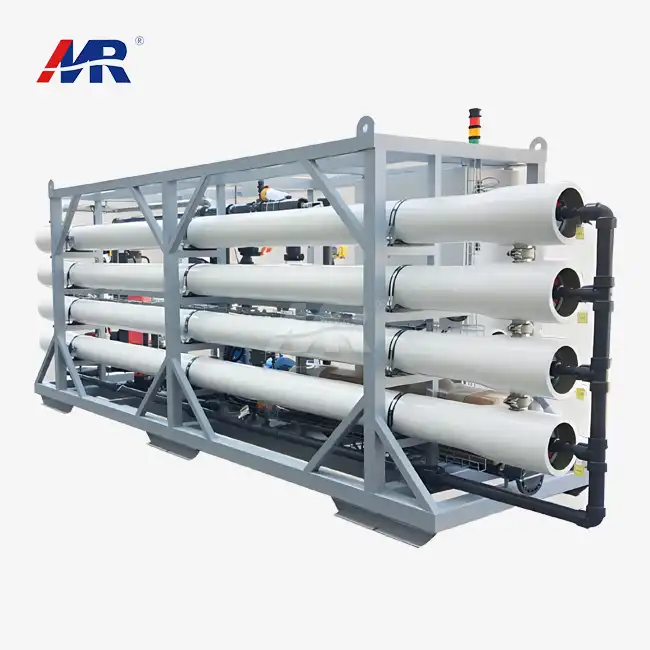
There is a feed pump, a raw water tank, cleaning, UF modules, a permeate tank, a backwash and CIP loop, and a product exit. Each block does something. Between 0.2 and 0.3 MPa comes from the feed pump. It is made up of hollow fibers with holes that are between 0.01 and 0.1 microns wide. It is possible for these fibers to catch colloids, bacteria, many viruses, and solids that are mixed with liquids. This loop changes the flow direction to get the cake off the fiber's surface. This is what the CIP loop does when backwashing doesn't work. Coagulation, air scrubbing, dechlorination, cleaning, and handling the concentrate are extra steps that can be added if the water or a process further down the line needs them. The train comes on a single frame that is already wired.
Dead-End vs Cross-Flow, Inside-Out vs Outside-In
It's good for low-solids streams and drinking water to run water straight through a dead-end filter because it doesn't lose much. With cross-flow, a concentrate stream keeps moving across the membrane. Cake doesn't get stuck on dirtier feed, but it costs more to clean up. Inside-out filtration takes water from the fiber hole outward, which evens out the flow and makes it easy to clean things again. Outside-in filtration can handle more solids because it gets water from the outside of the shell. Most of the city and RO preparation Ultrafiltration skids I suggest have a dead-end inside-out design that is continually sprayed with air. This makes it easy to clean and keeps recovery high.
UF Against RO, MF, and NF
UF gets rid of particles, colloids, and microbes, but it leaves in salts that have been dissolved. Osmosis needs 1 to 6 MPa and gets rid of ions. UF is put in front of it because it needs clean feed as well. The holes in microfiltration are bigger, so they can catch bigger particles. Nanofiltration, a method that is somewhere between UF and RO, takes some minerals out of water and makes it softer. During backwash cycles, automated skids controlled by a PLC keep the volume the same and record information on silt and pressure. The first units that are used by hand are cheaper, but they need to be carefully used by workers. For a plant that is left alone all night, automation is worth the money just because it works.
Match a Capacity Range and Technical Metrics to Your Application
Small, Medium, and Large Capacity Bands
Capacity bands help set the tone for the first conversation, but the correct rating is always based on site data:
- Small (about 10–50 m³/day): People put these units on test skids, in labs, hotels, out in the middle of nowhere, and in small business plants. The size of the footprint is more important than the amount of raw output. Single-train designs with a small permeate tank can usually fit without any extra work or an operator who is only in charge of that train.
- Medium (about 50 to 500 m³/day): Process water, food and drink lines, making electronics, small municipal plants, and reuse projects all use this size. Automatic backwash, CEB dosing, and PLC trends are all built into these boxes. Duty/standby makes them useful when work can't be stopped.
- Large (1,000 m³/day or more) wastewater for cities, pretreatment of seawater for desalination, mining, and electricity all move into multiple trains or containerized Ultrafiltration skids. A lot of backups, focused handling, and remote tracking are built into the design, and both the total capacity and the capacity per train are given.
Those bands don't show the limits; they show where to start. Large plants may need more membrane area than their flow rate suggests if the feedwater is dirty.
Flux, Membrane Area, and Effective Daily Output
Planned flux times the planned flow of permeate gives you the needed membrane area. Liters per square meter per hour (LMH) are used to measure flux, which controls everything further downstream. In the lab, the flux numbers are based on water that is clean and at room temperature. The flow numbers used in a plant need to take into account the feed, temperature, membrane material, and the way the plant is cleaned. Once the area is set, get rid of the downtime for backwash, flush, CEB, and CIP to get to a daily output that works well. Then choose the type of arrangement you want: one train, two trains together, duty/standby, or N+1. The MR-UF-30TH needs about 5.5 kW of power per hour, so the cost of energy is based on how many hours it runs instead of how many membranes it has.
Application Profiles From Drinking Water to Seawater
The main parts of drinking water projects are a stable filter turbidity, a cleaning barrier, and automatic backwash that meets the needs for reporting. For reuse projects to work, they need to take into account different loads and clean more often. The buildings and areas of food and drink plants need to be clean and easy to clean. The quality of the process water should also be consistent. Sites that deal with drugs need validation documents, material certificates, and controlled monitoring. The goal of preparation with seawater is to lower the SDI below 3.0 so that ro membranes further down the line see less material fouling. The capacity you should list for each profile should be different, even if the flow number looks the same on paper.
A Practical Capacity Decision Path and the Mistakes to Avoid
Build a Project Data Sheet First
These five steps will answer most questions about size. Describe how much of the product is made every day, how long the business is open, what the average and peak demand is, and how it plans to grow. Check the feedwater and make sure the pretreatment train is stable. Choose how the membrane will work, how it will heal, and how it will be cleaned. Set aside money for automation, backups, and maintenance. Next, ask for a plan that is based on what you know. There is a lot of information on a full data sheet, like the permeate flow, the quality of the feedwater, the quality of the goal water, the site temperature, the utilities that are available, the installation conditions, the level of automation, the standards that apply, and what the future holds. It's a guess on the part of the sellers when they quote without it, and that guess shows up later as a change order.
Total Cost of Ownership Beats Purchase Price
The price of the item includes the hardware. Over the course of ten years, ownership costs cover things like labor, building work, chemicals, power, changing membranes, getting rid of wastewater, and spare parts. A cheaper Ultrafiltration skid with a higher design flux looks better on paper, but it needs to be cleaned more often, draws more chemicals, and needs new membranes more often. Different suppliers tell me how much it will cost per cubic meter of permeate over five years. They also write down how long the membrane will last and how often it needs to be cleaned. That comparison usually changes the order of the group before any talks begin.
Four Mistakes That Sink a UF Project
If you size a plant based on its average flow, you miss the peak hour, which is what decides if it stays open or not. If you don't think about changes in the feedwater and bad preparation, a filter problem can turn into a cleaning problem. Price or nameplate capacity alone might not help you tell suppliers apart if you don't also compare membrane area, automation, or documentation. When you expand without a plan for care, you don't use your pricey membranes and do extra work that you didn't need to. There is an easy fix that needs to be made: high demand, a correct water analysis, a good flow rate, a good margin, and a flexible or N+1 layout that lets the plant grow without having to change the skid.
Conclusion
Capacity is not a number in a book; it is what the design makes possible. There are many things that the path goes through, such as daily and peak demand, feedwater quality and temperature, preparation, membrane flow, recovery, cleaning downtime, and redundancy. An Ultrafiltration skid won't work well enough in a season even if it meets its flow number on paper. This is because it doesn't take into account things like oil in the feed or the cold winter months. A well-matched unit, on the other hand, will keep the filtrate's quality and supply fixed for many years. The cost over time, the size, the amount of technology, and the space to grow are just as important as the number on the hood. It will be easy to make your choice once you have site data and have checked the membrane area behind the promised flow.
FAQ
1. Can a 100 m³/day requirement be sized from that number alone?
How long the machine is open for business, how long it takes to clean, what kind of water it uses, and what kind of redundancy is expected. Since it is used for 20 hours a day and 20% of the time, 100 m³ needs about 5.6 m³/h of permeate. It needs about 14 m³/h after 8 hours of use. The tools are very different, but the daily number is the same.
2. Why is a bigger skid not automatically better?
Having more space can raise the cost of cash, the amount of chemicals used, and the size of the area. It can also make membranes not work at all or with very little flow. It moves out of the design window where backwash intervals and cleaning cycles were planned when the working point is too big.
3. How do m³/h and m³/day differ in a quotation?
m³/h shows the instantaneous production and tells you how big the pump and membrane need to be. m³/day shows the total output and is based on how many hours the device is on. To be able to compare bids, ask suppliers to list both and explain what they think about recovery and availability.
Request Your Customized Ultrafiltration Skid Capacity Assessment From Morui
We will size the unit based on the information you send us, not on a page from a catalog. We will look at the flow rate, the source of the feedwater, the lab test, the planned water quality, the location of the site, and the date of delivery. Morui has its own workshops where it makes its own membranes and puts each Ultrafiltration skid together. You can also change the view, control, and storage. If you need industrial, containerized, or OEM water, you can email benson@guangdongmorui.com. Because we make straight Ultrafiltration skids, we can give you a quote for capacity, utilities, area, and lead time all at once.
References
1. U.S. Environmental Protection Agency — Membrane Filtration Guidance Manual (2005)
2. American Water Works Association — Microfiltration and Ultrafiltration Membranes for Drinking Water, Manual M53 (2016)
3. American Water Works Association — Reverse Osmosis and Nanofiltration, Manual M46 (2007)
4. Water Environment Federation — Membrane Systems for Wastewater Treatment, MOP 36 (2006)
5. National Research Council — Desalination: A National Perspective (2008)
6. Cheryan, M. — Ultrafiltration and Microfiltration Handbook (1998)
 VIEW MOREindustrial ultrafiltration systems
 VIEW MOREmembrane bioreactor mbr
 VIEW MOREcontainerized ro systems
 VIEW MOREcommercial sewage treatment plant
 VIEW MOREsubmerged membrane bioreactor
 VIEW MORE150m3/hour reverse osmosis plant
 VIEW MOREmembrane mbr
 VIEW MORE12m3/hour seawater desalination equipment