_1745823981883.webp)

Submerged Membrane Bioreactor Fouling: Causes and Solutions
Fouling is the most persistent operational challenge in any membrane/bioreactor-wastewater-treatment">submerged membrane bioreactor system. When suspended solids, organic matter, biological byProducts, and inorganic salts accumulate on membrane surfaces, transmembrane pressure (TMP) rises, permeate flux drops, and energy consumption climbs. Left unmanaged, fouling accelerates membrane degradation and inflates lifecycle costs. Understanding why fouling happens — and how to control it — is essential for engineers, plant managers, and procurement teams across municipal wastewater treatment, food and beverage production, pharmaceutical manufacturing, and industrial processing environments.
What Is Fouling in a Submerged Membrane Bioreactor?
Fouling Types and Their Operational Impact
There are several steps that happen in a submerged membrane bioreactor before the membrane gets fouled. Four main types of fouling affect how well a machine works:
- Biofouling happens when bacterial colonies stick to the membrane surface and form biofilms that can't be cleaned off with normal backwashing. Extracellular polymeric substances (EPS) and soluble microbial products (SMP) were found to be the main biofouling drivers in submerged membrane bioreactors in a study published in Water Research (2006).
- Organic fouling happens when dissolved humic substances, proteins, and carbohydrates stick to membrane holes and make flow paths smaller and smaller.
- Inorganic fouling (scaling) develops when calcium carbonate, iron hydroxide, or silica precipitates block membrane surfaces. This is a big problem in hard water or high-TDS industrial effluents.
- Particulate fouling occurs when fine suspended solids physically stick to the outside of the membrane under suction pressure.
The TMP responds in a different way to each type of fouling. Biofouling and organic fouling tend to build up slowly, but scale and particulate clogging can make the TMP jump quickly. The right countermeasure can be taken once you know which type dominates your system.
Submerged vs. External MBR: Why Fouling Dynamics Differ
The membrane module sits directly inside the bioreactor tank when it is submerged, and it works under low vacuum pressure (10–50 kPa). This design uses less energy, but it exposes more people to high-MLSS mixed liquor. When MBR systems are external (sidestream), they push mixed liquor through membrane modules at faster crossflow speeds. This naturally scrapes the membrane surface but uses a lot more energy. So, to keep systems from getting fouled, they need deliberate cleaning methods like aeration scouring, relaxation cycles, and regular chemical cleaning. These are some of the things that external systems can do with just hydraulic shear.
What Causes Fouling in SMBR Systems?
Operational Variables That Accelerate Fouling
The rate of fouling is directly related to how the machine is used. When you run a membrane at flux levels above its sustainable design threshold, which is also known as the "critical flux," strong suction forces are created that can permanently press foulants into the structure of the membrane. Studies show that running at 80–90% of critical flux makes cleaning intervals much longer. MLSS levels above 15,000 mg/L raise the viscosity of the mixed liquor, which makes air scrubbing less effective and raises the risk of fouling. Another common cause is not enough aeration; when the coarse bubble diffusers at the base of the membrane module don't work well, the shear force that removes biofilm from fiber surfaces quickly decreases.
Design and Material Factors
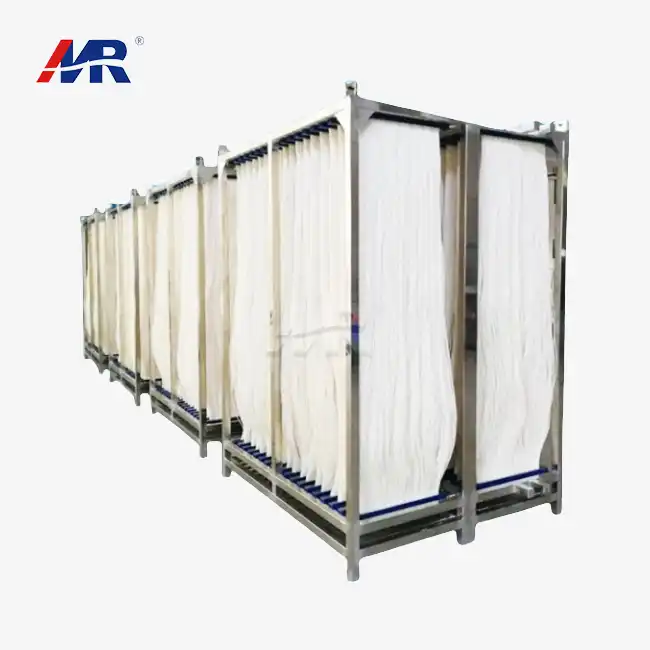
How evenly air moves through the fiber bundle depends on the shape of the membrane module. When modules are packed closely together, they trap sludge flocs between the fibers. This makes dead zones where fouling can happen quickly and without being stopped. The material of the barrier is also important. Organic compounds stick to hydrophobic materials more strongly, while organic compounds don't stick to hydrophilic PVDF (polyvinylidene fluoride) surfaces as well. For the Morui MR-MBR-18 module, we use 0.2 µm PVDF hollow fiber membranes that cover an area of 18 m² and are housed in a small 1300 × 1250 × 30 mm panel. PVDF is much less likely to get permanently fouled by organic matter than polyethylene alternatives because it naturally attracts water and is resistant to chemicals within the submerged membrane bioreactor environment.
| Parameter | MR-MBR-18 Specification |
|---|---|
| Model | MR-MBR-18 |
| Filtration Area | 18 m² |
| Membrane Material | PVDF |
| Pore Size | 0.2 µm |
| Module Dimension | 1300 × 1250 × 30 mm |
Effective Solutions and Preventive Strategies for SMBR Fouling
It is not possible to completely get rid of fouling, but it can be controlled to a point where operational continuity and membrane lifespan meet your investment expectations. There are three main parts of an organized mitigation approach: operating optimization, cleaning procedures, and material selection for the submerged membrane bioreactor.
Here are the main strategies that have been shown to lower the severity and frequency of fouling:
- Flux management: Keep the working flux below the critical level. Most submerged hollow fiber systems can work for 10 to 25 LMH (liters per square meter per hour), but this depends on the type of water they are fed. Cutting down on flux during times of high fouling protects the integrity of the membrane.
- Aeration scouring: For aeration scouring, coarse-bubble aeration can happen continuously or intermittently at the base of the membrane module. This forms an upward liquid crossflow that directly removes dirt from fiber surfaces. It is suggested that for flat-sheet and hollow fiber designs, the air-to-permeate ratio be between 10:1 and 20:1.
- Relaxation and backwashing cycles: Filtration stops sometimes (relaxation) so that cake layers can easily come off. Before TMP levels get too high, automated backwashing with permeate or clean water gets rid of more reversible foulants.
- Chemical cleaning: Sodium hypochlorite (NaOCl) is used for regular upkeep cleaning to get rid of biofouling and organic deposits. Citric acid or oxalic acid procedures are used to get rid of inorganic scaling. When maintenance rounds aren't enough to get the flux back, recovery cleaning, which is a more intense chemical soak, is used.
All of these methods work together to make membranes last longer. High-quality PVDF membranes can last between 5 and 10 years if they are properly pre-treated and maintained. This is backed up by many field operations that have been written about in Desalination and the Journal of Membrane Science.
Case Studies: Successful Fouling Management in SMBR Applications
Industrial Wastewater: Food and Beverage Processing Plant
Within six months of starting up, the TMP at a medium-sized beverage company that used a submerged membrane bioreactor system to recover process wastewater went up by 40%. Diagnostics for fouling found high levels of SMP that were connected to poor control of sludge retention time (SRT). TMP steadied and membrane flux returned to design levels after SRT was changed to keep MLSS between 8,000 and 10,000 mg/L and NaOCl maintenance cleaning was done every two weeks. Within three months of changing the protocol, the cost of treating one cubic meter of water dropped by about 18%.
Municipal Wastewater Treatment Upgrade
When a regional wastewater authority tried to add submerged membrane bioreactor modules to an existing activated sludge plant, growth problems kept happening because the influent had a lot of calcium hardness. Adding antiscalant dosing upstream and switching to a cleaning schedule with citric acid every three months cut down on inorganic fouling by more than 60%. The upgrade increased treatment capacity by two times within the same tank size. This is because submerged membrane bioreactor technology can handle higher MLSS levels than traditional secondary clarifiers.
How to Select the Right SMBR System to Minimize Fouling Risk
Selecting a submerged membrane bioreactor system is not just a matter of spending money. Total lifecycle worth is based on long-term fouling resistance, energy economy, and provider support. When buying systems, purchasing teams should look at the membrane material (PVDF works better than polyethylene in organic-heavy influents), the module geometry (flat-sheet panels like the MR-MBR-18 offer even aeration distribution), the consistency of the pores (0.2 µm reliably rejects pathogens for reuse applications), and the technical depth of the supplier (on-site commissioning support, cleaning protocol documentation, and spare parts availability).
When processes need to be scaled up, modular devices are especially useful. In three years, a plant that can handle 500 m³/day might need to be able to handle 1,500 m³/day. Panel-format modules, such as Morui's MR-MBR-18, make it easy to add more capacity without replacing the whole system. This protects capital investment against the risk of growth volatility within the submerged membrane bioreactor facility.
Conclusion
You can control membrane fouling if you know how it works, keep an eye on your system's early warning signals, and use the right mix of operating discipline and chemical care. With the help of organized aeration scrubbing and regular cleaning schedules, PVDF hollow fiber membranes that work within sustainable flux ranges give reliable long-term performance in municipal, industrial, pharmaceutical, and food processing settings. When you choose a membrane module made of proven material quality and a provider that can offer ongoing Technical support, fouling goes from being an operating risk to a manageable maintenance task for any submerged membrane bioreactor operator.
FAQ
1. How often should MBR membranes be chemically cleaned to prevent fouling?
Sodium hypochlorite is usually used for maintenance cleaning every one to four weeks, but this depends on the quality of the feed water and the operating flux of the submerged membrane bioreactor. Recovery cleaning, which is a more thorough process, starts when TMP goes over a certain limit, which usually happens every 3 to 12 months. Sticking to the cleaning plan stops fouling that can't be fixed and shortens the membrane's life.
2. What operational signs indicate early-stage fouling?
A slow rise in TMP at the same flux level or a measurable drop in flux at the same TMP level are both signs of fouling. Unusual rises in the amount of energy used for aeration and visual inspection showing discolored fiber surfaces or sludge buildup around module inlets are two more early warning signs that should be checked every day.
3. Can regular maintenance realistically extend membrane lifespan beyond five years?
Yes. With the right pre-treatment, better MLSS management, and regular chemical cleaning, PVDF membranes in submerged membrane bioreactor systems that are well-run usually last between 7 and 10 years. The length of time a membrane lasts is directly related to how well it is used, not just the quality of the material.
4. What MLSS concentration is optimal for minimizing fouling?
Between 8,000 and 12,000 mg/L is the best range for most submerged membrane bioreactor systems to work at. Concentrations above 15,000 mg/L make the mixed liquor thicker, make aeration scouring less effective, and speed up the buildup of fouling on membrane surfaces.
Partner with Morui for Proven SMBR Fouling Solutions
Morui has a full selection of submerged membrane bioreactor units that are designed to not get clogged up in real life. Our MR-MBR-18 is a 0.2 µm PVDF panel module with an 18 m² filtration area. It comes with full installation and testing support, as well as our own membrane production plant and a team of 20 experienced engineers. Get in touch with a provider of Morui submerged membrane bioreactors right away. To get prices and specs, email our engineering team at benson@guangdongmorui.com to request specifications and pricing.
References & Further Reading
1. Judd, S. (2008). The MBR Book: Principles and Applications of Membrane Bioreactors in Water and Wastewater Treatment. Elsevier.
2. Le-Clech, P., Chen, V., & Fane, T. A. G. (2006). Fouling in membrane bioreactors used in wastewater treatment. Journal of Membrane Science, 284(1–2), 17–53.
3. Meng, F., Chae, S.-R., Drews, A., Kraume, M., Shin, H.-S., & Yang, F. (2009). Recent advances in membrane bioreactors: Configuration, operation, and application. Water Research, 43(6), 1489–1512.
4. Hai, F. I., & Yamamoto, K. (2011). Membrane biological reactors. In Treatise on Water Science. Elsevier.
5. Wang, Z., Ma, J., Tang, C. Y., Kimura, K., Wang, Q., & Han, X. (2014). Membrane cleaning in membrane bioreactors: A review. Journal of Membrane Science, 468, 276–307.
6. Kraume, M., & Drews, A. (2010). Membrane bioreactors in wastewater treatment — Status and trends. Chemical Engineering & Technology, 33(8), 1251–1259.