_1745823981883.webp)

Industrial RO Membrane Elements Selection Guide
Choosing the right membrane/8040-reverse-osmosis-membrane">industrial ro membrane element can determine whether your water treatment system runs efficiently for years or struggles with fouling, high energy costs, and premature failure. This guide walks through the technology, selection criteria, supplier comparisons, procurement strategies, and maintenance tips you need to make a confident, cost-effective decision. Whether you operate a municipal water plant, run a manufacturing facility, or distribute RO consumables, understanding what separates a quality membrane from a mediocre one saves money and prevents downtime.
Understanding Industrial RO Membrane Technology
How Reverse Osmosis Works
In reverse osmosis, pressure pushes feed water through a barrier that lets water molecules pass but not dissolved salts, organics, bacteria, or silica. Pressure that is higher than the natural osmotic pressure of the feed water is what moves the machine. Usually, this is between 150 and 600 psi in saltwater sites. This produces a clean permeate stream and a concentrated reject stream that gets rid of the contaminants.
Membrane Material: Why TFC Polyamide Dominates
These days, most industrial membranes are made of Thin-Film Composite (TFC) polyamide. On top of a polysulfone support layer is a thin active polyamide layer that rejects salt at rates higher than 99% while keeping the flow rate acceptable. Older cellulose acetate membranes can handle chlorine better, but they reject a lot fewer contaminants and break down more quickly when the pH changes a lot. When it comes to tough uses involving salt water or process water, TFC polyamide is the standard.
Standard Sizes and What They Mean for Your System
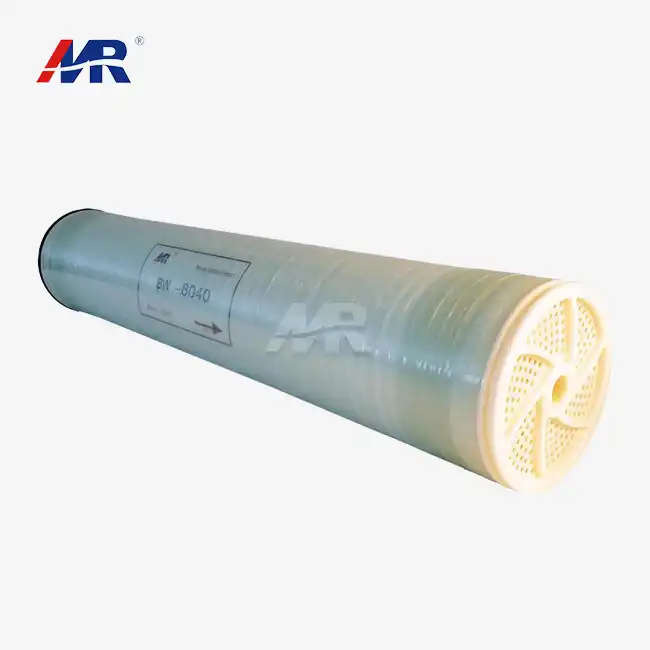
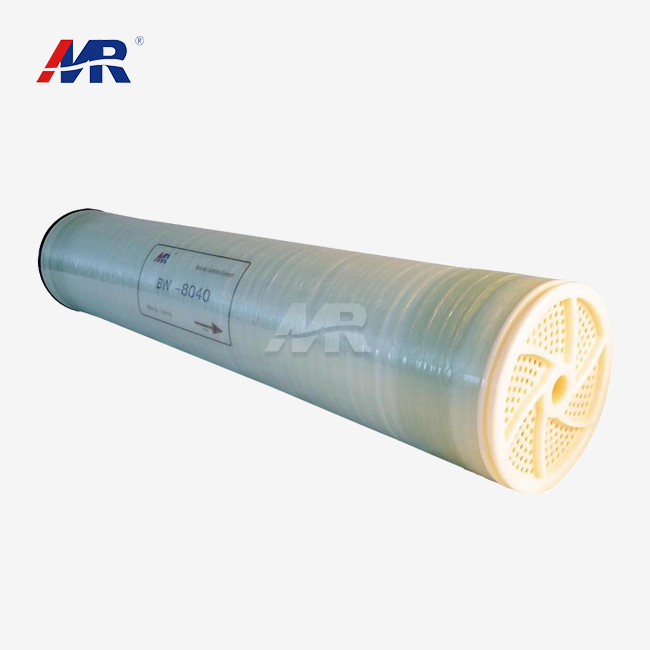
The most common sizes for industrial RO systems are the 8040 (8-inch diameter, 40-inch length) and the 4040 (4-inch diameter, 40-inch length). With these standard sizes, operators can switch parts between pressure tanks made by different companies without having to make any special changes. Like the Morui MR-BW-4040, which fits normal 4040 pressure vessels and has a 7.2 m² active membrane surface and a 99.5% salt rejection rate, it can handle 2,500 GPD at 1.55 MPa working pressure.
Criteria for Selecting the Right Industrial RO Membrane Elements
Feed Water Quality and Contaminant Profile
Do a full test of your feed water before choosing any industrial ro membrane element. Some important factors are hardness, iron content, turbidity, Total Dissolved Solids (TDS), and Silt Density Index (SDI). High-SDI water above 5 needs strong pre-treatment before the membrane stage. If this isn't done, the membrane's service life drops from 3–5 years to less than 12 months. High-rejection brackish water membranes like the MR-BW-4040 work well with brackish water sources that have TDS levels between 1,000 and 10,000 mg/L.
Rejection Rate, Flux, and Energy Balance
Most of the time, buyers talk about the salt rejection rate and the permeate flux. With a 99.5% rejection rate, the permeate has only about 5 mg/L of TDS for every 1,000 mg/L of TDS in the feed. This is enough to meet most industrial process water guidelines. More flux means fewer elements are needed to reach a goal output, but too much flux speeds up fouling. The real cost of running a system can be found by comparing these two numbers to the amount of energy used per cubic meter of product water.
Fouling Resistance and Chemical Compatibility
Free chlorine can damage polyamide TFC membranes. Over time, even 0.1 ppm of leftover chlorine causes oxidation in a way that can't be fixed. In chlorinated municipal supply systems, either sodium bisulfite or activated carbon must be used as a pre-treatment. Biofouling risk from warm feedwater means that it needs to be cleaned every so often. For reclaiming industrial wastewater or uses with a lot of organic matter, choosing elements with hydrophilic surface coats that stop organic matter from sticking makes cleaning times much longer.
Comparing Leading Industrial RO Membrane Brands and Solutions
Global Brands: Hydranautics, DowDuPont Filmtec, and Toray
Hydranautics, which is part of the Nitto Group, is known for its ESPA line, which is designed for low-energy use in muddy water. The BW30 line from DowDuPont Filmtec has been used for decades and has been proven to be consistent. Toray's TMH line is made for places with a lot of dirt. All three are certified by NSF/ANSI 61 and provide thorough technical data sheets that Western buyers in the US market need for system approval and compliance paperwork.
Where Morui MR-BW-4040 Fits the Market
The MR-BW-4040 is made by Morui at its own membrane factory in Guangdong, China. With this direct production approach, there are no middleman costs that drive up prices for goods that are sourced from outside sources. The MR-BW-4040 is proven to reject 99.5% of NaCl at 1.55 MPa and has an active area of 7.2 m² that produces 2,500 GPD. Morui sells parts under its own brand name or as private-label OEM goods that come with full technical data files. This is a big plus for equipment makers that need NSF paperwork for whole-machine certification.
OEM and Private-Label Options
The people who buy water purifiers, system integrators, and engineering firms (OEMs) often need industrial RO membranes with their own brand name on them. Morui can handle dedicated production runs with custom flux grades, active area configurations that are made just for the job, and production lines that are protected by NDAs. This is especially helpful for US-based equipment makers who need consistent performance data from batch to batch to keep their UL or NSF Certifications across all of their product lines.
Procurement Strategies for Industrial RO Membrane Elements
Direct Sourcing vs. Distributor Channels
Direct factory buying is helpful for operators who need to repair a lot of parts every three months. With a direct account, you can get discounts for large orders, consistent batch paperwork, and direct expert help. Distributors work with operators who need to be able to get stock locally and quickly. For first-time buyers, a dealer relationship lowers financial risk by letting them place smaller orders before committing to larger orders.
Managing Total Cost of Ownership
The purchase price per element is only one part of figuring out the cost. The total cost of ownership over a 3-year membrane cycle is based on the following:
- Initial element cost: Unit price multiplied by total elements in the system array.
- Replacement frequency: A well-maintained membrane runs 3–5 years; poor pre-treatment can cut this to under 18 months, doubling replacement spend.
- Energy consumption: Operating pressure directly affects pump electricity costs. Lower-pressure membranes at equivalent rejection reduce energy spend per m³ of permeate.
- Cleaning chemical costs: Frequent CIP cycles indicate fouling problems; addressing root causes reduces chemical consumption.
- Downtime cost: Unplanned membrane failure in a 24/7 production facility carries production-loss costs far exceeding the element price itself.
By knowing these numbers, buying teams can show why high-end parts are better than cheaper ones that won't last as long.
Lead Time and Stock Planning
When buying directly from makers in the US, buyers should plan their membrane replacement rounds 8–12 weeks ahead of time to account for the time it takes to ship goods across borders. This is cut down to days by distributors who sell from local stock. Morui helps stocking distributors by keeping production schedules and batch certificates consistent. This lowers the risk of supply disruption for customers during planned replacement cycles.
Optimization and Troubleshooting Tips for Industrial RO Membranes
Recognizing Fouling, Scaling, and Flux Decline
Fouling (the buildup of organic or biological matter), scaling (the precipitation of inorganic salts), and general flux decline are the three most common performance problems. According to industry standards, a Cleaning-In-Place (CIP) process should be started when the normalized permeate flow drops by 10–15%, the normalized salt passage rises by 5–10%, or the differential pressure across the array rises by 15% above the baseline. If these limits are caught early, lasting damage to the membrane is avoided.
Cleaning Protocols That Protect Membrane Life
Cleaning with citric acid, which has a low pH, gets rid of calcium carbonate and iron scaling. Cleaning with sodium hydroxide and a surfactant at a high pH level gets rid of organic fouling and biofilm. For mixed fouling, switching between these protocols in order—low pH first, then high pH—works better than cleaning in a single step. Always stick to the pH range and temperature limits suggested by the membrane maker. Cleaning at temperatures above 45°C can change the polyamide layer's performance forever.
Monitoring Tools and Preventive Schedules
Feed pressure, differential pressure, permeate conductivity, and flow rate should all be checked on a regular basis to spot issues early on. Putting online conductivity meters on the permeate line lets you track salt rejection in real time. A planned preventive maintenance routine that includes SDI testing, pre-filter replacement, and antiscalant dosing verification saves the membrane investment and keeps the quality of the treated water within the standards.
Conclusion
To choose the industrial ro membrane element, you need to make sure that the technical specs match your feed water conditions, system design, and long-term budget for running the system. For brackish water and process water uses, TFC polyamide elements in standard 4040 or 8040 formats are still the standard. The Morui MR-BW-4040 can reject 99.5% of salt, has an output of 2,500 GPD, and an active area of 7.2 m² at 1.55 MPa. It is made in the factory and comes with OEM support. To protect your membrane investment for its entire useful life, you should use good pre-treatment, planned maintenance, and open communication with your supplier.
FAQ
1. How long do industrial RO membrane elements typically last?
Service life is between 3 and 7 years, based on how well it was treated before and how well it is maintained. The upper end of that range is always reached by systems that keep SDI below 3 and run CIP cycles on time.
2. Can the MR-BW-4040 handle brackish water sources?
Yes. For brackish and well-water uses with TDS levels up to about 10,000 mg/L, the MR-BW-4040 is designed to work at 1.55 MPa and reject 99.5% of the NaCl.
3. Does free chlorine damage polyamide membranes?
Yes. Any free chlorine that stays above 0.1 ppm oxidizes the polyamide active layer in a way that can't be fixed. Before the membrane stage, chlorine must be neutralized by either activated carbon filters or sodium bisulfite dosing.
4. What certifications should US buyers look for?
The main US compliance standards are NSF/ANSI 61 for Products that come into contact with drinking water and NSF/ANSI 58 for RO systems.
5. How should unused membrane elements be stored?
Keep them in their original packaging, sealed, in a cool, dry place out of direct sunlight with a 1% sodium metabisulfite preservation solution. When stored incorrectly, the element dries out and loses its flux permanently before it is even attached.
Get a Direct Quote from Morui — Industrial RO Membrane Supplier
Morui makes the MR-BW-4040 industrial RO membrane element in its own factory and provides both branded and private-label products with full technical documentation. We can handle bulk orders, OEM programs, and requests for just one sample. We have 20 engineers, 14 branch offices, and a specialized membrane plant. You can email us at benson@guangdongmorui.com to get specifications, batch certificates, or a price quote for a large order right now.
References
1. Elimelech, M., & Phillip, W. A. (2011). The Future of Seawater Desalination: Energy, Technology, and the Environment. Science, 333(6043), 712–717.
2. Petersen, R. J. (1993). Composite Reverse Osmosis and Nanofiltration Membranes. Journal of Membrane Science, 83(1), 81–150.
3. Crittenden, J. C., et al. (2012). MWH's Water Treatment: Principles and Design (3rd ed.). John Wiley & Sons.
4. NSF International. (2020). NSF/ANSI 58: Reverse Osmosis Drinking Water Treatment Systems. NSF International Standard.
5. Fritzmann, C., et al. (2007). State-of-the-Art of Reverse Osmosis Desalination. Desalination, 216(1–3), 1–76.
6. Greenlee, L. F., et al. (2009). Reverse Osmosis Desalination: Water Sources, Technology, and Today's Challenges. Water Research, 43(9), 2317–2348.