



What Resistivity Should RO EDI Product Water Reach for Pharma Use?
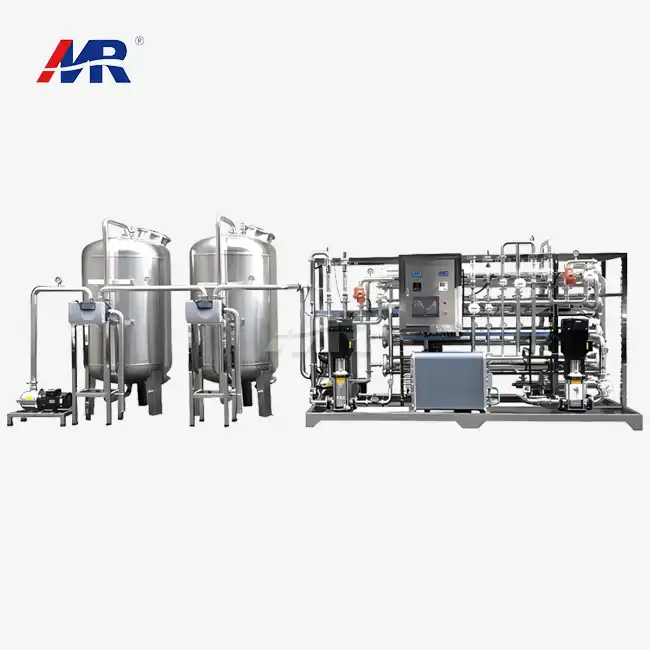
A well-designed ro edi system typically delivers product water between 5 and 18 MΩ·cm at 25°C. A realistic pharmaceutical design objective is typically between 10 and 15 MΩ·cm. The final value should adhere to your intended usage, pharmacopeial regulations, and validation strategy, even if that range is much beyond the compendial limit for filtered water. The 18.2 MΩ·cm value is not a general medicinal need; rather, it represents theoretical ultrapure water. Additionally, TOC, microbiological, endotoxin, and hygienic controls must support resistivity. I describe how to establish the goal, confirm it, and create a specification that a provider can fulfill below.
Understanding Resistivity Targets for Pharmaceutical Water
What Resistivity Tells You in an RO EDI Train?
Reverse osmosis eliminates the majority of the dissolved solids while pretreatment safeguards the RO membranes. The filtrate is then cleaned using electrodeionization, ion exchange membranes, resin, and a DC electric field. Because the resin constantly regenerates, the machine doesn't need any caustics or acids. Resistance increases as conductivity decreases. Thus, 1 µS/cm is equivalent to 1 MΩ·cm. It is crucial to always report both figures at 25°C since the reading varies with temperature. Additionally, dissolved carbon dioxide, particle accumulation, size, flow variations, and instrument drift may all affect the number. The trend provides more information than a single figure.
How Much Resistivity Is Enough for Pharma Use?
According to USP <645> Stage 1, clean water cannot include more than 1.3 µS/cm, or 0.77 MΩ·cm, at 25°C. It shouldn't be that much below an RO-EDI train. A design target of 10–15 MΩ·cm provides a suitable cushion and may be utilized for cleaning, mixing, creating buffers, and creating non-pure materials. A final polishing unit that approaches 18.2 MΩ·cm, the theoretical value of very pure water at 25°C, would be necessary for significant investigations or research. Electronics manufacturers covet that number, but drug buyers shouldn't simply duplicate it. Instead of matching the target to a headline number, match it to the intended purpose.
Why Resistivity Alone Does Not Prove Suitability?
Resistivity only tells you how many ions are present. It doesn't say anything about endotoxin, bacteria, or organic carbon. The USP sets a TOC limit of 500 ppb for both purified water and WFI. It also expects that microbes will be controlled by how the system is built and how it is tracked. Even though a tank with biofilm can hold 15 MΩ·cm of water, it will still fail a microbial test. Things like a sanitary design, pipes that can drain, few dead ends, circulation, and validated sanitization are just as important as the conductivity reading. Treat resistivity as one gate among several, not the whole inspection.
Factors, Verification, and Troubleshooting for RO EDI Water Quality
Feed Water and Operating Factors
If the RO permeate is bad in a ro edi system, the EDI module cannot fix it. How much resistance there is in the end depends on the temperature, flow, permeate conductivity, recovery, applied current and voltage, and the load on the module. Chlorine is bad for ro membranes. The membranes and EDI stack get dirty or scaled because of things like silica, iron, manganese, hardness, and suspended solids. Carbon dioxide and scaling can be prevented before the EDI stage by getting rid of them. Scaling and carbon dioxide interference both lower resistance. If you prepare well for RO, most EDI modules last between five and seven years. The buyer and the seller are both safe when the raw water is fully analyzed before a quote is given.
How to Verify Water Quality
Verification includes things like online monitoring, laboratory testing, and documented qualification. It is possible to add conductivity or resistivity sensors that can change based on temperature to the RO permeate, EDI product, loop return, and some other points of use. Write down the steps for sampling, the limits for the alarms, and the schedules for calibration. In the lab, TOC, bacteria counts, endotoxin, and ions that are specific to an application are all checked. First, IQ checks that the system matches the design. Then, OQ checks that it works in all of its possible ranges. Finally, PQ checks that the water quality stays the same over time. You can compare trends from sensors in different places. There is a problem with the sensor if there is a drop in one place. There is a problem with the RO or EDI if there is a drop everywhere.
Troubleshooting Low or Unstable Resistivity
You should first look at the monitor when the resistance goes down. Take a look at the pressure, flow, temperature, pretreatment condition, EDI current and voltage, and RO permeate conductivity after that. Only then should you order cleaning or replacement. If the RO stage gets dirty every three to six months, it might depend on the water that goes into it. Remember that good resistivity doesn't protect against microbial failures caused by stagnant tanks, dead legs, or bad sampling points. Pay attention to trends instead of just one number. You should also look at how responsive the service is, how long the modules last, and how much it costs to keep everything running when you compare providers.
Choosing and Specifying an RO EDI System for Pharmaceutical Plants
Comparing System Configurations
Each setup works well for a different reason. RO by itself costs less, but it doesn't have as much resistance. RO plus mixed-bed can reach a high resistance, but it needs to be chemically regenerated and requires labor. For RO EDI to work, it needs good RO permeate, is flexible, and doesn't need acid or caustic regeneration. It also gets rid of the need for regular manual labor. To use it in a lab, add UV or ultrafiltration to kill microbes and then polish it off. There needs to be more for injectables. Since RO-EDI does not produce WFI on its own, they require distillation, membrane-based WFI generation, ultrafiltration, or other specialized sanitization. Pick the simplest setup that still meets your validated requirement.
Process Flow and Morui Equipment
A normal pharmaceutical train starts with raw water, pretreatment, filtration, RO, EDI, UV, or ultrafiltration, and then polishes it if needed. After that, the water is stored in a sanitizable tank and then sent to a recirculating loop that serves the points of use. The water system, not the accessories, is what holds and moves the water. From the start, you should think about access controls, alarms, data storage, loop circulation, temperature control, sample places, and audit trails.
More than 95% of the water that goes through our Morui EDI water plant is recovered. It works at 2–6 bar of pressure and can handle 1–100 m³/h. The rated resistance is more than 18 MΩ·cm when the feed water and operation are right. The size depends on your requirements. Our factory produces RO, EDI, and UF lines under one roof. This means that we handle process design, fabrication, remote monitoring integration, and quality control from the membrane to the system.
Writing the RFQ
If you ask for a quote, you can tell the difference between a real performance guarantee and a marketing claim. These are the items I recommend including:
- Water quality limits: Write down the lowest conductivity or resistance value at 25°C, along with the range of temperatures and the minimum guaranteed value. List the TOC, microbial, and endotoxin limits, along with the sampling location where the supplier must meet each one.
- Design basis: Write down the design flow, peak demand, working schedule, full feed-water analysis, temperature range, storage amount, loop length, method of sanitization, and growth plans. When you have all the data, commissioning doesn't come as a surprise.
- Documentation and service: For service and paperwork, ask for P&IDs, material certificates, FAT/SAT, IQ/OQ support, warranty terms, a spare-parts list, training, commissioning, and a maintenance schedule. Specify who delivers each item and when.
Conclusion
For drugs, the resistance goal should match the intended use. It is common for a RO EDI system to reach 5–18 MΩ·cm at 25°C. A design goal of 10–15 MΩ·cm is enough for many purified-water needs, which is much higher than the USP limit of 1.3 µS/cm. The 18.2 MΩ·cm number works for ultrapure water in laboratories and semiconductors, but not for all pharmaceutical processes. Resistivity changes with temperature, the quality of the RO permeate, and EDI operation. Tests like IQ/OQ/PQ, TOC, microbial, and endotoxin need to be used to verify suitability. After EDI, sanitary storage and distribution keep the water safe, and for injectable goods, WFI methods beyond RO-EDI are required. Buyers can decide which system to purchase with the help of a clear specification and an honest comparison of configurations.
FAQ
Q1: Does pharmaceutical purified water need 18.2 MΩ·cm?
A: Not at all. The USP sets a Stage 1 conductivity limit of 1.3 µS/cm at 25°C, which is about 0.77 MΩ·cm. Many RO-edi systems operate between 5 and 18 MΩ·cm. The right target depends on the validated use.
Q2: How does RO EDI differ from mixed-bed deionization?
A: Mixed-bed resin needs chemical regeneration or exchange. With EDI, the resin stays fresh because of an electric field; it doesn't need acid or caustic to work. However, it does require high-quality RO permeate.
Q3: Why does resistivity decline over time?
A: It could be because of sensor drift, RO membrane deterioration, scaling, fouling, carbon dioxide, temperature, or weak pretreatment. Check the sensor first, then follow the trend.
Q4: Can RO EDI make WFI on its own?
A: No, bacteria and endotoxins need to be controlled more strictly in water for injection. This is achieved through distillation or membrane-based WFI generation.
Request a Pharma RO EDI Water-Quality Assessment from Morui
Tell Morui where you are, what water grade you want to achieve, your capacity requirements, and a study of your raw water. In order to set up a RO EDI system, our engineers will offer a process flow design, validation documentation support, and the choice of pretreatment. As a manufacturer running RO, EDI, and UF lines under one roof, we build to your specification. Email benson@guangdongmorui.com to get in touch.
References
1. United States Pharmacopeia and National Formulary, General Chapter <645> Water Conductivity, 2023
2. United States Pharmacopeia and National Formulary, General Chapter <1231> Water for Pharmaceutical Purposes, 2023
3. International Society for Pharmaceutical Engineering, ISPE Baseline Guide Volume 4: Water and Steam Systems, Third Edition, 2019
4. U.S. Food and Drug Administration, Guide to Inspections of High Purity Water Systems, 1993
5. European Pharmacopoeia, Water for Injections Monograph 0169, 2017
6. ASTM International, D1193 Standard Specification for Reagent Water, 2018
 VIEW MOREseawater desalination equipment
 VIEW MOREultrafiltration drinking water system
 VIEW MOREwastewater treatment plant
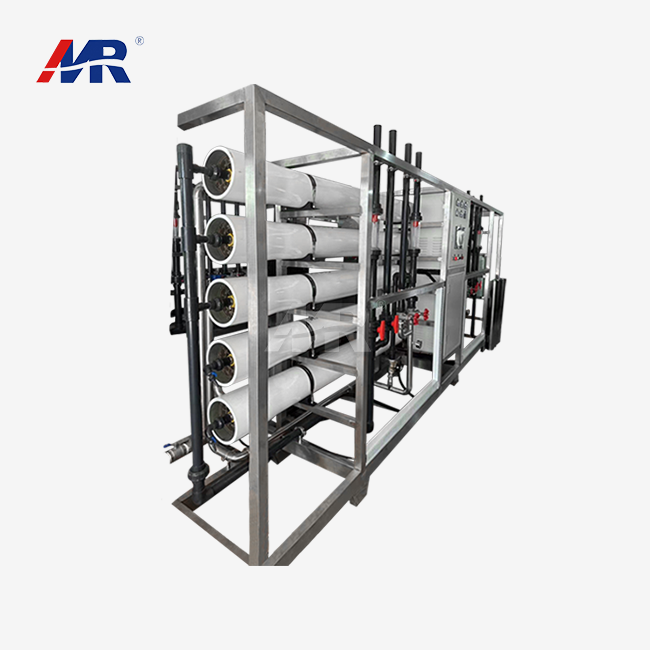 VIEW MOREhighest rated reverse osmosis system
 VIEW MOREsewage treatment plant
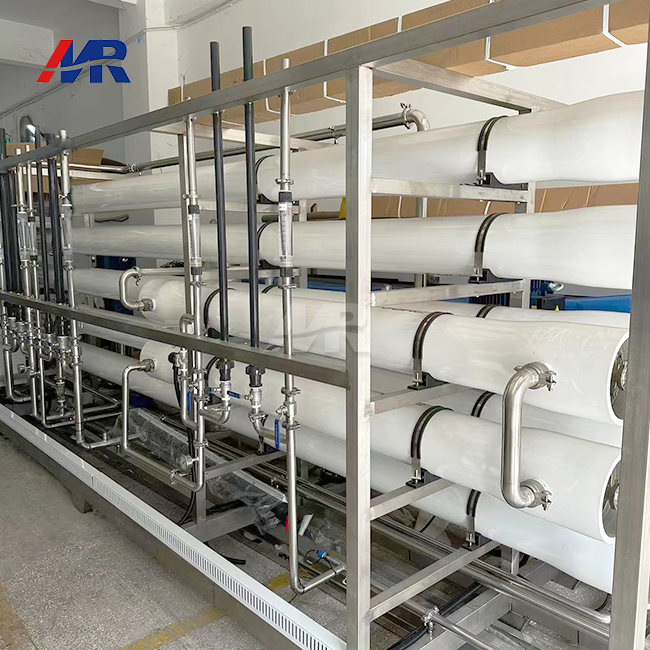 VIEW MOREosmosis drinking water system
 VIEW MOREwaste water treatment plant
 VIEW MOREindustrial ro membrane