


How Does a 1000LPH EDI System Produce Consistent Ultrapure Water?
An edi system that generates 1000 LPH ultrapure water forces dissolved ions through ion-selective membranes under a direct electric field with no acid or caustic regeneration needed. This electrodeionization (EDI) device is rated at around 1,000 liters per hour and is downstream of a reverse osmosis (RO) step to finish off the polishing effort that RO began. For years, I have specified and troubleshot these trains for semiconductor fabs, pharma plants, and power stations all throughout Asia, the Middle East, and Latin America. This article talks you through the technology and how it works, the feed water it requires, and what maintains the output stable at 18.2 MΩ·cm month after month. If you are looking for one for a new construction or a retrofit, our staff at Morui can examine your raw-water analysis and recommend a matching RO+EDI train. Contact us at benson@guangdongmorui.com for a straight 1000LPH EDI system manufacturer quotation (not a reseller markup) based on feed water.
What Makes a 1000LPH EDI System Produce Ultrapure Water?
What "1000LPH EDI System" Means
The “1000LPH” marking is a notional design flow of ~1000 liters/hour at certain feed conditions. Actual output depends on feed temperature, feed conductivity, recovery rate, and intake pressure. A unit rated for 1000 LPH at 25°C with feed water conductivity of 10 µS/cm may only provide 850 LPH at 15°C with more difficult water to treat.
A 1000LPH EDI system is a polishing step, not a whole treatment plant. Pretreatment and RO are normally distinct skids, upstream. Buyers who think that the EDI unit alone manages the raw water have scaling membranes and unreliable resistivity in weeks.
Main Process Stages From Raw Water to Ultrapure Output
In normal circumstances, water passes through seven steps before arriving at a storage tank or distribution loop. I have listed them sequentially below.
- First, raw or municipal water is introduced. This is followed by multimedia or cartridge filtering to remove sand, rust particles, and coarse materials that would otherwise foul downstream membranes within days of commencement.
- Activated carbon filtration eliminates free chlorine and certain organic molecules, sparing the RO membranes from oxidation and degradation by chlorine that would occur within a matter of weeks.
- Normal operation is controlled for hardness by softening or antiscalant dosing so that calcium and magnesium do not precipitate on RO membranes or EDI resin surfaces.
- Reverse osmosis eliminates around 95 to 99 percent of the residual dissolved ions, and the permeate generally has a conductivity of less than 20 µS/cm and is the EDI feed stream.
- The EDI module finishes the ion polishing step, raising resistivity to the range of 10 to 18.2 MΩ·cm, depending upon feed quality and recovery parameters.
- Final 0.1 to 0.22 micron filtering, UV treatment, or ozone sanitation maintains microbiological purity in the distribution loop for pharmaceutical or electronic grade applications.
Product water is sent to a storage tank or a continually circulating loop to retain resistivity at the point of usage.
These phases are interactive, and if you miss any stage, you will generally see a resistivity issue someplace downstream.
What EDI Can and Cannot Remove
EDI is effective in removing dissolved ionic pollutants like as calcium, magnesium, sodium, chloride, sulfate and bicarbonate. Not suitable for suspended particles, microbes, oils or high organic loads. They need to be taken off earlier in the train.
Conductivity, resistivity, TOC, silica, and microbiological tests, if required by the application, should be used to validate final water quality. If a supplier gives you a resistivity number but not the test technique, you are just getting part of the story.
How Does EDI Remove Ions From Feed Water Continuously?
The Electrodeionization Operating Principle
Electrodeionization combines mixed-bed ion-exchange resin with cation- and anion-selective membranes placed in alternating dilute and concentrate chambers surrounded by electrodes. A direct current electric field pushes positively charged ions (cations) to the cathode and negatively charged ions (anions) to the anode.
The ions go through the membrane according to their charge and end up in the concentrate stream. The pure water continues in the dilute channel. This is the basic mechanism that allows a 1000LPH EDI system to operate constantly without the need for a chemical regeneration cycle.
Why EDI Resin Does Not Need Routine Chemical Regeneration
Inside the resin bed, the voltage applied breaks down a small quantity of water into hydrogen ions (H+) and hydroxide ions (OH-). The ions constantly renew the resin in situ instead of having to strip laden resin with acid and caustic as with a traditional mixed-bed deionizer.
Bin Liu, author of this book and Senior Overseas Water Treatment Technical Manager at Morui, says: “In my own commissioning work I have seen feed conductivity spikes of only 5 µS/cm cause product resistivity to drop from 16 MΩ·cm to less than 10 MΩ·cm in twenty minutes. EDI still requires proper feed water and frequent sanitization, but it eliminates the chemical-handling phase needed for mixed-bed systems.
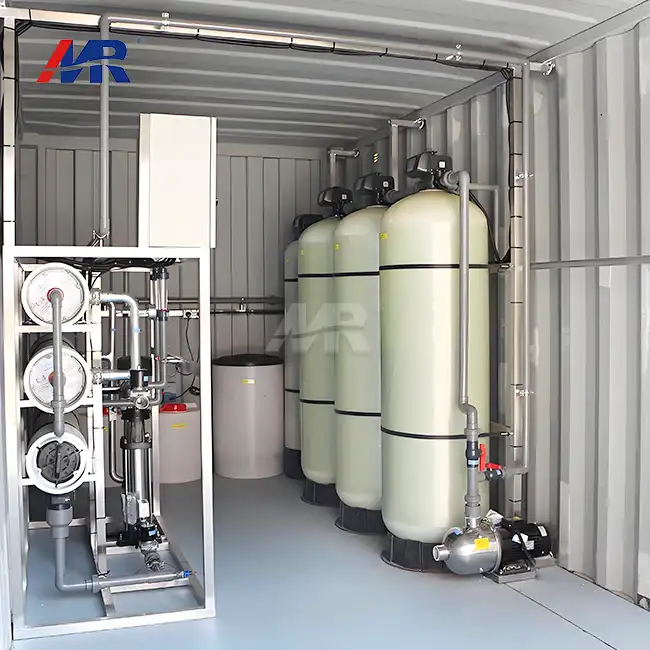
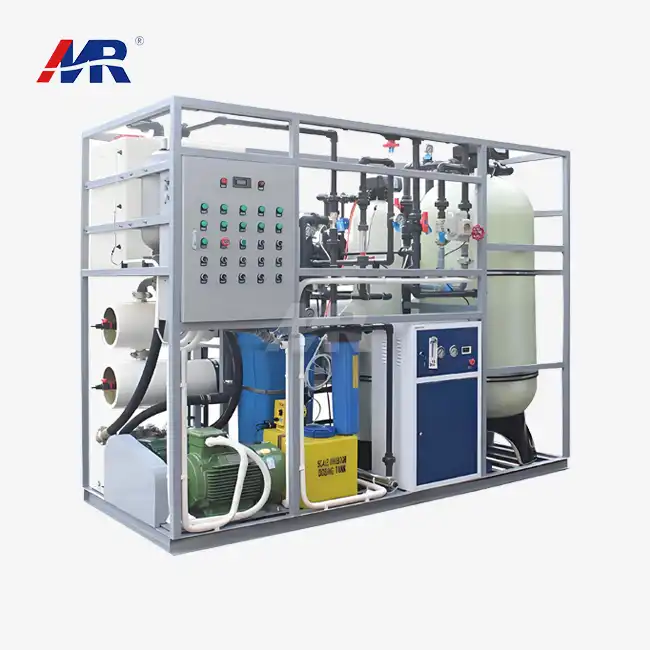
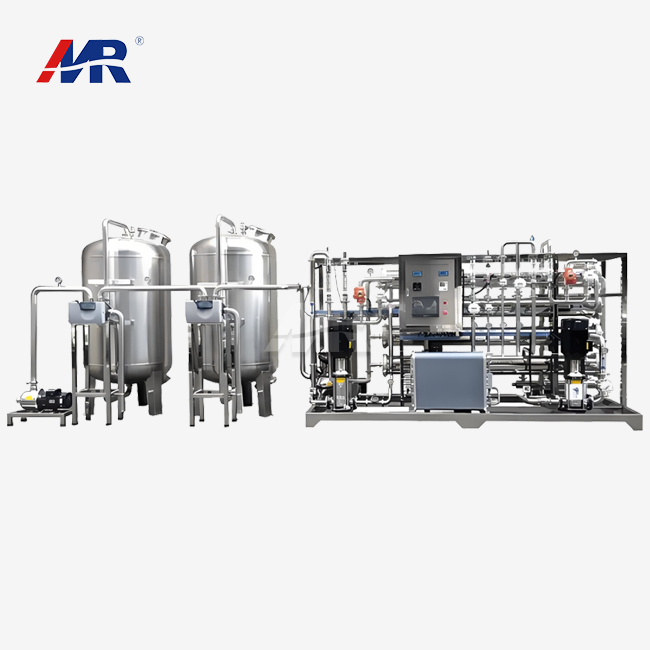
A Simple Process-Flow Picture of a 1000LPH EDI System
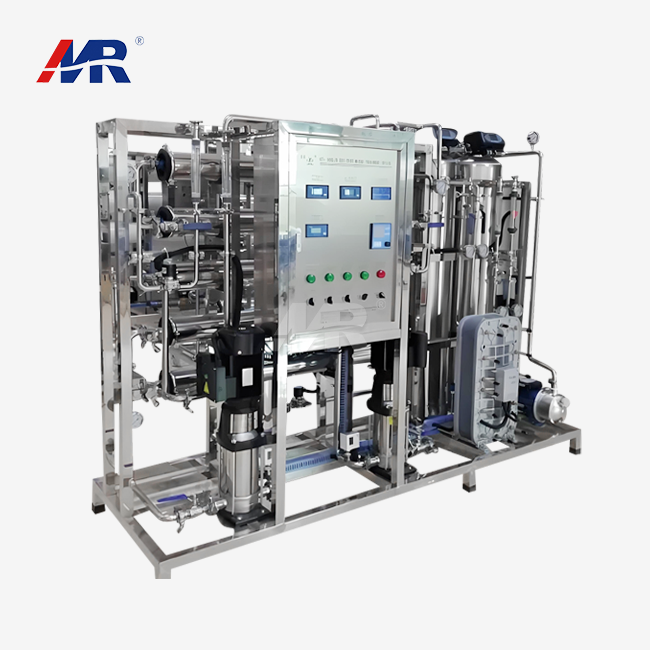
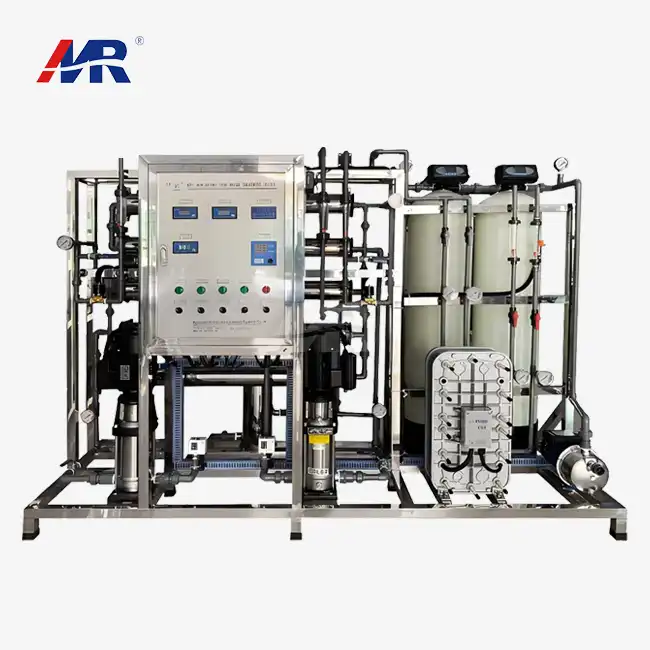
Imagine the skid going from left to right. RO permeate is introduced via an intake flow meter and a conductivity sensor. This is separated into the dilute chambers of the EDI stack, and product water flows out the far end to a conductivity-monitored product line that feeds the storage tank.
The smaller concentrate stream flows in parallel, transporting rejected ions to a drain or partial recycling line. A separate stream of water runs around the electrode chambers to rinse the electrodes. Pressure gauges at the inlet, product outlet, and concentrate outlet provide the operator the ability to detect any obstruction or scaling trend before it causes a resistivity decline.
What Feed Water Quality Does a 1000LPH EDI System Require?
Typical Inlet-Water Requirements
Feed water quality is the single biggest variable in EDI performance. The table below lists what to verify before accepting a 1000LPH EDI system into service.
| Parameter | Typical design consideration | Verification method |
|---|---|---|
| Feed source | RO permeate or equivalent low-ion water | Water analysis report |
| Conductivity | Within the module manufacturer's allowable range, usually under 20 µS/cm | Conductivity meter |
| Hardness | Controlled to limit scaling on resin and membranes | EDTA titration or lab report |
| Free chlorine | Removed before EDI to protect resin and membranes | DPD test or lab analysis |
| Silica | Kept low, since high silica raises scaling risk | Laboratory silica test |
| Iron and manganese | Minimized before RO and EDI | Laboratory analysis |
| Temperature | Within module operating limits, typically 5-35°C | Calibrated temperature sensor |
| SDI/particulates | Controlled through pretreatment and RO | SDI test and filter inspection |
| Microbiological load | Controlled through sanitation and hygienic design | Microbiological testing |
Why RO Permeate Commonly Feeds EDI
RO filters the ionic and organic load before it enters the resin bed in the EDI module. Stable RO permeate (typically < 20 µS/cm) enhances product conductivity, recovery rate, and module service life.
If EDI is run directly on raw or softened water without RO, scaling, fouling, unsteady output, and premature module failure may result. I have seen this happen on a retrofit job when the customer sought to economize on capital cost by deleting the RO stage. EDI module failed at 50% of rated life during the first year.
Feed-Water Acceptance Checklist
I suggest that we go through a brief checklist with the technical team and equipment supplier before we approve any 1000 LPH train for everyday operation.
- Pull a current raw-water and RO-permeate analysis, not a previous project, since source water chemistry changes with seasonal rains, groundwater levels, and local industrial effluent near the intake site.
- Check pretreatment capacity against the full 1000 LPH demand plus concentrate and reject flows, as inadequate pretreatment will foul slowly and show up months after initiation.
- Monitor RO recovery and permeate conductivity trends throughout a week, not just a one-time measurement at commissioning under perfect circumstances.
- Compare the amounts of chlorine, hardness, silica, iron, manganese, and carbon dioxide against the limitations specified by the supplier and highlight those that are approaching the top limit for greater scrutiny.
These examinations identify most feed-water issues in a 1000LPH EDI system before they develop into warranty disputes six months into operation.
How Does EDI Compare With Conventional Ion Exchange?
1000LPH EDI System Versus Mixed-Bed Deionizer
| Criteria | EDI system | Mixed-bed deionizer |
|---|---|---|
| Regeneration | Continuous electrical regeneration | Chemical regeneration or resin swap |
| Chemical handling | Low routine chemical use | Acid and caustic usually required |
| Output stability | Stable with controlled feed quality | Declines as resin capacity is exhausted |
| Footprint | Compact, modular skid | Needs vessels and regeneration equipment |
| Maintenance | Electrical, membrane, sensor checks | Resin replacement and vessel servicing |
| Best fit | Continuous ultrapure production | Intermittent use or lower volume |
| Main risk | Sensitive to poor RO permeate | Breakthrough and chemical handling |
EDI System Versus Conventional Deionization
Typically, a deionizer operates until the resin is used up, then pauses until it can be regenerated or replaced. EDI operates 24/7 as long as the feed water quality is in range, which is ideal for semiconductor, pharma, and power industries requiring a 24-hour supply.
EDI is not always the superior choice everywhere. For a lab that runs with water for just a few hours a day, or a backup polishing loop that is used only periodically, a simpler mixed-bed cartridge that saves the capital expenditure of an EDI stack and control panel could be adequate.
Choosing the Right 1000LPH EDI Water Purification System
Matching a 1000LPH EDI system to the work is more than just a comparison of flow rates. Discuss these topics with your provider before signing a quotation.
- Check product flow need vs. peak demand, not average daily consumption. Undersized trains can cause storage tank decline during shift changes or batch production surges.
- Document the product conductivity or resistivity objective, associated with a specified test method and sample point, to avoid ambiguity over what “ultrapure” implies for your contract.
- Choose to run continuously or in batch mode, since the warranty terms are affected by batch cycling, which puts a different kind of stress on EDI stacks than constant 24-hour flow.
- The available electrical supply and utility capacity must be weighed against the connected load of the system, including the starting current draw, which may be much in excess of operating current.
- These checks keep the quoted system tied to the particular site circumstances, and not some generic catalog spec sheet.
Which Operating Parameters Affect EDI Water Purity Most?
Critical Operating Parameters
Several factors shift product resistivity up and down in real time. The most important are feed conductivity and total ionic load, then product flow rate, recovery %, and concentrate flow rate. Feed temperature has a direct effect on ion mobility and resin performance.
Pay special attention to the carbon dioxide and silica content. The conventional EDI resin is a poor remover of un-ionized CO2, and dissolved CO2 is converted to carbonic acid within the stack, increasing the conductivity of the product. The set of levers available to an operator is completed by the applied voltage, current, and product-water backpressure.
Typical Monitoring Points
At a minimum, a well-instrumented skid tracks RO permeate conductivity, EDI product conductivity or resistivity, and concentrate conductivity. Feed, product, and reject pressure gauges indicate fouling early. The operator completes his daily checklist with measurements of temperature, voltage, and current, as well as flow rate.
Internal service records from more than 60 installed EDI trains in Southeast Asia and Latin America have shown that maintaining feed conductivity at 8 to 12 µS/cm can keep product resistivity above 15 MΩ·cm for more than 8,000 operating hours between module inspections. This data point comes from our own after-sales records and is why we encourage clients to look at feed conductivity carefully, not only on the product side.
How to Read Unstable Output Signals
| Symptom | Possible cause | Initial check |
|---|---|---|
| Rising product conductivity | Poor RO permeate or exhausted pretreatment | Check RO conductivity and feed analysis |
| Sudden conductivity spike | Flow interruption, sensor error, or electrical fault | Check alarms, flow, wiring, calibration |
| Reduced product flow | Fouling, blocked filter, or pressure imbalance | Inspect filters and pressure differential |
| High concentrate conductivity | Incorrect concentrate flow or scaling | Check flow control and water chemistry |
| Frequent alarms | Unstable utilities or incorrect setpoints | Review PLC trends and operating limits |
How Can a 1000LPH EDI System Maintain Stable Output?
Control-System and Instrumentation Requirements
Do not order the PLC or control-panel functionalities before they are defined. Specify conductivity or resistivity transmitter range, flow, pressure, temperature, voltage, and current sensors. A high-conductivity diversion valve automatically diverts off-spec water away from storage. Alarm history, data recording, and calibration traceability should be on the spec sheet, not the supplier's default settings.
Field Case: Stabilizing Output at a Southeast Asia Display-Panel Plant
A display panel maker in Vietnam contacted Morui after seeing that their previous EDI train revealed product resistivity between 8 and 16 MΩ·cm during shift changes. Our engineering team discovered that the RO permeate conductivity spiked from 8 to 35 µS/cm each time the RO booster pump cycled on at startup.
We placed a buffer tank between RO and EDI, adjusted the RO recovery rate from 78% to 72%, and put in a feed conductivity interlock that stops the EDI product flow until the permeate stabilizes below 15 µS/cm. Product resistivity was consistent at 17.1-17.8 MΩ·cm over six weeks, unexpected downtime was reduced by around 40%, and the factory was able to avoid replacing EDI modules that would have normally failed within a year.
Quality Verification Before Shipment and Commissioning
A true factory acceptance test (FAT) is more than a brief run on tap water. Below is the checklist we go through before each 1000LPH EDI system leaves our doors.
- Material and component verification ensures that all wetted parts match the authorized bill of materials, since over time, replacement of gaskets or fittings might introduce leachables that are not compliant with pharmaceutical or electronic-grade water specifications.
- Hydrostatic pressure testing and electrical insulation tests uncover manufacturing flaws before units ship, saving weeks of delay compared to finding a leak after installation abroad.
- Performance testing for conductivity and resistivity under simulated feed conditions verifies the module fulfills guaranteed output before the client receives delivery, not after.
- PLC, alarm, and interlock testing ensures that the control logic really triggers the diversion valve and alarm outputs per the functional design specification.
OEM & Custom Systems Consistency Controls
Before fabrication begins, OEM purchasers should agree on inlet-water conditions and product requirements, and acceptance criteria should be stated in writing. The unit shall be supplied with serial numbers, membrane-module data, instrument calibration Certifications, and FAT results. Operating manuals, P&IDs, wiring diagrams, and spare-parts list should accompany the unit.
When Does EDI Need Pretreatment or RO Before Operation?
Pretreatment Steps Required Before EDI
Most installations need a combination of many preparation processes. Suspended particles are removed by a multimedia filter. Activated carbon removes chlorine and organics. Hardness is controlled by softening or antiscalant dosage. The cartridge filter collects the small particles, before reverse osmosis reduces the bulk ionic load, and the addition of degassing if carbon dioxide levels are high.
Risks of Operating EDI Without Proper Pretreatment
Failure to pretreat or undersizing of the pretreatment process leads to scaling of membranes and resin, decreased ion removal effectiveness, and increasing product conductivity over time. I have seen module replacement prices treble in 3 years at locations that take shortcuts on pretreatment to economize on initial capital outlay. Poor pretreatment in regulated pharma applications might potentially cost a facility its certification status during an audit.
Pretreatment Sizing Checklist
Size pretreatment for complete 1000 LPH product demand, including reject and concentrate flows not typical daily consumption. Test against peak raw water conditions, not average circumstances, since one poor week of source water might ruin resin that took months to condition correctly. Before final equipment sizing, consider backwash demand, storage-tank capacity, seasonal variance, and any planned production growth.
How Should a 1000LPH EDI System Be Monitored, Maintained, and Supplied?
Routine Maintenance Schedule
Daily inspections should include conductivity, flow, pressure, alarms, leaks, and odd sounds from the pumps and the EDI stack. Weekly and monthly duties consist of filter inspection, trend assessment, valve checks, and pretreatment performance evaluation. The quarterly maintenance involves calibration of the instruments and cleaning of the components, while the yearly service comprises examination of the EDI module, replacement of consumables, and a re-look at the feed-water chemistry against the original design basis.
Maintenance Requirements and Spare Parts
Routine wear items include cartridge filters, conductivity or resistivity probes, pressure sensors, solenoid valves, and pump seals. Control-panel fuses and relays and sanitization chemicals suitable for the materials of construction complete a useful spare-parts package. Replacement of the EDI module itself is less frequent, but should be included in a 5 to 8 year lifetime plan depending on the feed-water quality.
Supplier Evaluation Criteria for a 1000LPH EDI System
Who creates and services the 1000LPH EDI system is as important as the technical spec. Ask any potential supplier for reference projects with confirmed capacity and water-quality data, engineering drawings, FAT reports, and traceable component records. Confirm warranty conditions, export paperwork experience, and whether they provide OEM/ODM modification if you require private marking or sanitary pipes for pharma water.
Use-Case Scenarios Across the Buyer Spectrum
Different purchasers want different things from the same fundamental technology. The OEM customer often wants a small, repeatable EDI module with private labeling, interface customisation, and documented acceptance testing that they can resell under their own brand. A distributor requires consistent specs, dependable packaging, spare-parts inventories and predictable delivery dates to bid against local tenders. An end-user facility will require integration help to integrate the new skid into existing RO, storage and loop distribution without interrupting production.
Morui has all of its RO, EDI, and UF product lines in one plant, which means that process design, fabrication, and quality control are all kept under one roof from membrane procurement to completed skid. Depending on the extent of the project, we construct to electronic-grade and pharma-grade requirements. We provide integration of remote monitoring for clients operating several locations across various time zones. Besides EDI trains, our firm has more than 14 branches and 500 people, including 20 engineers and our own membrane manufacturing line. We represent brands such as Shimge water pumps, Runxin valves, and Createc instruments for clients who desire a one-stop bill of materials.
What Should Buyers Verify Before Selecting a 1000LPH EDI System?
Technical and Commercial Specification Checklist
Don't simply compare vendors on headline pricing; compare them side-by-side on rated capacity, guaranteed product-water quality, feed-water needs, and recovery rate. Compare your installation area to the power supply and associated load, materials of construction, level of automation, physical dimensions, and operational weight. A fair comparison is completed with warranty conditions, extent of installation, availability of replacement parts, and delivery timeline.
1000LPH EDI System Price and Total Cost of Ownership
A good quote comparison breaks out the EDI module and skid cost from pretreatment and RO equipment, tanks, pumps, UV units, filters, and the distribution loop. The landed-cost comparison should include the electrical control panel and software, FAT paperwork, freight, insurance, duty and installation, and continuing consumables and maintenance costs.
The pricing for a 1000LPH EDI system is not the same for every project. The cost is dependent on the quality of the feed-water, the amount of automation, the materials, the compliance requirements, the customisation and the destination. The module line item quotation will often be lower, but it masks a thinner pretreatment package that costs more in membrane replacement in two years.
International Procurement Terms
Cross-border purchasers should check manufacturing lead time, payment conditions, and Incoterms such as EXW, FOB, CIF, or DAP before confirming a purchase order. Export packaging, warranty exclusions, breadth of installation support, and verification of place of origin all impact landing cost and risk. Confirm HS code, commercial invoice, packing list, and certificate of origin early. Customs delays at the final port may knock commissioning dates back weeks.
Which Standards and Documents Apply
Compliance requirements depend on the destination, setup, and application. Depending on the design of the control panel and pressure vessel, CE marking may entail EU electrical, EMC, mechanical, or pressure-equipment regulations. ISO 9001 is not a water-purity certification by itself, but rather a quality-management framework, and USP <1231> is used when the system produces pharmaceutical water under a certified procedure (United States Pharmacopeia, 2023). ASTM D1125 and ASTM D5127 provide reference procedures for conductivity, resistivity, and ultrapure-water quality assessment pertinent to electronics applications (ASTM International, 2022). A provider should instead specify the particular scope, certificate number, and conformity method for any compliance claims, rather than offering certificates generically.
Conclusion
A 1000LPH EDI system delivers constant ultrapure water due to electrically regenerated ion exchange and selective ion transport, and is virtually always combined with upstream RO. The optimal system for your site is not determined by module price alone. Consider capacity, feed-water quality, product objectives, pretreatment, monitoring, and overall cost.
If you need continuous, low-chemical production of ultrapure water with consistent demand throughout the day, EDI is your option. RO and adequate pretreatment should be used when the feed-water ionic load or pollutant levels are too high for a bare EDI module. Compare the whole system scope across quotations and insist on performance testing, documentation, and clearly stated acceptance criteria before signing off on delivery.
FAQ
1. How does a 1000LPH EDI system work?
A 1000LPH EDI system uses ion-exchange resin, selective membranes, and a direct-current electric field to remove dissolved ions continuously. RO permeate normally feeds the EDI module to protect performance and improve final water quality.
2. What is the capacity of a 1000LPH EDI system?
Nominal capacity sits near 1,000 liters per hour, though actual production depends on feed temperature, conductivity, recovery rate, and inlet pressure. Buyers should request guaranteed flow at stated inlet and outlet specifications rather than a catalog number alone.
3. Does a 1000LPH EDI system require reverse osmosis?
In most industrial setups, yes. EDI needs RO or equivalent low-conductivity pretreatment, since direct raw-water operation causes scaling, fouling, unstable output, and early module failure.
4. What water quality can a 1000LPH EDI system produce?
EDI can reach low-conductivity or high-resistivity water, up to 18.2 MΩ·cm, when feed quality and operating parameters stay controlled. The guaranteed spec should state conductivity or resistivity, temperature, silica, TOC, and microbiological limits along with test methods.
5. How much does a 1000LPH EDI system cost?
Price depends on whether the quote includes pretreatment, RO, tanks, pumps, controls, installation, validation, documentation, and freight. A fair comparison separates equipment cost from installation, logistics, consumables, and lifecycle maintenance spend.
6. How often does a 1000LPH EDI system need maintenance?
Operators should check conductivity, flow, pressure, temperature, and alarms daily. Filters, instruments, pumps, valves, and the EDI module itself need periodic inspection or replacement based on water quality and the manufacturer's service schedule.
7. Is EDI better than a mixed-bed deionizer?
EDI cuts routine chemical regeneration and delivers continuous output, which suits steady industrial demand well. Mixed-bed deionizers can still make sense for intermittent use, backup polishing, or simpler equipment needs with lower upfront cost.
Ready to Spec Your RO+EDI Train With a Direct Factory Partner?
Picking the right 1000LPH EDI system comes down to matching real feed-water data against a supplier who can prove performance, not just promise it. Morui runs RO, EDI, and UF production under one roof, handling process design, fabrication, FAT, and after-sales support from a single team. Whether you need a standard module as a 1000LPH EDI system supplier relationship or a custom-validated OEM build, send your water analysis to benson@guangdongmorui.com and our engineering team will reply with a feed-water-matched proposal.
References
1. ASTM International (2022). ASTM D1125, Standard Test Methods for Electrical Conductivity and Resistivity of Water. Referenced in the discussion of resistivity and conductivity test methods. https://www.astm.org/d1125-14r22.html
2. ASTM International (2022). ASTM D5127, Standard Guide for Ultra-Pure Water Used in the Electronics and Semiconductor Industries. Referenced in feed-water and product-water quality sections. https://www.astm.org/d5127-21.html
3. United States Pharmacopeia (2023). USP General Chapter <1231>, Water for Pharmaceutical Purposes. Referenced in the compliance and validation discussion for pharma applications. https://www.usp.org/compendial-notices/general-chapter-1231-water-pharmaceutical-purposes
4. International Organization for Standardization (2023). ISO 3696, Water for Analytical Laboratory Use. Referenced regarding laboratory-grade water quality benchmarks. https://www.iso.org/standard/9254.html
5. U.S. Environmental Protection Agency (2023). Drinking Water Treatability Database and Water Treatment Resources. Referenced in the pretreatment and contaminant-control discussion. https://www.epa.gov/water-research/drinking-water-treatability-database-tdb
6. NSF International (2023). Water Treatment Equipment and Component Standards. Referenced regarding equipment certification relevant to destination-market compliance. https://www.nsf.org/knowledge-library/water-treatment-system-standards
About the author: Bin Liu is Senior Overseas Water Treatment Technical Manager at Guangdong Morui Environmental Technology Co., Ltd. He has specified and commissioned RO, EDI, and UF systems for semiconductor, pharmaceutical, and power-plant clients across Asia, the Middle East, and Latin America, and works directly with Morui's engineering team on feed-water analysis, system design, and factory acceptance testing for export projects.