

_1745823981883.webp)

What Do Wastewater Treatment Plant Units Include?
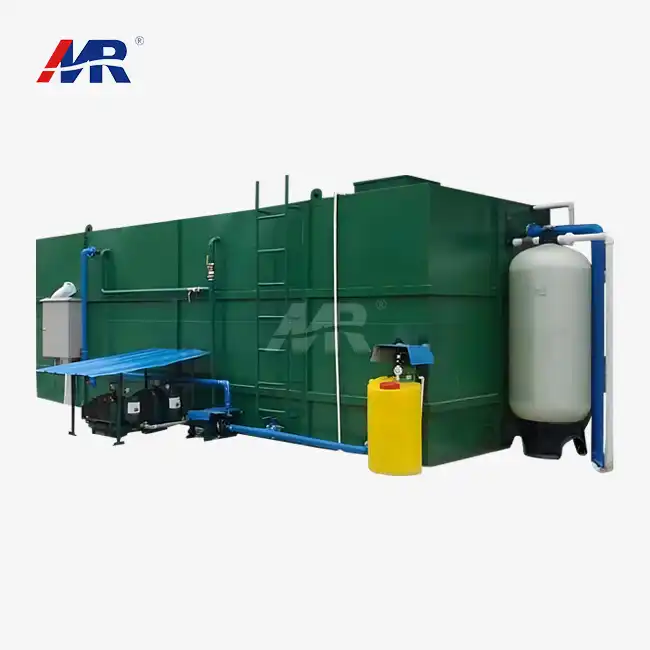
If you operate a municipal facility, a food processing plant, or an industrial business, you already know that wastewater doesn’t take care of itself. The real issue is not whether you need a treatment system, but whether you completely grasp what goes into one and how each component impacts your compliance, your expenses, and your operational continuity. Wastewater treatment plant units are the modular or integrated operational units, such as bar screens, grit chambers, biological reactors, clarifiers, membrane systems and disinfection skids, which collectively remove physical, chemical and biological contaminants from sewage or industrial effluent. These units may be used in preliminary, primary, secondary, and tertiary treatment processes. Today’s designs generally integrate many functions into small systems that can be containerized for quicker deployment and tighter footprint control.
What Are the Core Components of a Wastewater Treatment System?
Knowing how each step affects the quality of the final effluent gives procurement professionals a decisive advantage when they are choosing equipment or judging supplier proposals.
Preliminary and Primary Treatment Units
The initial stage in the treatment procedure is mechanical separation. Bar screens and fine screens can remove big bits of material and dirt that might harm equipment further down the line. The next phase is grit chambers, where the flow is slowed so sand, gravel, and foreign particles may settle out. Then, primary clarifiers remove part of the BOD and the floating solids by gravity. According to the U.S. EPA, initial treatment alone generally removes 50 to 70 percent of the total suspended particles and 25 to 40 percent of the biological oxygen demand (BOD) from raw municipal sewage. This is a big decline before biological processes kick in.
Secondary Biological Treatment Units
After the first step, biological wastewater treatment plant units are used. Liquid organics are broken down by microbial populations in sequencing batch reactors (SBR), membrane bioreactors (MBR), and activated sludge systems. Aerobic processes utilize air to break down carbon compounds. Anaerobic digesters do not need oxygen, and they create a byproduct called biogas, which may be recycled. The decision of which of these technologies is employed has a direct bearing on the amount of energy required, the volume of sludge, and the quality of the effluent. This is clearly a key option for any procurement team.
Tertiary and Disinfection Units
In the tertiary treatment stage, nutrients, pathogens, and micropollutants that were not eliminated during the secondary treatment are removed. Some typical processes at this stage include activated carbon adsorption, UV disinfection, chlorination, or media filtration. If the goal is to reuse the effluent, for example in agricultural irrigation or industrial recycling, tertiary units raise the treated water to near-potable standards.
What Types of Biological Treatment Units Are Available, and How Do They Compare?
It's important to think about efficiency, space, energy use, and long-term maintenance when choosing the right biological treatment method. There is a useful comparison between the most common configurations in the table below.
| Treatment Unit | Footprint | BOD Removal | Energy Use | Best Application |
|---|---|---|---|---|
| Conventional Activated Sludge | Large | >90% | Moderate–High | Large municipal plants |
| SBR (Sequencing Batch Reactor) | Moderate | >90% | Moderate | Variable-flow industrial sites |
| MBR (Membrane Bioreactor) | Compact (up to 50% smaller) | >95% | Moderate–High | Urban, reuse-focused, high-quality effluent |
| MBBR (Moving Bed Biofilm Reactor) | Moderate | 85–95% | Low–Moderate | Shock-load-prone industrial operations |
| Anaerobic Digester | Variable | 60–80% | Low (net energy positive) | High-strength organic waste (F&B, agri) |
MBR systems consistently stand out when land is scarce, or effluent standards are stringent. The membrane barrier physically excludes pathogens and suspended solids, enabling TSS levels below 5 mg/L and turbidity under 1 NTU—performance levels that conventional clarifiers cannot reliably match.
How Do You Choose the Right Wastewater Treatment Units for Your Application?
The correct unit design hinges on who is producing the wastewater, what's in it, and what level of regulation your discharge has to fulfill.
The organic load of municipal wastewater is rather steady and is effectively handled by conventional activated sludge or MBR systems. The problem with industrial wastewater is a different kind. Food and beverage plants create high-COD and high-FOG (fats, oils, and grease) streams requiring dissolved air flotation (DAF) and anaerobic pre-treatment prior to aerobic polishing. Pharmaceutical and biotech firms need systems that can manage API residues and trace organics. Often, they will use biological reactors and advanced oxidation process (AOP) wastewater treatment plant units.
Space limitations are equally crucial. The time for civil construction on site is reduced by 60-80% in compact containerized modules compared to standard concrete buildings, a big benefit for enterprises that can’t afford protracted shutdowns. Packaged systems also make permitting easier and enable capacity to be increased in phases by adding parallel modules rather than having to replace infrastructure.
Energy is a substantial running expense, as aeration blowers use 50-70% of the plant's total energy. The combination of VFD-controlled blowers and fine-bubble membrane diffusers may substantially decrease the kilowatt-hours per cubic meter of water treated, a benefit that adds up nicely over the life of the system.
What Should B2B Buyers Evaluate When Procuring Wastewater Treatment Units?
Purchasing choices based on unit pricing sometimes lead to a higher total cost of ownership. Some things are worth paying conscious attention to.
Buyers often don’t understand how essential the material construction is. Constructed of SS304/316L stainless steel or HDPE-lined carbon steel, units can withstand the corrosive pH extremes or the chloride exposure seen in industrial environments. ISO 12944 provides corrosion protection classes for steel buildings in hostile environments, and any credible provider should be able to identify the class their coating system meets.
Automation capabilities are also critical. Modern treatment systems are equipped with PLC/SCADA controllers that continuously monitor the Trans-Membrane Pressure (TMP), DO levels, flow rates, and alert states without any human intervention. This is useful since there is a general scarcity of qualified operators in the industry of wastewater.
What really decides whether a unit keeps on working after the first start-up is after-sales support, such as commissioning help, availability of replacement parts, and mbr membrane cleaning techniques. The MBR membranes usually need a chemically enhanced backwash weekly, and a thorough chemical-in-place (CIP) cleaning every three to six months as per permeability trends.
Real-World Application: The Morui MR-MBR-5TH in Domestic Wastewater Treatment
A practical reference point is the Morui MR-MBR-5TH, a packaged household wastewater treatment plant unit for decentralized or site-specific implementation. It uses an AAO (Anaerobic–Anoxic–Oxic) + MBR process flow, which handles nitrogen and phosphate removal, together with BOD and TSS reduction, in one integrated system.
The unit processes 100 m³/day and has a footprint of just 9 × 2 × 2.4 meters. This is excellent for isolated housing subdivisions, rural resorts, small townships, or industrial campuses where connection to a centralized sewer is problematic or cost-prohibitive. The AAO biological stage treats nitrification and denitrification, while the downstream MBR membrane module offers effluent clarity that meets or exceeds regulatory discharge limitations.
This unit is one of the Products of Guangdong Morui Environmental Technology Co., Ltd., which offers a wide range of water treatment solutions for industrial wastewater, saltwater desalination, and drinking water production. Morui has 20 in-house engineers, a membrane manufacturing plant, and numerous equipment processing facilities to serve the whole life cycle from design to commissioning.
Conclusion
Wastewater treatment plant units are not interchangeable commodities—each component carries a defined role in the treatment sequence, and the overall system performance depends on how well those components are matched to the specific influent characteristics and discharge requirements of your application. Biological treatment technology, material construction, automation capability, and supplier support all influence whether an investment delivers the intended ROI. Compact MBR-based systems like the MR-MBR-5TH demonstrate that high-quality effluent and space efficiency are achievable together, even for decentralized applications.
FAQ
1. What is the difference between aerobic and anaerobic treatment units?
Aerobic units use oxygen-dependent microorganisms to break down organic compounds and are well-suited for low-to-moderate strength effluent. Anaerobic units operate in the absence of oxygen, produce biogas as a byproduct, and are more efficient for high-strength streams, though they require longer hydraulic retention times and more careful temperature control.
2. How often do MBR membranes need maintenance?
MBR membranes generally require a chemically enhanced backwash on a weekly cycle and a full Chemical-in-Place (CIP) recovery cleaning every three to six months, depending on Trans-Membrane Pressure trends. Regular maintenance extends membrane service life and protects permeate quality.
3. Can treatment units handle variable or shock loads?
Standard activated sludge wastewater treatment plant units can be vulnerable to hydraulic and organic surges. Systems incorporating MBBR biofilm carriers or an upstream equalization (EQ) tank are specifically engineered to absorb shock loads without process failure, making them a sound choice for food processing or sites with uneven flow patterns.
4. What certifications should a supplier provide?
Reputable suppliers should document compliance with ISO 12944 for corrosion protection, ASME B31.3 for process piping, and IEC 60204 for electrical safety. A Factory Acceptance Test (FAT) report confirms that pumps, blowers, sensors, and PLC logic have been validated before shipment.
Ready to Configure the Right Treatment System? Contact Morui Today
Morui offers a full range of wastewater treatment plant units — from compact packaged MBR systems to large-scale industrial configurations — backed by in-house engineering, membrane manufacturing, and end-to-end commissioning support. Whether you need a reliable wastewater treatment plant units supplier for a municipal upgrade or a custom solution for a demanding industrial site, Our Team is ready to help. Reach out at benson@guangdongmorui.com to request a consultation.
References
1. U.S. Environmental Protection Agency. Wastewater Technology Fact Sheet: Membrane Bioreactors. EPA 832-F-07-008. 2007.
2. Metcalf & Eddy / Tchobanoglous, G., Stensel, H. D., Tsuchihashi, R., & Burton, F. Wastewater Engineering: Treatment and Resource Recovery (5th ed.). McGraw-Hill Education. 2014.
3. Water Environment Federation. Membrane Systems for Wastewater Treatment. WEF Press. 2006.
4. Judd, S. The MBR Book: Principles and Applications of Membrane Bioreactors for Water and Wastewater Treatment (2nd ed.). Elsevier. 2011.
5. American Water Works Association. Water Quality and Treatment: A Handbook on Drinking Water (6th ed.). McGraw-Hill. 2011.
6. International Water Association. Activated Sludge Models ASM1, ASM2, ASM2d and ASM3. IWA Publishing. 2000.
