

_1745823981883.webp)

Containerized ro system Maintenance: Best Practices
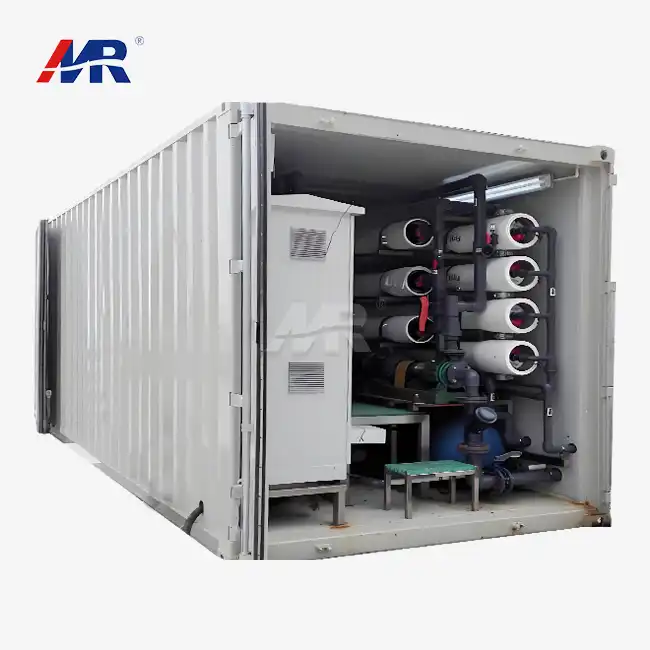
Proper maintenance of a containerized RO system is what separates a unit running at peak capacity from one that quietly drains your operating budget. These self-contained, modular water treatment units house membranes, high-pressure pumps, media filters, and automated controls within a single ISO container frame. Because all components share a compact enclosure, one neglected part can cascade into broader system failure. Whether you operate in food and beverage processing, pharmaceutical production, power generation, or municipal water supply, a disciplined maintenance program is the most cost-effective investment you can make in your water treatment infrastructure.
Understanding Containerized RO System Maintenance
Why System Architecture Shapes Maintenance Needs
A containerized RO system is not just an RO skid that has been put in a box. Each part of the system depends on the others because it has pretreatment steps like a media filter for getting rid of suspended solids, brackish water ro membranes, and automatic CIP cleaning. For instance, Morui's MR-CTRO-25TH model has a media filter and brackish water reverse osmosis (BWRO). It uses 32 kW per hour, recovers 55–65% of the water, and keeps a salt rejection rate of 98%. If the quality of the feed water gets worse or if a filter vessel doesn't backwash when it's supposed to, membrane flux drops, energy draw goes up, and the quality of the product water can drop below what's required, sometimes without an obvious alarm.
Tight limits are especially hard for people who work in industries like making electronics or medicines. It's not a small problem if the salt rejection rate drops by 2% in an ultrapure water loop used for chip cleaning or a GMP-regulated process. This can cause production to stop or a regulatory non-conformance event. Knowing how each part works together in the small space of a container is the first step in making a good maintenance plan.
Key Maintenance Procedures and Best Practices
Long-term system dependability depends on repair that is planned and written down. Responses to failures that happen on the spot always cost more than preventative measures. For example, data from membrane makers constantly shows that unplanned downtime costs three to five times more than planned maintenance activities of the same type.
The most important maintenance rules that every operator should follow are these:
- Routine physical inspection: Walk the containerized RO system once a week. Check for weeping fittings, high-pressure connections that have become loose from vibration, and corrosion on the structure of the container itself, especially if it will be used near water or in places with a lot of humidity. Applications that use seawater for desalination and offshore platform units are more likely to experience accelerated corrosion cycles.
- Membrane cleaning and flushing: If the normalized flow of permeate drops by 10–15% or the normalized flow of salt rises by 10–15% from baseline, a chemical cleaning event is needed. To get rid of mineral scale, use solutions with a low pH. To get rid of biological or organic waste, use solutions with a high pH. To keep cleaning chemicals from getting into the product water, always flush the unit well with permeate-quality water before putting it back into service.
- Media filter backwash and inspection: In systems like the MR-CTRO-25TH, the multimedia filter stage keeps suspended solids from getting to the membranes further down the line. At each review, check the difference in pressure across the filter bed. If the pressure drop goes above the manufacturer's limit or turbidity breakout is seen, the filter media needs to be replaced.
- Consumable replacement on schedule: The differential pressure, not just the date, should be used to decide when to replace the cartridge filters that come before the RO membrane array. When cartridges are worn or collapse, they lose fibers, which can permanently foul membrane elements. Record the age and performance records of each part.
- Parameter monitoring and logging: At least once per shift, write down the working pressure, permeate flow, concentrate flow, conductivity, and temperature. A well-built control panel can do a lot of this automatically, but sensor drift can be caught by hand that an automated system might miss.
When these steps are followed regularly and carefully written down, they back up guarantee claims and provide the audit trail that regulatory bodies in pharmaceutical, municipal, and food-grade settings need.
Comparing Containerized RO Maintenance with Other RO Systems
Knowing how containerized units compare to standard fixed installations helps procurement teams make sure that upkeep budgets are spent correctly.
| Criteria | Containerized RO System | Traditional Fixed RO Plant | Residential/Light-Duty RO |
|---|---|---|---|
| Component accessibility | Modular design with panel access | Needs civil construction | Easy access to the cartridge |
| Maintenance downtime | Shorter; modular swap-out | More time; construction on-site | Minimal; easy to do yourself |
| Energy optimization | Factory-balanced and integrated | Depending on how well it was installed | Does not apply |
| Scalability | As the need grows, add more containers | Needs a lot of building work | Fixed amount of space |
| Environmental adaptability | Made for harsh or remote sites | Construction tailored to the site | Use inside a residence |
| Compliance documentation | Baseline info sent by the factory | Records made by the site | Don't need it |
The flexible design of a containerized RO system really cuts down on the average time it takes to fix. When a high-pressure pump needs to be replaced, the part can be accessed through the service panels on the container without affecting the nearby infrastructure. This structural advantage directly leads to higher uptime and lower total cost of ownership for industrial operators with tight production schedules, such as those in petrochemical refining, beverage bottling, or hospital dialysis water circuits.
Choosing the Right Service Partner for Containerized RO Maintenance
Support for your maintenance program is only as good as the people who work on it. It is a key partner when a containerized RO system seller offers genuine spare parts, clear service procedures, and quick-to-respond field experts.
Put these factors at the top of your list when looking at service partners. First, make sure that the provider has or can get original membrane elements, high-pressure pump seals, and instruments that are calibrated to the needs of your unit. Second, make sure that the service techs know both how RO works and what technical limitations there are when working inside a container. Third, carefully read the warranty terms. Some suppliers won't cover you if you use chemicals or consumables from a different company.
Customized maintenance contracts make things even better. A yearly contract with a set fee that covers regular checks, chemical cleaning kits, and fast shipping of extra parts takes away budget uncertainty and keeps the buying and operations teams on the same page. For businesses that don't have a lot of money, rental and financing models let them keep using the system without having to pay a lot of money up front.
For every job, Guangdong Morui Environmental Technology Co., Ltd brings more than 500 workers, 20 qualified engineers, and its own facility for making membranes. With more than 14 branches and relationships with companies like Shimge Water Pumps, Runxin Valves, and Createc Instruments, Morui gives industrial users the technical depth and supply chain reliability they need. You can find out about all of our services at moruiwater.com.
Future-Proofing Your Containerized RO System Through Smart Maintenance
The next step forward in maintaining RO systems is already available. IoT-enabled sensors send real-time data on conductivity, flow, and pressure to cloud-based screens. This lets testing be done from afar without having to wait for a planned site visit. Predictive analytics platforms can show when membrane performance is deteriorating days before it gets bad enough to affect the quality of the product water. This lets maintenance teams plan their work for planned shutdowns instead of having to fix problems that happen without warning.
Along with smart technology, environmentally friendly upkeep methods are becoming more popular. Using better pretreatment and antiscalant doses to lower the amount and frequency of chemical cleaning events not only saves money on chemicals but also lowers the load on the effluent treatment system, which is important for sites with strict release permits. It's just as important to responsibly manage concentrate streams for operations close to sensitive water bodies.
When industrial buying professionals use these methods together, they put their water treatment assets in a good position to meet practical and environmental performance goals for the next ten years or more. Smart maintenance can help your containerized RO system be ready for the future.
Conclusion
A containerized RO system rewards operators who see maintenance as an ongoing discipline rather than a reactionary action. Water quality and capital investment are both protected by regular check cycles, cleaning membranes on time, keeping accurate records of parameters, and working with a qualified service partner. As smart monitoring and environmentally friendly methods become common in treating industrial water, the first sites to use them will be able to run with significantly less risk and cost. The MR-CTRO-25TH and other modular units like it are designed to work in harsh industrial settings, but engineering alone doesn't guarantee performance. It's called structured care.
FAQ
1. How often should RO membranes in a containerized unit be cleaned?
When the normalized permeate flow drops by 10–15% or the normalized salt passage rises by 10–15% from what it was at commissioning, the containerized RO system is clean. When the feed water has a lot of dirt in it, like when city wastewater is reused or seawater is desalinated, cleaning can happen as often as every four to eight weeks. In situations with less fouling, like treating brackish groundwater, it's more common to wait three to six months between cycles.
2. What are early warning signs that the system needs urgent attention?
Keep an eye out for a steady rise in operating pressure to maintain the target flow, a drop in the performance of permeate conductivity, strange noises coming from the high-pressure pump, or leaks that can be seen at the ends of the membrane vessels. If a single shift deviates more than 10% from the set average parameters, it should be looked into right away instead of waiting and seeing.
3. Can remote monitoring technology be added to an existing containerized system?
Yes. Most current containerized RO systems can work with retrofit IoT sensor kits as long as the control panel can handle both analog and digital signal inputs. A qualified systems integrator can connect existing instruments to a cloud platform without having to buy new core parts. The tech team at Morui can help with figuring out how to integrate both new and old units.
Partner with Morui for Reliable Containerized RO System Solutions
With proven experience in containerized RO system design, supply, and after-sales service, Morui assists industrial operators in the manufacturing, food and beverage, pharmaceutical, and municipal sectors. Your investment is safe at every step thanks to our in-house membrane production, qualified engineers, and global-grade component partnerships. Get in touch with our expert team right away to talk about a maintenance plan or to get a price quote for the MR-CTRO-25TH. Reach us at benson@guangdongmorui.com.
References
1. AWWA (American Water Works Association). Reverse Osmosis and Nanofiltration: Manual of Water Supply Practices. 2nd ed., 2007.
2. Dow Water & Process Solutions. FILMTEC™ Reverse Osmosis Membranes Technical Manual. 2021.
3. Metcalf & Eddy / AECOM. Water Reuse: Issues, Technologies, and Applications. McGraw-Hill, 2007.
4. WaterWorld Magazine. Industrial Membrane System Maintenance Protocols and Best Practices. 2022.
5. Desalination Journal (Elsevier). Performance Evaluation of Containerized Brackish Water Reverse Osmosis Systems in Remote Deployments. 2020.
6. IDA (International Desalination Association). Desalination Yearbook 2023–2024: Modular and Containerized Systems Outlook. 2023.
