

_1745823981883.webp)

Send your feedwater report to Morui at benson@guangdongmorui.com. As an 8m3/hour two pass reverse osmosis system manufacturer, we calculate feed flow, recovery, and polishing steps for your target conductivity. Our group has more than 14 branches and 20 engineers, so a proposal reaches you quickly. Include your TDS, target permeate quality, and daily operating hours.
How Does an 8m³/h Two-Pass RO System Work?
What Is an 8m3/hour Two-Pass Reverse Osmosis System?
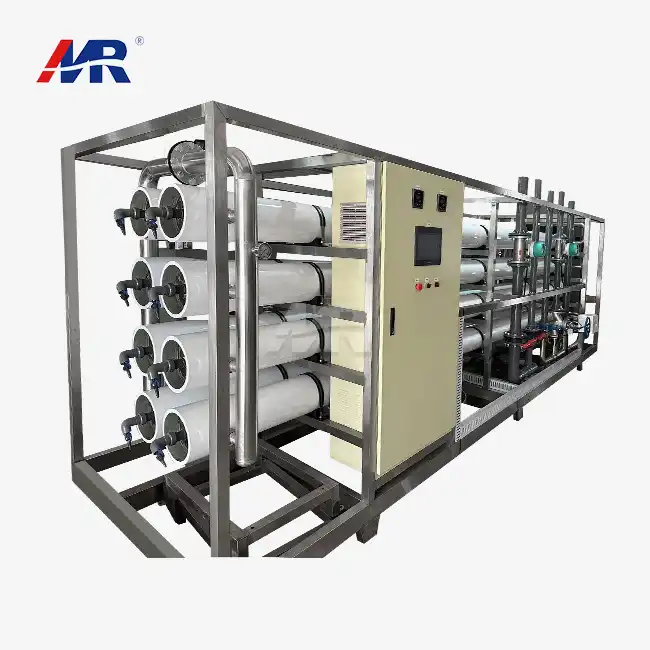
An 8m3/hour two pass reverse osmosis system is a packaged unit that puts feedwater through two complete RO stages. It delivers 8 cubic meters, or 8,000 liters, of permeate per hour. Pass 1 handles the bulk salt load. Pass 2 treats the Pass 1 permeate again and removes what remains. RO uses pressure to push water through a semipermeable membrane. It is the most common municipal desalination technology in the United States.
What Are the Stages of the Workflow?
The workflow of an 8m3/hour two pass reverse osmosis system has five stages. Pretreatment removes large particles and chlorine. A high-pressure pump then drives pass 1, which splits water into permeate and concentrate. A small break tank holds the permeate while the system conditions its pH. A separate pump drives pass 2 through a smaller membrane bank. Post-treatment adjusts pH and restores minerals when your process needs them.
What Do the Product Specifications Show?
Table 1 lists the published parameters of our 8m3/hour two pass reverse osmosis system and explains why each matters to your budget and water quality.
| Parameter | Morui value | Why it matters |
|---|---|---|
| Capacity | 8 m³/hour | Sets output: 192 m³ per day at 24-hour operation |
| Salt rejection | Above 99% | Defines permeate purity before any polishing step |
| Recovery rate | Up to 75% | Controls raw water use and concentrate volume |
| Power consumption | Under 0.8 kWh/m³ | Drives daily operating cost |
| Construction | Corrosion-resistant materials | Extends service life in wet plant rooms |
| Design | Modular, compact, customizable dimensions | Fits tight spaces and allows later expansion |
Why Use Two-Pass RO for High-Purity Water?
When Does a Single Pass Fall Short?
Some processes set tight conductivity limits. USP purified water must stay under 1.3 µS/cm at 25°C in the Stage 1 in-line test. Its total organic carbon limit is 500 ppb. The most common purified water train combines RO, electrodeionization, and UV light. In an 8m3/hour two pass reverse osmosis system, pass 2 cuts the salt load that the polishing step must handle. That protects downstream resin and stabilizes output.
Why Does Boron Push Designs Toward Two Passes?
Boron slips through ro membranes at neutral pH. Boric acid is small and carries no charge, so the membrane cannot hold it back. Applications that need less than 0.5 ppm of boron usually use two passes. A peer-reviewed study found boron rejection as high as 96% in a two-pass setup without pH adjustment. Pass 1 permeate stayed below 1.4 ppm.
What Happens Between the First and Second RO Pass?
In your 8m3/hour two pass reverse osmosis system, the permeate from pass 1 flows into a break tank. Operators often add a small dose of caustic soda here to raise the pH. Higher pH ionizes boric acid, and the charged ion is easier for the membrane to reject. Dissolved carbon dioxide also adds conductivity. Raising pH converts that gas into bicarbonate, an ion the pass 2 membranes block far better.
Is Scaling a Risk at High pH?
Rarely. Pass 1 removes more than 99% of the hardness. Pass 2 of an 8m3/hour two pass reverse osmosis system faces little scaling risk even at pH 10.5. The dose is modest. One large plant study estimated that 20 mg/L of caustic lifts permeate from pH 8 to pH 10. Your own dose depends on alkalinity, so our engineers confirm it during design.
Why Is Pass 2 Smaller Than Pass 1?
Pass 2 treats only the permeate, and that volume is smaller than the raw feed. The 8m3/hour two pass reverse osmosis system loses water as concentrate in both stages, so pass 1 must be sized larger. That extra capacity ensures pass 2 receives enough water to hold a steady 8 m³/h at the outlet.
How Does Two-Pass RO Compare With Single-Pass RO?
An 8m3/hour two pass reverse osmosis system buys purity, and it costs more to build and run than one pass. The International Desalination Association paper notes that a two-pass design with caustic lowers overall recovery and raises capital cost, chemical use, and energy. Table 2 sets the two designs side by side.
| Feature | Single-pass RO | Two-pass RO |
|---|---|---|
| Best fit | Irrigation, general process water, cooling makeup | Pharmaceutical, electronics, boiler feed, low-boron water |
| Permeate quality | Good; limited by one membrane barrier | Much lower conductivity from a repeated barrier |
| Boron control | Weak at neutral pH | Strong with pH raised in pass 2 |
| Overall recovery | Higher | Lower, unless concentrate is recycled |
| Capital and energy cost | Lower | Higher: added pump, membranes, and tank |
| Chemicals | Antiscalant only | Antiscalant plus optional caustic |
Choose two passes when your process demands the purity, and choose one when it does not. Morui builds both types. We run our own membrane factory and act as an agent for Shimge water pumps, Runxin valves, and Createc instruments. That lets pumps, valves, and monitoring reach your 8m3/hour two pass reverse osmosis system from one supplier.
What Feedwater Quality Does an 8m³/h RO System Need?
What Feed Limits Protect the Membranes?
DuPont's data sheet for FilmTec brackish elements sets a maximum feed Silt Density Index of 5 and a free chlorine limit under 0.1 ppm. It also lists a continuous pH range of 2 to 11 and a maximum temperature of 45°C. Multimedia filters lower SDI, carbon removes chlorine, and cartridge filters catch fine particles. Pretreatment protects both passes of the 8m3/hour two pass reverse osmosis system.
How Do Scaling Ions Affect the Design?
Brackish sources bring scaling risk. The USGS found that 48 to 74 percent of brackish groundwater samples were oversaturated with barite, and silica removal before RO is difficult. Send us your hardness, silica, iron, and barium figures. Our engineers then set antiscalant doses and recovery. That keeps pass 1 of your 8m3/hour two pass reverse osmosis system clean and gives pass 2 low-hardness permeate.
How Much Water Does an 8m³/h Two-Pass RO Produce?
The 8m3/hour two pass reverse osmosis system produces 8 m³/h of permeate, or 160 m³ per day at 20 hours of operation. Raw water demand is higher because each pass rejects a share as concentrate. Table 3 shows an illustrative balance that assumes Morui's 75% maximum recovery in each pass. Real recovery depends on your feedwater.
| Item | Calculation | Result |
|---|---|---|
| Final permeate | Rated output | 8.0 m³/h |
| Pass 2 feed | 8 ÷ 0.75 | 10.7 m³/h |
| Pass 2 concentrate | 10.7 − 8 | 2.7 m³/h |
| Raw water, concentrate discarded | 10.7 ÷ 0.75 | 14.2 m³/h (56% overall) |
| Raw water, pass 2 concentrate returned to pass 1 | 14.2 − 2.7 | 11.6 m³/h (69% overall) |
How Does Recycling Pass 2 Concentrate Help?
Pass 2 concentrate is low in salt because it comes from permeate. In an 8m3/hour two pass reverse osmosis system, returning it to the Pass 1 inlet cuts raw water demand. The example falls from 14.2 to 11.6 m³/h. That saves about 2.6 m³ every hour. Recycling works best when your feed is costly or scarce.
What Does Power Use Look Like?
At our published figure of under 0.8 kWh/m³, an 8m3/hour two pass reverse osmosis system draws under 6.4 kWh per hour. Over 20 hours a day and 350 days a year, output reaches 56,000 m³. Annual energy stays under 44,800 kWh, or under $4,480 at $0.10 per kWh. Federal analysts note that desalination can be energy-intensive, so this line deserves a close look in every quote.
Which Industries Need an 8m³/h Two-Pass RO System?
Pharmaceutical plants use it as the front end of purified water systems. The USP allows equivalent methods for water for injection, including double-pass RO combined with ultrafiltration, if the system is validated. Food and beverage plants use it for beverage and process water, where stable taste and quality protect the product.
Semiconductor and electronics plants use a RO water purification system to feed ultrapure water trains for rinsing. Power plants use it upstream of boiler feed polishing, while chemical processors use it for reactions and cleaning that require the removal of scale-forming ions. Small municipal systems can also benefit, as the federal desalination plan identified modular systems as a priority for rural and remote areas. Morui supplies each of these sectors with an 8 m³/hour two-pass reverse osmosis system and provides installation and commissioning as one package.
How Should You Size and Configure the System?
How Do You Size for Peak Demand?
Start with your peak hourly demand, not your daily average. If peaks exceed 8 m³/h, add a permeate storage tank instead of buying a larger unit. Then confirm the target conductivity, the pH your process accepts, and the operating hours. Our 8m3/hour two pass reverse osmosis system uses a modular design, so you can add capacity later. Dimensions can be customized for your plant room.
What Should You Send Before Ordering?
Send a full raw water analysis with TDS, pH, temperature, hardness, silica, iron, chlorine, and SDI. Add your required permeate quality and any boron limit. Tell us whether you want post-treatment such as remineralization. With those figures, Morui can specify pretreatment, pump sizing, recovery, and pH conditioning for your 8m3/hour two pass reverse osmosis system. Guangdong Morui Environmental Technology Co., Ltd also covers seawater desalination, industrial wastewater, and drinking water production.
Conclusion
An 8m3/hour two pass reverse osmosis system gives you higher purity by passing water through two membrane barriers, with a pH-conditioning step in between. It costs more than single-pass RO, so choose it only when your process needs the extra purity or boron control. Use the three tables above to check specifications, water balance, and trade-offs. Then request a design based on your own feedwater data.
FAQ
1. How does an 8m3/hour two pass reverse osmosis system work in simple terms?
Pretreated water passes through one bank of RO membranes, and the permeate collects in a small tank. A separate pump then sends that permeate through another membrane bank. Each pass in the 8m3/hour two pass reverse osmosis system rejects most remaining salts. The final water reaches far lower conductivity than one pass can deliver.
2. How much raw water does an 8 m³/h two-pass RO need?
In our illustrative example at 75% recovery per pass, the 8m3/hour two pass reverse osmosis system needs 14.2 m³/h of raw water. If you return pass 2 concentrate to the pass 1 inlet, demand falls to 11.6 m³/h. Your actual figure depends on feedwater chemistry and target quality.
3. Does two-pass RO need chemicals between the passes?
Not always. A small caustic dose raises pH and improves boron rejection, so it helps when boron limits are tight. One plant study estimated 20 mg/L of caustic to move permeate from pH 8 to pH 10. Water without a boron concern can skip it.
4. Can two-pass RO alone meet USP purified water limits?
Usually it needs a polishing step. The USP Stage 1 conductivity limit is 1.3 µS/cm at 25°C, and the common train adds electrodeionization and UV light after RO. Tell us your target, and we will recommend the full train and validation support.
5. What feedwater does an 8m3/hour two pass reverse osmosis system accept?
Feed should stay at or below SDI 5 with free chlorine under 0.1 ppm, based on DuPont's membrane limits. Scaling ions such as barium and silica need special attention. Share your full analysis so our engineers can design the pretreatment.
Need a Two-Pass Design for Your Water? Talk to Morui's Engineers
Morui builds each 8m3/hour two pass reverse osmosis system for sale with pretreatment, pumps, membranes, controls, installation, and commissioning. Email benson@guangdongmorui.com with your water report and target permeate quality. Our group has more than 14 branches and 20 engineers. We will reply with a sized proposal and a clear price.
References
1. Lab Manager (2026). Pharmaceutical-Grade Water: Meeting USP Purified Water and WFI Standards in the Lab. Cited in the high-purity, industries, and FAQ sections. https://www.labmanager.com/pharmaceutical-grade-water-meeting-usp-purified-water-and-wfi-standards-in-the-lab-35260
2. Farhat, A., Ahmad, F., Hilal, N., and Arafat, H. (2013). Boron removal in new generation reverse osmosis membranes using two-pass RO without pH adjustment, Desalination, 310. Cited in the boron section. https://khazna.ku.ac.ae/en/publications/boron-removal-in-new-generation-reverse-osmosis-ro-membranes-usin/
3. International Desalination Association World Congress (2013). Analyzing Three Years of SWRO Plant Operation at Elevated Feed pH, Franks et al. Cited in the boron, interstage, comparison, and FAQ sections. https://membranes.com/analyzing-three-years-of-swro-plant-operation-at-elevated-feed-ph-to-save-energy-and-improve-boron-rejection
4. DuPont Water Solutions (2022). FilmTec Fiberglassed Elements for Light Industrial Systems, Product Data Sheet. Cited in the feedwater and FAQ sections.
5. U.S. Geological Survey (2017). Brackish Groundwater in the United States, Professional Paper 1833. Cited in the scaling section. https://pubs.usgs.gov/pp/1833/pp1833.pdf
6. Congressional Research Service (2025). Desalination: Converting Saline Water into a Municipal Water Source, Insight IN12378. Cited in the definition, power, and industries sections. https://www.everycrsreport.com/files/2025-11-21_IN12378_f667edaa4ac4f641d01b49cdd6915adcc7ea39ad.pdf
About the author. Bin Liu is a Water Treatment Technical Writer at Guangdong Morui Environmental Technology Co., Ltd. Bin writes technical guidance on reverse osmosis design, water balance, and high-purity water for industrial, pharmaceutical, and municipal buyers. Working alongside Morui's engineers, who design, install, and commission RO systems, Bin checks every figure against a listed source or Morui's published specifications.
