

_1745823981883.webp)

Submerged Membrane Bioreactor Operation and Maintenance Guide
A membrane/bioreactor-wastewater-treatment">submerged membrane bioreactor (SMBR) integrates activated sludge biological treatment with membrane filtration—typically microfiltration or ultrafiltration—directly inside the reactor tank. Unlike conventional systems, vacuum suction draws permeate through immersed membranes while retaining all solids, eliminating secondary clarifiers entirely. This guide covers everything engineers, procurement managers, and facility operators need to know: from start-up procedures and daily monitoring to cleaning protocols, comparative technology insights, and procurement decisions. Whether you manage a municipal wastewater plant, food processing facility, or industrial site, proper operation and maintenance directly determines system longevity and effluent compliance.
Understanding Submerged Membrane Bioreactors: Technology & Design Principles
What Makes the Submerged Configuration Different?
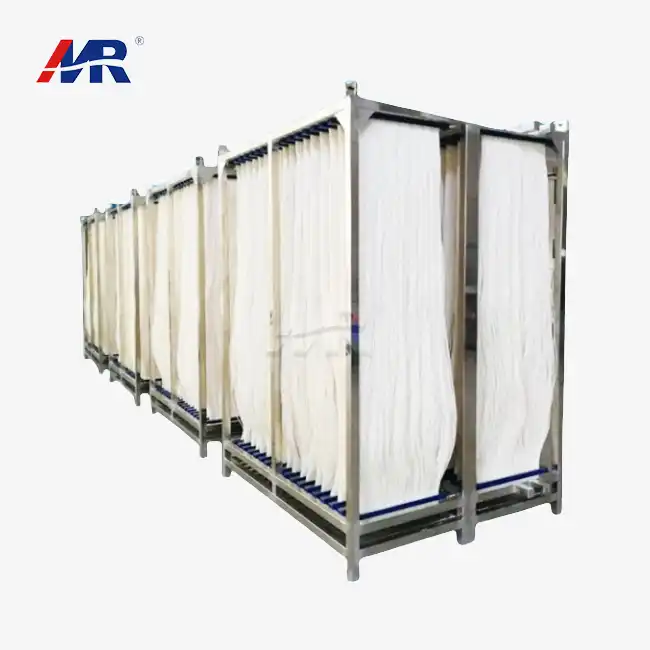
Submerged membrane bioreactor modules that are fully submerged in mixed liquor can be made with hollow fibers or flat sheets. Hollow fiber membranes can hold a lot of stuff, and flat sheet modules like Morui's MR-MBR-18 are popular because they are easy to clean and check. The MR-MBR-18 has a PVDF membrane with 0.2 µm pores, an effective filter area of 18 m², and a small profile (1300 x 1250 x 30 mm), making it perfect for retrofit setups with limited room.
Important design factors that every engineer should keep an eye on are:
- Transmembrane Pressure (TMP): This pressure usually ranges from 0.1 to 0.4 bar, and a rise in TMP indicates the start of fouling.
- Flux Rate: The steady flow of wastewater from cities is usually between 15 and 25 LMH (liters per square meter per hour).
- MLSS Concentration: For best results, the concentration should be between 8,000 and 12,000 mg/L. Above 15,000 mg/L, the viscosity rises and the air efficiency decreases.
MBR technology has better effluent turbidity below 1 NTU compared to traditional activated sludge (CAS) systems. It also lowers the reactor area by up to 50% and gets rid of all sludge bulking problems. External MBRs make it easier to get to the membrane, but they use a lot more energy because of cross-flow pumping. For most continuous industrial and municipal applications, submerged configurations are better.
Operation Best Practices for Optimum SMBR Performance
Start-Up Procedures and Daily Monitoring Parameters
When you start a submerged membrane bioreactor up right, it will be reliable for a long time. Before filtering can begin, the membrane units must be fully wet, and the integrity of the system must be checked. Using active return sludge for biological culture seeding speeds up the acclimation of biomass, and steady MLSS is usually reached within 2–4 weeks, depending on the properties of the wastewater.
Here are the most important operational parameters that every operator should check every day:
- Dissolved Oxygen (DO): Keep the DO level between 2.0 and 4.0 mg/L in the aeration zone to keep aerobic biodegradation going without too much aeration.
- MLSS: Check once a week and change the rate at which the sludge is wasted to keep concentrations in the 8,000–12,000 mg/L target range.
- Membrane Permeability: Do the math often; a trend that goes down over days, not hours, means that the membrane is slowly getting clogged and needs planned action.
- TMP Trend Logging: Automated SCADA systems can log TMP every 5 minutes, catching any strange jumps before they get worse and cause damage that can't be fixed.
These ways of monitoring keep performance stable and cut down on the costs of reactive maintenance by a large amount. A food preparation company with a 500 m³/day MBR system said that unplanned downtime dropped by 30% after automated TMP logging and real-time DO control changes were put in place.
Troubleshooting Common Operational Disruptions
Membrane fouling is still the most common problem that MBR systems have to deal with. When TMP goes up quickly within hours, biofouling or a problem with conditioning the sludge is most likely to blame. By briefly lowering the flow by 10–15% and making sure that the air is spread evenly across the module, time can be bought for biological recovery. If fouling keeps happening even after air scouring changes, it's time for an early chemical maintenance clean instead of waiting for the planned time.
Maintenance Strategies to Extend SMBR Lifespan and Efficiency
Physical and Chemical Cleaning Protocols
There are three main types of fouling in a submerged membrane bioreactor: biofouling (biofilm buildup), inorganic scaling (calcium carbonate, iron), and organic foulants (proteins, polysaccharides). Each needs a different answer. A well-organized maintenance plan usually has the following parts:
- Air Scouring (Continuous): The coarse bubble aeration below the module causes turbulence that keeps the membrane surfaces from sticking to particles.
- Relaxation Cycles: Stopping the suction for one to two minutes every eight to ten minutes of filtration lets the particles that have been deposited fall off on their own through aeration. This is a low-energy way to control fouling.
- Maintenance Chemical Cleans (Every 2–4 Weeks): 200 to 500 parts per million of sodium hypochlorite (NaOCl) kills biofouling and organic deposits, and 0.2 to 0.5 percent citric acid breaks down inorganic scale.
- Recovery Chemical Cleans (When TMP Exceeds 50 kPa): Higher concentrations of NaOCl (1,000–3,000 ppm) and longer soak times (6–12 hours) bring badly clogged membranes back to their normal permeability.
If you follow these steps every time, the PVDF membrane will last an extra 7 to 10 years in normal municipal wastewater conditions.
Inspection Schedule for Ancillary Components
Aside from the membrane itself, other parts that need to be checked regularly are fans, permeate pumps, pressure monitors, and flow meters. Over time, blower blade wear lowers the effectiveness of air and raises energy costs. Vibration checks done every three months catch damage early. When permeate pumps work against high backpressure, it means there is a partial blockage, which should be looked into right away. When compared to reactive fix methods, predictive maintenance using vibration analytics and energy consumption trends cuts total maintenance costs by about 20 to 25 percent.
Comparative Insights: SMBR vs Other Bioreactor Technologies
When procurement teams know where submerged membrane bioreactor technology works better than other options, they can justify spending money on it and choose the best setup.
| Criteria | Submerged MBR | External MBR | Conventional Activated Sludge |
|---|---|---|---|
| Footprint | Small (–50%) | Moderate | Large |
| Effluent Turbidity | <1 NTU | <1 NTU | 5–10 NTU |
| Energy Consumption | Moderate | High | Low–Moderate |
| Sludge Management | Low generation | Low generation | High generation |
| Maintenance Complexity | Moderate | High | Low |
| Retrofit Compatibility | Very Good | Fair | N/A |
When it comes to size, effluent quality, and lifetime running cost, submerged membrane bioreactor systems are the best choice. External designs are good for specific uses that need quick membrane access, but they use a lot of energy, which makes them less suitable for ongoing high-volume treatment. Conventional activated sludge is cheap at first, but it doesn't meet standards for effluent that can be reused without tertiary polishing, which adds cost and complexity further down the line.
Pay attention to the membrane material, effective area, pore uniformity, and chemical resistance when evaluating different MBR modules. The MR-MBR-18 is made of PVDF membranes, which are highly valued in the industry for their ability to increase hydrophilicity, their ability to withstand a wide range of pH levels (2–11), and their ability to remain mechanically stable even when subjected to repeated backwash stress.
Procurement and Installation Guide for Submerged Membrane Bioreactors
What Drives Pricing and Lead Time?
The total cost of buying a submerged membrane bioreactor system depends on a number of factors. The amount of membrane surface area needed goes up directly with the daily treatment volume and the target flux. Customization, like using stainless steel frames instead of standard ABS headers or changing the module sizes to fit certain tank shapes, raises the unit cost but can save a lot of money on civil construction costs.
Normal setups like the MR-MBR-18 have lead times of 3 to 6 weeks from the time the order is confirmed. Large jobs that need special manifolding and multi-module arrays may take 8–12 weeks to finish. By timing the arrival of the membrane with the finishing of the civil tank, costly storage delays can be avoided on-site.
Installation involves attaching module frames to bolts on the tank floor, linking permeate leads to the suction system, and turning on aeration diffusers. Morui's engineering team helps with commissioning on-site and makes sure that the aeration is even, the flow is balanced across parallel modules, and the control system is fully integrated before handing over the keys. OEM partnerships are available for customers who need white-label modules or combined skid kits. Morui's own membrane production plant can handle specific needs and maintains high quality standards.
Conclusion
Whether a submerged membrane bioreactor system lives up to its design promise over a decade or falls short within a few years depends on how well it is operated and maintained on a regular basis. A reliable SMBR works by keeping an eye on TMP trends, making sure MLSS stays within target ranges, applying cleaning chemicals on time, and regularly checking other equipment. With its 18 m² PVDF membrane, 0.2 µm precision filtration, and small 1300×1250×30 mm profile, the MR-MBR-18 is a tried-and-true module that can be used in both commercial and city settings. If an operation follows the steps in this guide, it will be more likely to be compliant, run more efficiently, and have lower lifetime costs.
FAQ
1. How often should MBR membranes be chemically cleaned?
Every two to four weeks, maintenance cleans with citric acid or diluted sodium hypochlorite are usually done. When TMP is higher than 50 kPa and permeability has dropped well below baseline, recovery cleans are done.
2. What is the expected membrane lifespan?
When systems are well taken care of, high-quality PVDF membranes in a submerged membrane bioreactor last between 7 and 10 years. Usually, early replacement is caused by not enough pre-treatment, too much MLSS, or not enough chemical cleaning.
3. Can an existing activated sludge system be retrofitted with submerged MBR modules?
Yes, retrofitting is common. Submerged modules can be added to existing aeration tanks with only slight civil changes. This often doubles the facility's treatment capacity without making it bigger.
4. How does the system handle fluctuating industrial wastewater loads?
Because the hydraulic retention time and sludge retention time are not tied together, MBR systems can handle changes in load well. In order to keep biological stability, however, sudden large organic surges should be handled by equalization tanks.
5. What MLSS concentration is optimal?
At 8,000 to 12,000 mg/L, most submerged MBR systems work best. Concentrations above 15,000 mg/L make the sludge thicker and make it less efficient at moving oxygen around, which raises energy costs without improving performance.
Partner with Morui for Your Next MBR Project
Morui is an expert at providing engineered water treatment options. We have our own membrane production plant and a team of 20 dedicated engineers to back us up. As a reliable supplier of submerged membrane bioreactors, we help projects in the industrial, municipal, and commercial sectors from the initial size calculations to the on-site commissioning. You can get our MR-MBR-18 module and the rest of our MBR product line through flexible OEM arrangements and quick customer service after the sale. To get a personalized quote right away, email our technology team at benson@guangdongmorui.com to request a customized quotation today.
References
1. Judd, S. (2011). The MBR Book: Principles and Applications of Membrane Bioreactors for Water and Wastewater Treatment (2nd ed.). Elsevier.
2. Stephenson, T., Judd, S., Jefferson, B., & Brindle, K. (2000). Membrane Bioreactors for Wastewater Treatment. IWA Publishing.
3. Le-Clech, P., Chen, V., & Fane, T. A. G. (2006). Fouling in membrane bioreactors used in wastewater treatment. Journal of Membrane Science, 284(1–2), 17–53.
4. Meng, F., Chae, S. R., Drews, A., Kraume, M., Shin, H. S., & Yang, F. (2009). Recent advances in membrane bioreactors: Configuration, operation, and application. Water Research, 43(6), 1489–1512.
5. Hai, F. I., & Yamamoto, K. (2011). Membrane biological reactors. In Treatise on Water Science (Vol. 4). Elsevier.
6. Water Environment Federation. (2012). Membrane Bioreactors: WEF Manual of Practice No. 36. McGraw-Hill.
