_1745823981883.webp)

Ultrafiltration Size vs. Microfiltration Key Differences
When choosing a membrane filter technology, it is very important to know how big the pores are. Ultrafiltration targets viruses, dissolved proteins, and colloidal particles with an ultrafiltration size range of 0.01 to 0.1 microns. Microfiltration removes mostly bacteria and solids in the water with pores that are between 0.1 and 10 microns in size. Ultrafiltration membranes can handle molecules between 1,000 and 500,000 Daltons, while microfiltration can handle bigger particles without taking molecular weight into account. In settings like pharmaceutical manufacturing, municipal water treatment, and industrial processing, this basic difference has a direct effect on operational pressure, energy consumption, and the suitability of the application.
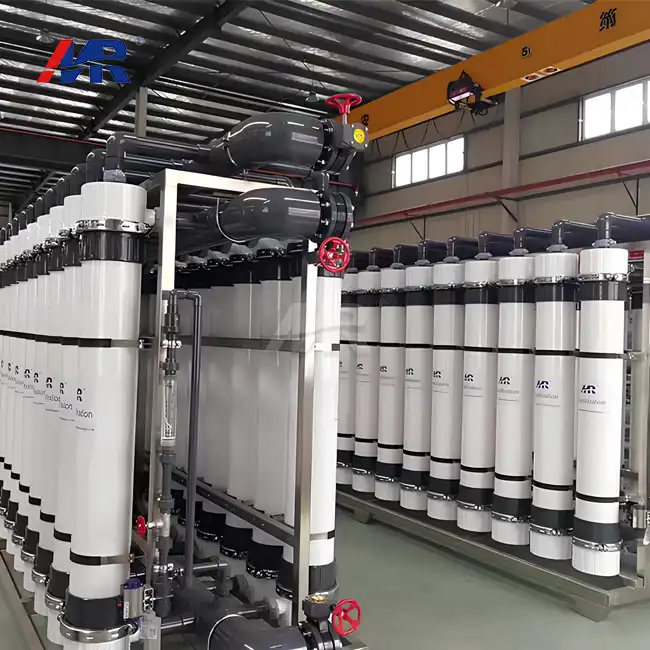
Understanding Membrane Pore Size Classification
Different types of membrane filtration occur on a spectrum based on the size of the pores. This category changes how well the separation works, how the system works, and the pollutants that are being separated.
Ultrafiltration membranes have two-sided designs that let you precisely control the size of the pores. The support layer gives the skin layer its mechanical strength, while the skin layer does the real separating. Most ultrafiltration systems work at 1 to 10 bar pressure and get rid of substances based on their molecular weight instead of their particle width. Testing from pharmaceutical uses shows that ultrafiltration can get rid of 99.99% of viruses with pores that are about 0.02 microns in size.
With bigger holes, microfiltration membranes can be built in a way that is symmetrical or uneven. For pre-treatment uses, these membranes work at lower pressures (usually 0.2 to 2 bar), which saves energy. Microfiltration is said to get rid of 99.5% of bacteria and turbidity particles bigger than 0.2 microns without adding any chemicals.
Three main differences in how membranes are classified:
- Pore geometry: ultrafiltration uses pores that are smaller and more controllable.
- How to separate things: size exclusion vs. surface filtering
- Pressure needs—ultrafiltration needs more force to move the fluid.
Ultrafiltration works better when you need to get rid of dissolved chemical compounds or separate proteins. Microfiltration, on the other hand, is a cost-effective way to clear up liquids or get rid of particles that are suspended in them.
Filtration Efficiency and Contaminant Retention
There are big differences in how well these membrane technologies work, which has an effect on both the quality of the output and the cost of running the business.
Ultrafiltration devices are very good at keeping ultrafiltration size viruses, endotoxins, and macromolecules in solution. At room temperature, pilot tests in the beverage processing show flux rates of 50 to 200 litres per square metre per hour. Fouling resistance is affected by the chemistry of the membrane surface. For example, hydrophilic modifications make membranes 40–60% less likely to adsorb proteins than membranes that have not been changed. Pharmaceutical companies depend on ultrafiltration to get water that is free of pyrogens and meets USP standards, and removes endotoxins consistently.
Microfiltration makes things very clear while having little effect on the substances that are removed. Food processing plants say they filter more than 500 litres per square metre per hour to get rid of yeast cells and other particles. Because the pores are bigger, salts, sugars, and flavour molecules that have been dissolved can pass through without changing. Microfiltration keeps 98% of the original whey proteins while getting rid of fat globules and bacteria, according to tests done in dairy farms.
Solute rejection profiles reveal critical differences. Ultrafiltration throws out molecules with a molecular weight higher than its cutoff, making clear separation lines. A 30 kDa ultrafiltration barrier lets smaller molecules pass through but blocks 95% of molecules bigger than 50 kDa. Microfiltration only rejects particulate matter and doesn't reject liquid species very well.
Comparison of performance based on practical data:
- Ultrafiltration flow rate: 50 to 200 L/m³/h (depending on pressure)
- Microfiltration flow: 200–1000 L/m³/h (less likely to get clogged).
- Ultrafiltration keeps viruses, proteins, and colloids
- Microfiltration keeps germs, suspended solids, and turbidity in the water.
Ultrafiltration is the best way to separate molecules when you need to concentrate useful proteins or filter heat-sensitive solutions in a clean way. If you want to clarify a lot of things quickly with little effect on the processing, microfiltration is the way to go.
Operating Pressure and Energy Consumption
Power needs and system complexity play a big role in how economically viable something is. These things have an effect on both initial costs and ongoing operating costs.
To get past osmotic resistance and membrane hydraulic resistance, ultrafiltration units work at high transmembrane pressures. For the best permeate flux without membrane compaction, industrial systems usually keep the pressure between 3 and 7 bar. In urban settings, treating water for use uses about 0.2 to 0.6 kWh of energy per cubic metre. Spiral-wound membrane modules get 300 to 800 square meters of membrane area for every cubic metre of module volume. This is the best packing density.
Microfiltration systems work well at pressures that are much lower. Microfiltration units that are powered by gravity can work in remote areas without any outside energy because they only use hydraulic head. Pumped systems use between 0.05 and 0.2 kWh per cubic metre, which is 30 to 60 per cent less energy than similar ultrafiltration systems. Microfiltration uses hollow fibre membrane modules most of the time because they offer small designs with structures that can support themselves.
Different technologies use different fouling management methods. Crossflow configurations are used in ultrafiltration systems. The feed velocity provides shear forces that keep concentration polarisation to a minimum. Every 30 to 60 minutes, backwashing cycles restore 85 to 95% of the original flux. Microfiltration usually uses dead-end filtration with regular backpulses to get the same flux recovery with less complicated hydraulics.
Thoughts on pressure and energy:
- 2 to 10 bar ultrafiltration, moderate energy needs
- Microfiltration: 0.1 to 2 bars, very little energy use
- Frequency of cleaning: ultrafiltration needs stricter rules
- Setting up the module: spiral-wound vs. hollow fibre optimisation
Microfiltration can save you a lot of money on electricity costs in certain situations where it's needed for large-scale activities. Ultrafiltration gives you the accuracy you need if your process needs to separate molecules with very small differences in weight, even though it needs more energy.
Industry-Specific Applications and Selection Criteria
When choosing membrane filter systems, different industries put different performance factors at the top of their lists. Figuring out these needs helps you choose the best technology.
Ultrafiltration is required for important steps in the pharmaceutical and research industries. Ultrafiltration is the last step in GMP-compliant water systems after reverse osmosis. It gets rid of germs and endotoxins without using chemical cleaners. When making monoclonal antibodies, ultrafiltration membranes with a molecular weight of 30 to 100 kDa are used to concentrate proteins by 10 to 20 times while still keeping biological activity. Validation procedures show consistent log reduction values, usually 6 logs for virus removal, which is needed to make sure injectable Products are safe.
Both technologies are used strategically in the food and drink businesses. Microfiltration is used by dairy makers to cold pasteurise milk, which makes it last longer without damaging the proteins. Microfiltration is used in juice clarification to get rid of pulp and microorganisms while keeping vitamins and flavour ingredients. Ultrafiltration, with its ultrafiltration size, is used by breweries to stabilise beer by getting rid of proteins and tannins that cause haze and lower quality. Ultrafiltration lowers the turbidity to less than 0.5 NTU while keeping the original gravity and alcohol level.
To meet strict standards for drinking water, more and more municipal water treatment plants are using ultrafiltration systems. Membrane bioreactors treat wastewater biologically, and ultrafiltration makes it safe for indirect drinkable reuse. Performance data from plants that are already running show that turbidity stays below 0.1 NTU and overall coliform removal goes above 6 log reduction. The average cost of capital is $0.30 to $0.60 per gallon of daily capacity, which is about the same as other multi-barrier methods.
To make electronics and semiconductors, you need ultrapure water with less than one particle per millilitre. Microfiltration is used in pre-treatment trains to keep downstream reverse osmosis filters from getting clogged. Tight ultrafiltration membranes are used for final cleaning to get rid of colloidal silica and organic contamination that makes wafers flawed. Measurements of resistivity show that the water quality always goes above 18 megohm-cm.
Ultrafiltration gives you recorded safety margins if your facility makes injectable drugs or needs to get rid of pathogens in a proven way. If your business is mostly about clarifying drinks or RO pre-treatment, microfiltration will work well enough for less money.
Membrane Fouling and Maintenance Requirements
Long-term operational success rests on fouling control strategies that work well and are tailored to the characteristics of the membrane and the makeup of the feed water.
Ultrafiltration screens get clogged in a number of different ways. When residual solutes build up on the membrane surface, making secondary resistance layers, concentration polarisation happens. Protein fouling happens when hydrophobic interactions and electrostatic pull happen. This is especially bad when biological processing is happening. Systems that treat hard water can get scaled up due to mineral precipitation. Chemical cleaning with alkaline, acidic, and enzymatic formulas is part of maintenance plans along with physical cleaning by backwashing. If you take good care of your ultrafiltration system, the membranes will last for 5 to 7 years and keep 80 to 90% of the original flux.
Particulate fouling from suspended solids cake creation is the main problem that microfiltration has to deal with. Compared to ultrafiltration, these membranes are less likely to get clogged up with colloids and organic matter because their pores are bigger. Backwashing is a simple process that successfully removes accumulated particles. It is often automated to happen every 15 to 30 minutes. Chemical cleaning is done about once a month on average, while ultrafiltration cleaning is done once a week in similar situations. In properly built systems with enough pre-treatment, membrane replacement can happen every 7 to 10 years.
Testing for permeability helps find buildup early on. Normalised flux estimates that take into account changes in temperature and pressure show a slow loss of performance. A 15% drop in flux usually leads to better cleaning methods being used before fouling happens permanently. Advanced monitoring systems keep an eye on transmembrane pressure trends and let workers know when fouling rates aren't normal and need to be looked into.
Maintenance comparison summary:
| Parameter | Ultrafiltration | Microfiltration |
|---|---|---|
| Cleaning frequency | Weekly to biweekly | Monthly |
| Chemical consumption | Moderate to high | Low to moderate |
| Backwash frequency | Every 30-60 minutes | Every 15-30 minutes |
| Membrane lifespan | 5-7 years | 7-10 years |
| Fouling complexity | Multiple mechanisms | Primarily particulate |
If your operation can support intensive maintenance protocols to achieve superior separation, ultrafiltration warrants consideration. If minimising operational complexity and extending service intervals align with your priorities, microfiltration reduces labour requirements.
Cost Analysis and Return on Investment
For financial reasons, you need to look at more than just the original capital costs. You also need to look at the ongoing costs and the benefits in terms of productivity.
Ultrafiltration systems require a bigger initial investment. Depending on the module design and materials, they usually cost $150 to $400 per square metre of membrane area. For piping, instrumentation, and control systems, installation costs go up by 30 to 50 per cent. However, the technology gets rid of the need for chemicals to sanitise in many situations. A 100-cubic-meter-per-hour municipal system costs between $800,000 and $1,200,000 to build and has yearly costs of between $60,000 and $90,000 for things like energy, cleaning chemicals, and membrane replacement stocks.
Microfiltration systems are a lot cheaper, ranging from $80 to $200 per square metre of membrane area, due to the larger pore size than ultrafiltration size. Because the pressure needs to be lower, the pump and pipe requirements are also lower. A similar 100-cubic-meter-per-hour microfiltration plant starts at $400,000 to $700,000 and costs $35,000 to $55,000 a year to run. When used correctly, the 40–50% capital savings shorten the time it takes to get the money back.
Creating value is more than just measuring costs. Ultrafiltration processing is a gentler way for pharmaceutical companies to get more products than standard methods that use heat or chemicals. Producers of drinks know that cold-filtered goods last longer and sell for more money. Water companies can escape expensive disinfection byproduct violations and use less chlorine at the same time.
Three financial things to think about when evaluating a project:
- Capital intensity—the initial cost for ultrafiltration is higher.
- Operating efficiency—microfiltration saves money on upkeep and energy costs
- Value of the product: ultrafiltration makes high-end uses possible, which justifies higher processing costs.
If your project needs the best separation performance for high-value goods, investing in ultrafiltration will pay off in a big way. If minimising costs is what drives decisions for normal clearing tasks, microfiltration offers good economics.
Conclusion
The difference between ultrafiltration size and microfiltration pore dimensions is what really affects what can be used, how it works, and how much it costs. The 0.01-0.1 micron range of ultrafiltration makes exact molecular separation possible, which is needed to make medicines, get rid of viruses, and concentrate proteins. The 0.1–10 micron openings in microfiltration make it easy to clarify and get rid of germs in pre-treatment applications, water purification, and the processing of drinks. Finding the right technology means balancing the features of the membrane (like its pores, the amount of pressure it needs, its tendency to get clogged, and how often it needs to be maintained) with the goals and budget of the process. Both technologies have been shown to work well when they are used correctly and within their ideal working ranges.
Partner with Guangdong Morui for Optimal Ultrafiltration Solutions
Selecting the right ultrafiltration size and membrane technology requires balancing technical performance against operational realities. Guangdong Morui Environmental Technology combines manufacturing expertise with comprehensive service capabilities, producing membranes at our dedicated facility while maintaining partnerships with premium component suppliers, including Shimge Water Pumps and Runxin Valves. Our engineering team—20 specialists supported by 500 skilled professionals across 14 regional branches—designs customised systems matching your exact separation requirements and capacity needs. Whether you need pharmaceutical-grade ultrafiltration systems or cost-effective microfiltration pre-treatment, we deliver turnkey installations with full commissioning support. Connect with our ultrafiltration manufacturer team at benson@guangdongmorui.com to discuss your water treatment challenges and receive detailed technical proposals backed by decades of successful project implementation.
References
1. Baker, R.W. (2012). Membrane Technology and Applications (3rd ed.). John Wiley & Sons, Chichester, United Kingdom.
2. Cheryan, M. (1998). Ultrafiltration and Microfiltration Handbook. CRC Press, Boca Raton, Florida.
3. Judd, S. & Judd, C. (2011). The MBR Book: Principles and Applications of Membrane Bioreactors for Water and Wastewater Treatment (2nd ed.). Elsevier, Oxford, United Kingdom.
4. Mulder, M. (1996). Basic Principles of Membrane Technology (2nd ed.). Kluwer Academic Publishers, Dordrecht, Netherlands.
5. van Reis, R. & Zydney, A. (2007). Bioprocess membrane technology. Journal of Membrane Science, 297(1-2), 16-50.
6. Water Environment Federation (2006). Membrane Systems for Wastewater Treatment. McGraw-Hill Professional, New York, New York.