_1745823981883.webp)

An osmosis drinking water system costs about $150 to $27,000, depending on size and use. Yearly filter and membrane upkeep comes on top of that. This guide breaks down filter prices, installation fees, system types, and long-term water costs. I wrote it for plant managers, facility owners, and procurement teams who want clear numbers before they request quotes. You will find typical price ranges, the features that raise the bill, and a checklist for comparing offers side by side.
Need a firm number instead of a range? Guangdong Morui Environmental Technology Co., Ltd. works as an osmosis drinking water system manufacturer and supplies engineered units with installation and commissioning. Send your daily water volume, water source, and site location to benson@guangdongmorui.com.
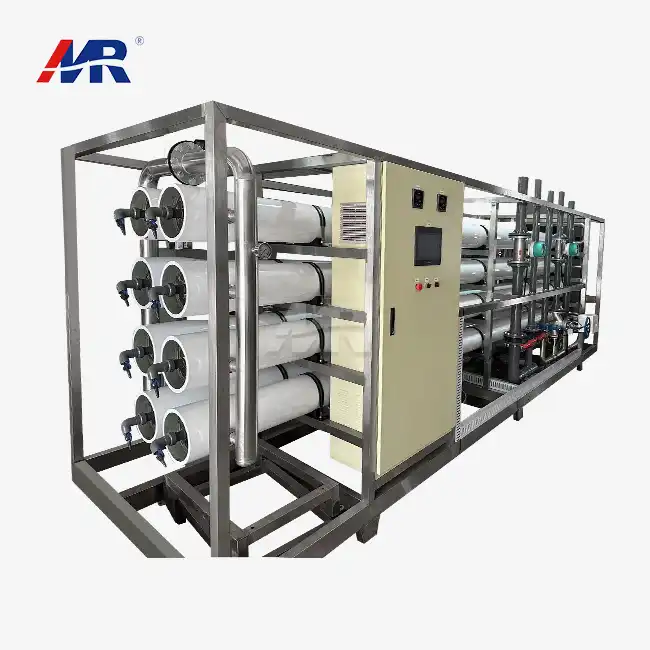
What Determines an Osmosis Drinking Water System Cost?
What Is an Osmosis Drinking Water System?
An osmosis drinking water system is a treatment unit that forces water through a semipermeable membrane. The membrane blocks dissolved solids and many contaminants. Most units add a sediment filter and a carbon filter before the membrane, plus a post-filter after it. Point-of-use models treat one tap. Whole-house models treat the main line. Industrial units treat process water at much higher flow rates.
Which Factors Move the Price Most?
System type sets the price more than any other factor. Brand, installation difficulty, and certification come next. Most units carry three to seven filtration stages, and each added stage raises the price within the same brand. Water quality matters too. Chlorine can damage a membrane, so carbon pretreatment is common. Extremely hard water may need a softener ahead of the unit. I advise buyers to test their water before they compare any osmosis drinking water system quote.
Why Are Buyers Budgeting for Treated Water Now?
Demand for safe water keeps growing. WHO and UNICEF report that 2.1 billion people still lack safely managed drinking water. Factories, clinics, schools, and hotels across Asia, South America, and Africa often install their own equipment to close that gap. A clear cost picture helps them choose the right osmosis drinking water system and avoid costly rework.
How Much Do RO Filters Cost to Replace?
What Is the Yearly Filter Budget?
Replacement filters form the main recurring cost of any osmosis drinking water system. Most systems need new filters every six months to two years, depending on system type. This Old House estimates about $400 per year to run a system, including water and filters. Pre-filters protect the membrane from grit and chlorine, so skipping changes shortens membrane life. Table 1 lists the schedule and typical costs.
| Component | Replacement interval | Typical cost |
|---|---|---|
| Sediment, carbon, and post-filters | Every 6 months to 2 years, by system type | Included in the yearly running cost |
| RO membrane | Every 3 to 5 years | $50–$100 |
| Yearly running cost (water plus filters) | Every year | About $400 |
| Professional repair visit | As needed | $150–$800 |
Source: This Old House, 2026
What Do Membranes and Service Calls Cost?
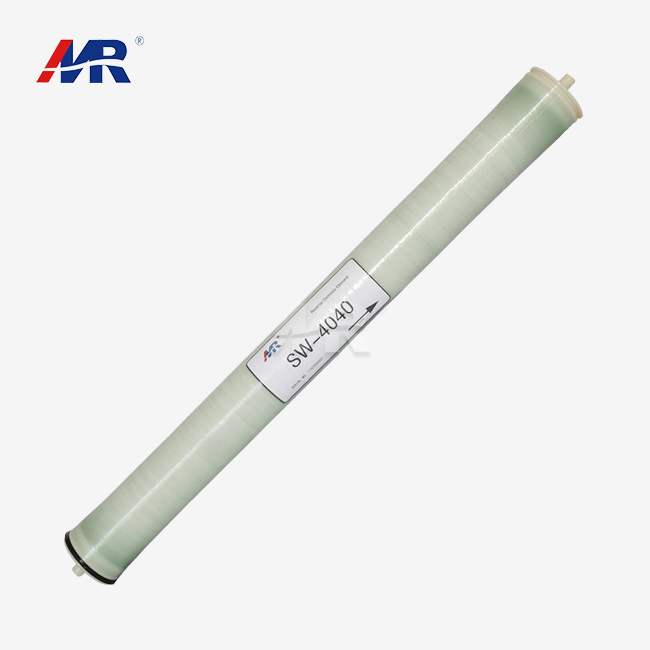
The membrane is more durable than the filters. A $ 50- $ 100 switch every 3-5 years is to be expected. Professional repair visits range from $150 to $800.Compare with certified units' performance. Testing is required for total dissolved solids (TDS) reduction. NSF/ANSI 58 also includes efficiency and recovery ratings. Morui has its own membrane factory so that customers have direct contact with the producer for membrane delivery.
What Does Professional RO Installation Cost?
What Do Plumbers Charge?
Professional installation of an osmosis drinking water system averages $300 to $700. Point-of-use units cost less, usually $150 to $300.Complex jobs, such as tight cabinets or long pipe runs, can reach $1,500.Plumbers charge about $45 to $200 per hour. Ask for a written estimate that lists labor, fittings, the drain connection, and the final test and flush.
Should You Install It Yourself?
You may be able to install simple under-sink units yourself and save $100 to $300.Whole home units are a separate thing. One plumbing error may lead to water damage that costs $1,305 to $5,707 to fix. Forget about DIY for industrial consumers. One-stop installation and commissioning by Morui. The firm also operates as an agent for Shimge water pumps, Runxin valves, and Createc instruments, keeping important components under one contract. Its osmosis drinking water system lineup includes residences, clinics, and plants.
How Do RO System Types Affect the Total Cost?
System type sets the budget range for any osmosis drinking water system. Table 2 compares the main categories.
| System type | Typical cost (materials and labor) | Best use |
|---|---|---|
| Point-of-use | $150–$1,300 | One kitchen, office, or lab tap |
| Point-of-entry (whole house) | $1,000–$4,800, up to $10,000 with a softener package | Homes and compounds, well water, high chlorine |
| Commercial | $4,500–$27,000 | Hotels, restaurants, small plants |
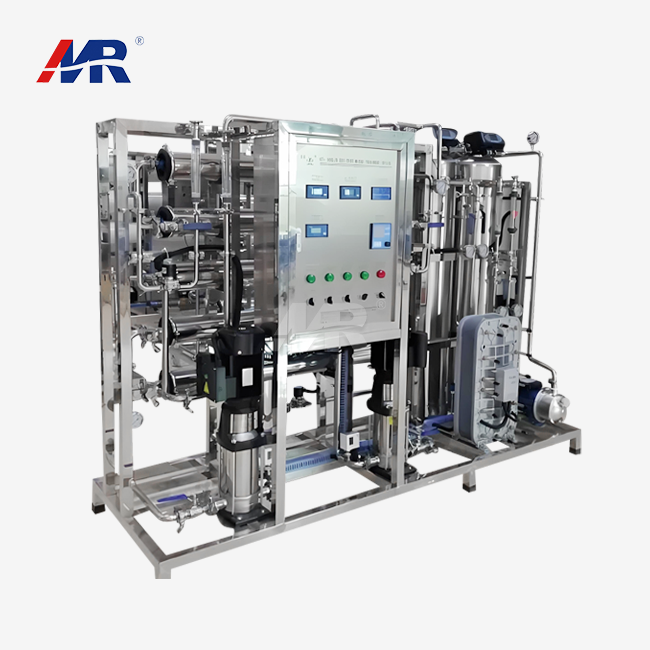
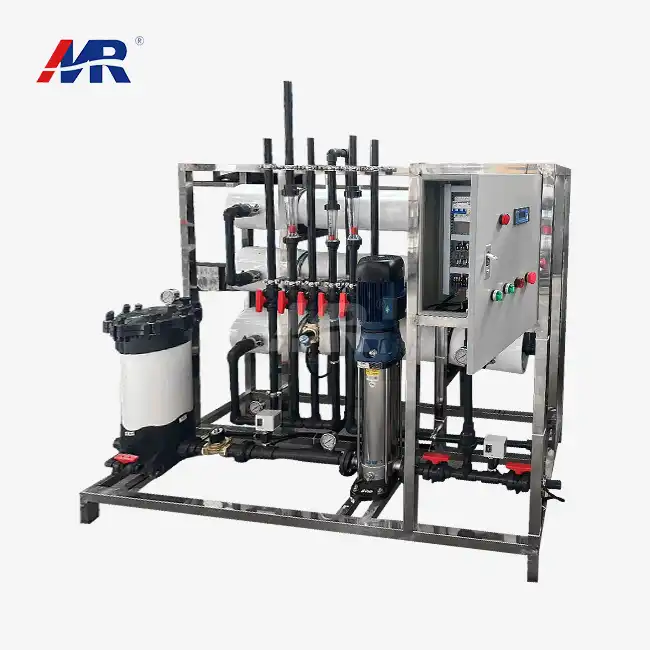
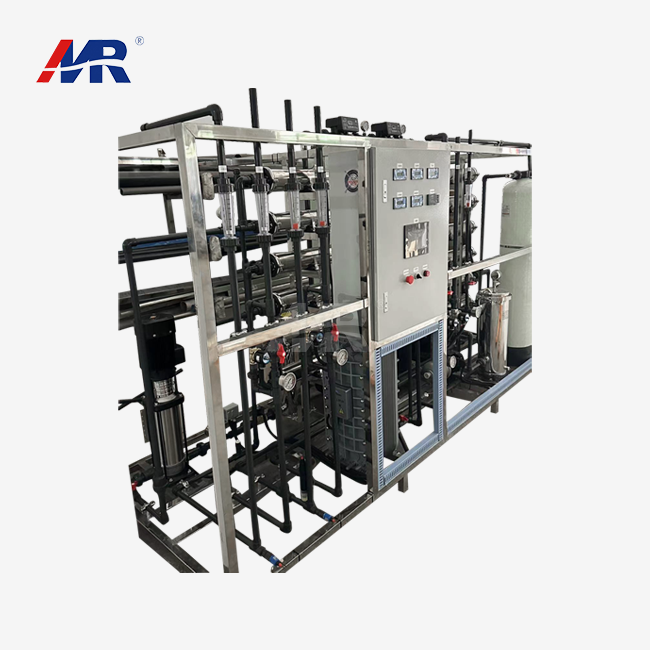
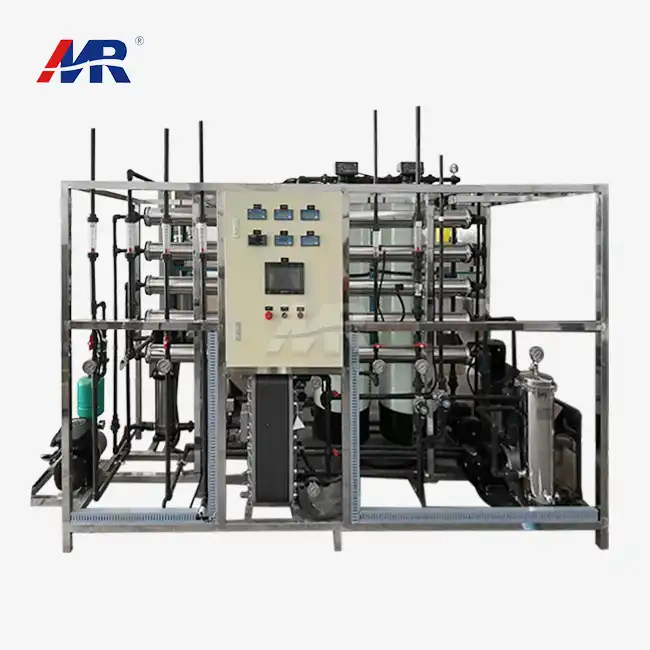
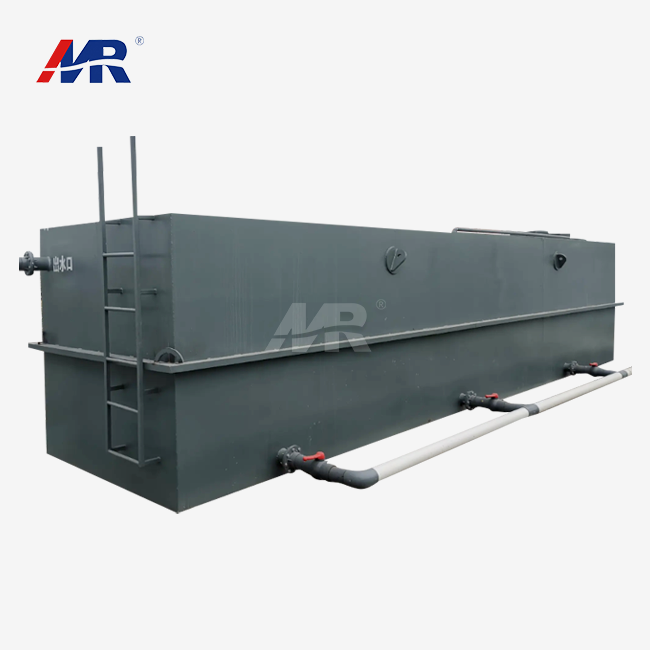
| Morui industrial unit | Quoted per project | Plants and utilities needing up to 40,000 GPD |
Sources: This Old House, 2026; Morui product specifications
How Does Capacity Change the Price?
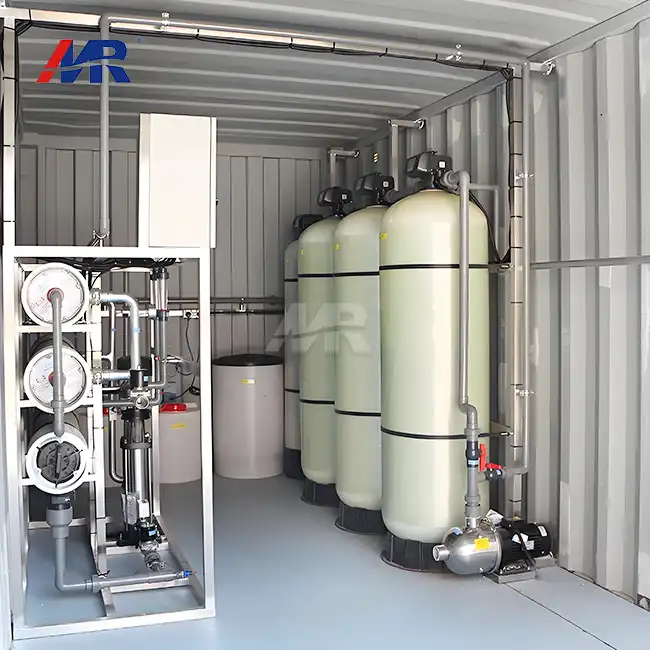
Capacity adds cost in steps. A home unit serves one tap. A commercial unit needs a higher flow rate, several points of use, and a storage tank. Morui builds an industrial osmosis drinking water system that delivers up to 40,000 gallons per day (GPD) and rejects 99% of TDS. It runs at 150 to 220 PSI on 220V or 380V power. Feed water temperature can range from 40°F to 100°F (4°C to 38°C).
Which Industries Use Each Type?
Application scenarios show how the categories differ. A bottled water plant needs steady volume and low TDS for production. A hospital or laboratory needs clean water for dialysis, disinfection, and precision work. A resort or apartment compound needs treated drinking water at many taps. An irrigation project in an arid region may treat brackish water at scale. Morui lists residential, commercial, healthcare, food and beverage, pharmaceutical, and agricultural uses for its equipment.
Which Features Increase an RO System’s Price?
Features raise the price in predictable ways. Buyers should pay for the features their water source and end use require. Three upgrades matter most.
- Water efficiency. Standard point-of-use systems can send up to four gallons to the drain for each gallon produced. EPA puts the typical figure at five gallons or more. Newer designs reach a 1-to-1 ratio, and that upgrade adds up to $300 to the price. Buyers who pay high water rates should weigh that upgrade against yearly drain losses.
- Stages, remineralization, and UV. Units carry three to seven filtration stages, and more stages raise the price. A remineralization stage adds minerals back after the membrane removes them. An ultraviolet attachment helps when bacteria are a concern. Morui offers optional UV sterilization after its post-filtration stage, so buyers add it only where the water source requires it.
- Certification and support parts. NSF certification is voluntary because no federal rules cover residential treatment units, but it can raise the unit price. The NSF/ANSI 58 standard tests TDS reduction, efficiency, and recovery ratings. Booster pumps and smart alerts add cost too. Morui supplies matching pumps, valves, and instruments alongside its units, which simplifies spare parts planning.
Match features to the site. A carbon stage matters for chlorinated municipal water, while a softener may matter more for very hard well water. The right mix keeps your osmosis drinking water system cost in check.
How Much Does RO Water Cost Over Time?
Upfront price tells only part of the story. According to This Old House, the average person spends about $1,500 per year on bottled water. An RO system averages about $400 per year to run. Table 3 shows a five-year comparison built from those figures.
| Option | Upfront cost (unit and installation) | Yearly running cost | 5-year total |
|---|---|---|---|
| Bottled water | $0 | $1,500 | $7,500 |
| Point-of-use RO, low end | $150 | $400 | $2,150 |
| Point-of-use RO, high end | $1,300 | $400 | $3,300 |
Simple arithmetic from This Old House ranges. Excludes local water rates and the $50–$100 membrane swap.
How Fast Does the Investment Pay Back?
Even the high-end point-of-use case pays back within two years against bottled water. Year one costs $1,700 for RO and $1,500 for bottles. By year two, RO totals $2,100 while bottled water reaches $3,000. Local water rates and membrane swaps will shift these numbers slightly. A well-sized osmosis drinking water system for a plant follows the same logic at a larger scale, with flow rate and water tariff replacing per-person spend.
Is a Whole-House or Under-Sink RO System More Cost-Effective?
For most places, under-sink units are cheaper. EPA defines a point-of-use system as one that processes water for drinking and cooking, not the bulk water for washing and flushing. That emphasis keeps it small and inexpensive.
Whole home units make more sense in specific instances. Extension counsel notes that whole-home RO is unfeasible since the traditional units lose around 75 percent of the input water. Home units also produce treated water slowly, around two to seven hours per gallon; therefore, a storage tank is typical. A point-of-entry system still makes sense for households with private wells or high chlorine levels. Select an under-sink system for drinking and cooking. Opt for whole-house if you want treated water at all taps. With each Osmosis Drinking Water System decision, a water test should be done.
What Should You Include in an RO System Cost Estimate?
A full estimate will itemize every line item. Get each provider to bid the same scope of work so you can compare apples to apples. Keep this checklist close at hand while you read proposals.
- Equipment and capability. Ask for unit pricing, rated flow in GPD, recovery rate, membrane count, and number of stages. Find out what feed water analysis was used to size the unit. Two quotations may be compared only when they are based on the same water source and the same daily volume. The true price discrepancy is hidden by mismatched assumptions.
- Installation and start-up. Check labor, fittings, drain and electrical connections, and final test and flush.5. Power supply match. (220V, 380V) Ask whether the provider sends its own engineers. Having one team to answer to makes finger-pointing less likely if a defect arises after starting. Morui delivers this service under one contract.
- Operating expenses and consumables. Throw in filters, a membrane change every 3-5 years at $50-$100, and service calls at $150-$800.Include electricity utilization and water drainage volume. Ask for a spare parts list with the prices so that you can anticipate the annual budget of your osmosis drinking water system without surprises. Certification and guarantee. Request NSF/ANSI 58 test documentation as the market demands. Select a manufacturer that provides a warranty. The maintenance instructions include a list of replacement parts and their change intervals. Written conditions safeguard against performance below the rated 99% TDS rejection. Check every claim in writing.
Send the same checklist to all suppliers. Then compare the totals over five years, not just the price. That practice converts a puzzling pricing disparity into a straightforward choice.
Conclusion
An osmosis drinking water system costs $150 to $1,300 at point-of-use scale. Whole-house units run $1,000 to $4,800, and commercial equipment runs $4,500 to $27,000. Filters cost about $400 per year, and membranes cost $50 to $100 every three to five years. Installation adds $300 to $700 on average. Compare quotes on total five-year cost, confirm certification, and match capacity to your water source. Morui can size each osmosis drinking water system to your volume and site.
FAQ
1. How much does it cost to install an osmosis drinking water system?
Professional installation averages $300 to $700. Point-of-use units cost about $150 to $300 to install, and complex jobs can reach $1,500.
2. Is an osmosis drinking water system worth the money?
It often is when you buy bottled water. The average person spends about $1,500 per year on bottles, compared with about $400 to run an RO system.
3. Does RO water lack minerals?
Yes. The membrane strips most dissolved minerals, and This Old House notes that WHO has raised concerns about relying on demineralized water. A remineralization stage adds minerals back.
4. How much water does an RO system waste?
Typical point-of-use units send four to five gallons to the drain for each gallon produced. Efficient designs reach a 1-to-1 ratio at a higher purchase price.
5. Can Morui customize an osmosis drinking water system for my plant?
Yes. Morui offers customizable options, including capacity up to 40,000 GPD, optional UV sterilization, and 220V or 380V power. Email benson@guangdongmorui.com with your water data.
Ready to Price an Osmosis Drinking Water System for Your Project?
Morui is an osmosis drinking water system supplier with more than 14 branches, 500 employees, 20 engineers, and its own membrane production factory. Share your daily volume, water analysis, and site location at benson@guangdongmorui.com. Our engineers will return a written quote covering equipment, filters, installation, and commissioning.
References
1. This Old House (2026). How Much Does a Reverse Osmosis System Cost? (2026 Guide). Cited for cost ranges, installation fees, filter and membrane schedules, efficiency upgrades, and bottled water comparison. https://www.thisoldhouse.com/plumbing/reverse-osmosis-system-cost
2. U.S. Environmental Protection Agency, WaterSense (2024). WaterSense Specification Development Update: Point-of-Use Reverse Osmosis Systems. Cited for the point-of-use definition and typical drain water ratio. Products-specification-update-for-pou-ro-systems_february-2024_508.pdf">https://www.epa.gov/system/files/documents/2024-02/ws-products-specification-update-for-pou-ro-systems_february-2024_508.pdf
3. NSF International (2026). NSF/ANSI 58: Reverse Osmosis Drinking Water Treatment Systems. Cited for certification scope, TDS reduction, efficiency, and recovery ratings. https://www.nsf.org/ca/en/knowledge-library/nsf-ansi-58-reverse-osmosis-drinking-water-treatment-systems
4. Michigan State University Extension (accessed 2026). A Guide to Home Water Treatment (E3342). Cited for pre-filtration, carbon pretreatment, and softener guidance. https://www.canr.msu.edu/uploads/resources/pdfs/e-3342_wcag_2.0.pdf
5. University of Massachusetts Amherst, Center for Agriculture, Food and the Environment (accessed 2026). Reverse Osmosis Treatment of Drinking Water Supplies. Cited for water waste and production time. https://www.umass.edu/agriculture-food-environment/cafe/fact-sheets/reverse-osmosis-treatment-of-drinking-water-supplies
6. World Health Organization and UNICEF (2025). 1 in 4 people globally still lack access to safe drinking water. Cited for the global access gap. https://www.who.int/news/item/26-08-2025-1-in-4-people-globally-still-lack-access-to-safe-drinking-water---who--unicef