_1745823981883.webp)

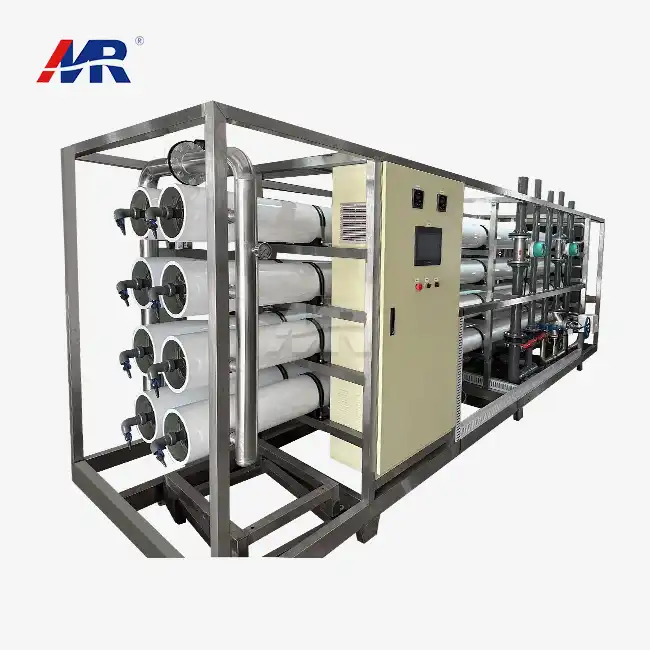
Planning a new project? Morui builds each reverse osmosis plant from 1,000 to 100,000 m³ per day. Email benson@guangdongmorui.com to speak with a reverse osmosis plant manufacturer that runs its own membrane production factory. Send your water analysis and flow target, and our engineers will suggest a pretreatment train, membrane type, and layout.
What Water Quality Should You Test Before Choosing RO?
What is a reverse osmosis plant?
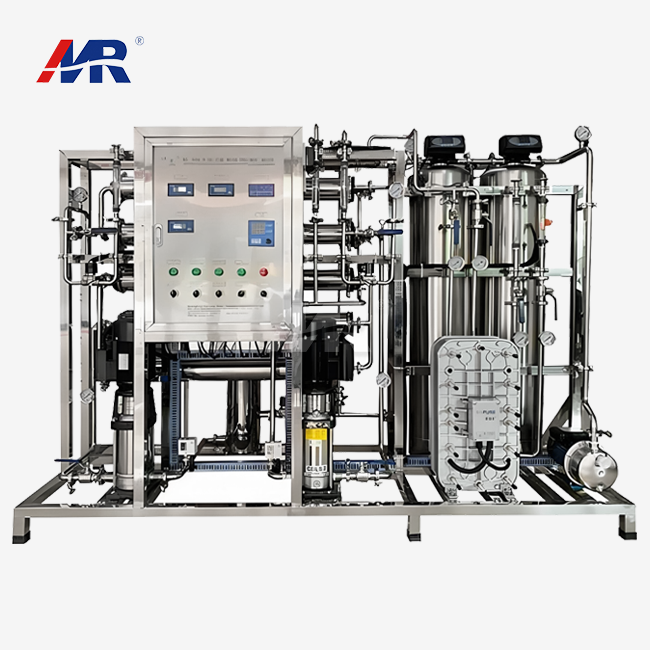
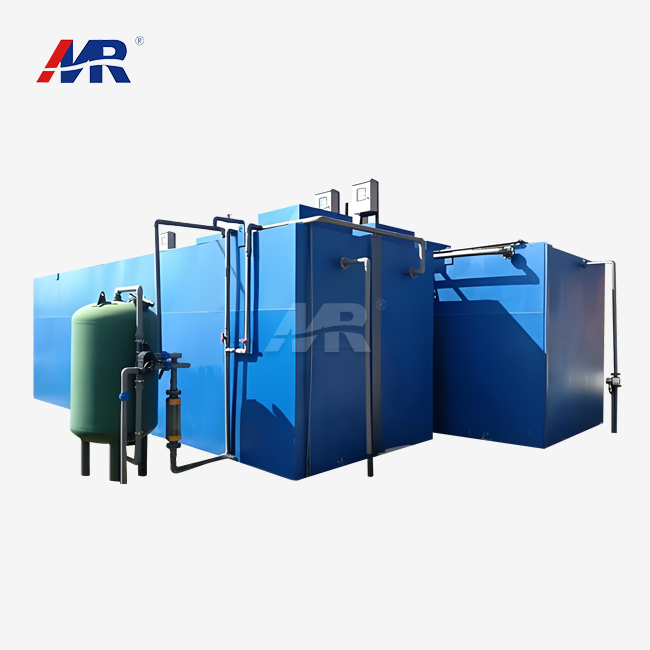
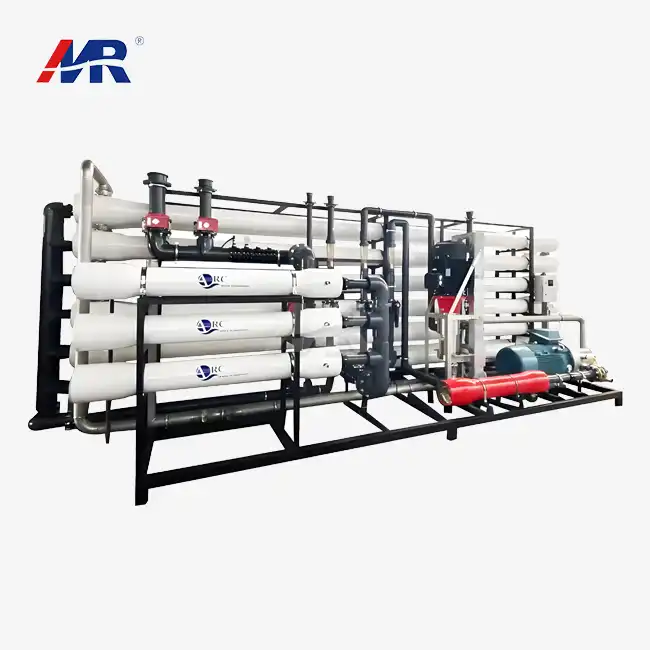
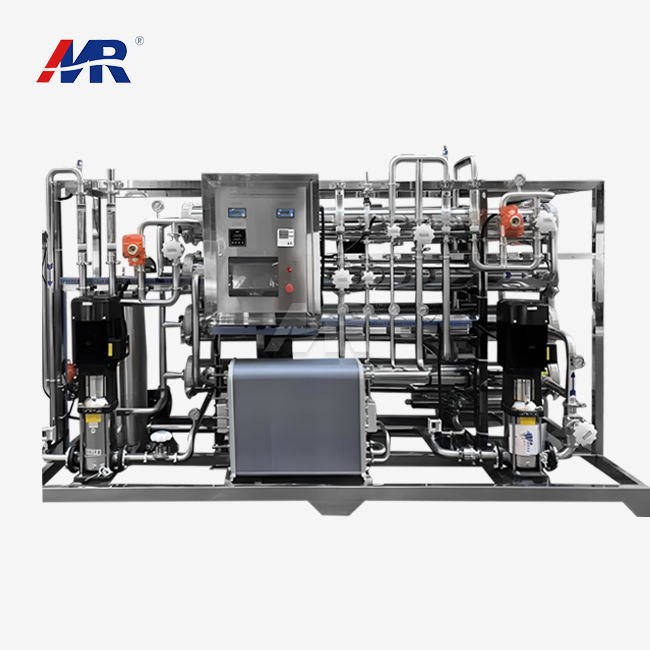
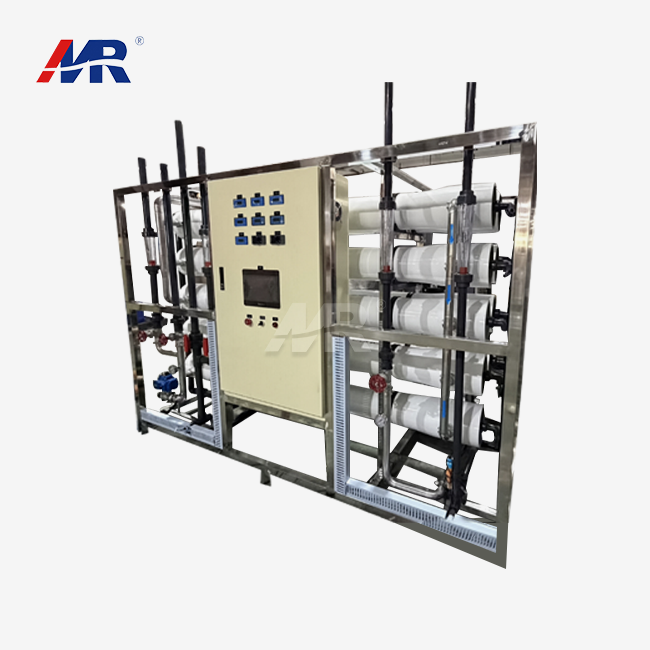
A reverse osmosis plant. A water treatment plant that uses pressure to drive water through a semipermeable membrane. The membranes reject dissolved salts, metals, and organics. The plant discharges clean permeate. The rejected material is removed by a concentrate stream. The full reverse osmosis system comprises pre-treatment, high-pressure pumps, post-treatment, and controllers. Morui’s facilities use high-flux, low-fouling thin-film composite (TFC) membranes and PLC-based control.
Which water tests matter most?
Design methods start with feed water chemistry, pH, temperature, and the silt density index (SDI). Add total dissolved solids (TDS), hardness, silica, chlorine, and iron to that list. Test in different seasons, because well and river water shift over the year. Table 1 shows what each test decides.
| Test | What it tells you | Design decision |
|---|---|---|
| TDS | Salt load | Membrane type, pressure, energy use |
| Hardness and silica | Scaling risk | Antiscalant dose, recovery limit |
| SDI | Fouling potential from fine particles | Pretreatment train |
| Temperature and pH | Flux and scaling behavior | Membrane area, chemical dosing |
| Chlorine, iron, organics | Membrane damage and fouling | Carbon filtration, oxidant removal |
A skipped test often shows up later as scaling, fouling, or an energy bill nobody planned for. Testing costs little compared with a membrane set.
How Do RO System Capacity and Flow Rate Affect Selection?
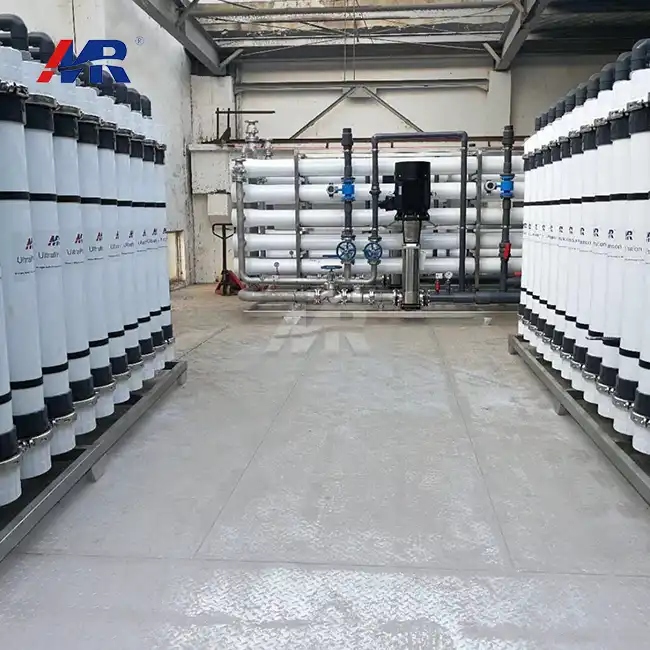
Capacity sets pump size, vessel count, footprint, and price. Size the reverse osmosis plant for permeate demand, then work back to feed flow using recovery. Morui builds plants from 1,000 to 100,000 m³ per day, with recovery up to 85%.
How do you turn demand into feed flow?
Divide permeate demand by recovery. A plant that needs 5,000 m³/day at 75% recovery needs about 6,667 m³/day of feed. At 85% recovery, it needs about 5,882 m³/day. That saves roughly 784 m³ of feed every day.
Why plan for growth?
Peak demand, future expansion, and cleaning downtime all change the right size. Modular design lets you add skids later instead of oversizing on day one. Overbuilding raises capital cost. Underbuilding forces costly expansions.
Which RO Membrane Type Fits Your Water Source?
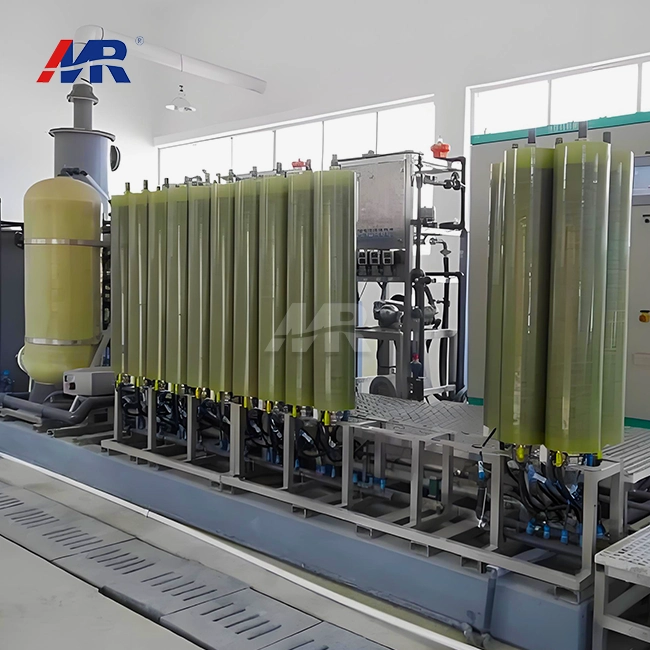
Match the membrane in your reverse osmosis plant to the salt load. Brackish water and seawater need different membranes and pressures. Brackish elements run at lower pressure and reach higher recovery. Seawater elements handle higher salinity but recover less water. Morui's TFC membranes deliver 99.5% salt rejection, and our own factory makes them.
Which applications fit each source?
Towns with brackish wells use a reverse osmosis plant for municipal drinking water. Factories use it for industrial process water, from boiler feed to food and beverage production. Coastal cities and islands use seawater desalination to close supply gaps.
Wastewater reclamation is the fourth case. Plants treat secondary effluent and reuse it, which cuts both intake and discharge. Guangdong Morui Environmental Technology Co., Ltd serves all four Cases, from industrial wastewater to drinking water production.
What Pretreatment Does a Reverse Osmosis System Need?
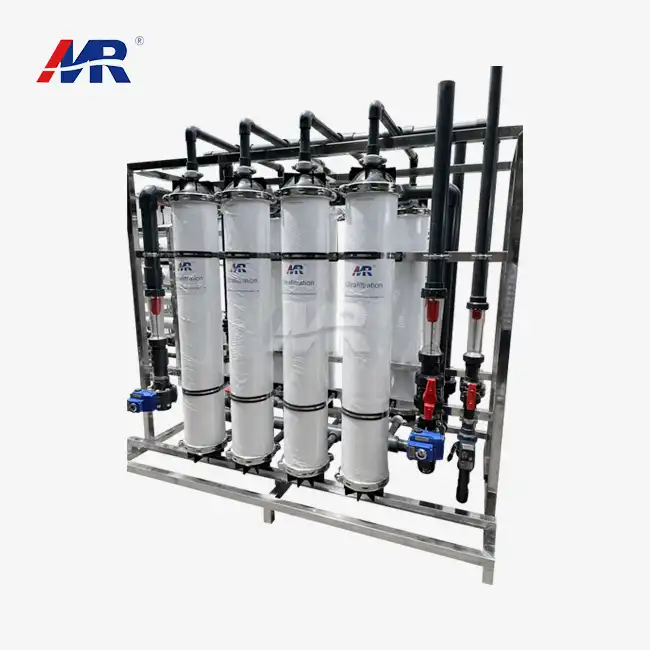
Pretreatment protects the membranes in every reverse osmosis plant, and membranes are your largest wear item. Typical trains use strainers, multimedia filters, and cartridge filters. Carbon filters remove chlorine. Antiscalant dosing blocks mineral crystals. Membrane makers and designers advise a 15-minute SDI below 4.0.
How do you set the pretreatment train?
Deep wells need light filtration. Surface water needs multimedia filters and sometimes ultrafiltration. Chlorinated municipal feed needs carbon or dechlorination to protect the polyamide layer. High hardness may call for softening. Ask your reverse osmosis plant supplier for a written SDI target and test it at the pump inlet.
How Do Single-Pass and Two-Pass RO Systems Differ?
Stages and passes are different ideas. Stages treat the concentrate again to raise recovery. Passes treat the permeate again to raise purity. A single-pass reverse osmosis plant sends feed through one membrane system. A two-pass reverse osmosis plant sends that permeate through a further RO unit. Choose two passes when your process demands very low conductivity, such as boiler feed or electronics rinse water.
| Layout | What gets treated again | Main gain | Typical use |
|---|---|---|---|
| Single stage, single pass | Nothing | Low cost, simple operation | Recovery below about 50% |
| Two stage (often 2:1 array) | Concentrate | Recovery up to about 75% | Costly or scarce water |
| Three stage | Concentrate | Recovery above 75% | Strict brine limits |
| Two pass | Permeate | Higher purity | Boiler feed, electronics |
Do you need both stages and passes?
Many reverse osmosis plants combine them: stages for recovery and a further pass for purity. Each addition costs more in pumps, vessels, and energy. Add only what your permeate specification requires. We size the layout from your water analysis and quality target, not from a standard template.
Which RO Features Affect Water Quality and Recovery?
Four features move the numbers in any reverse osmosis plant: array design, membrane quality, energy recovery, and control. Array design sets recovery, as Table 2 shows. Membrane quality sets salt rejection and fouling rate. Morui's rated figures are up to 85% recovery and 99.5% salt rejection, with 2.5 to 3.5 kWh/m³ of energy use.
How does automation help?
PLC-based control adjusts dosing, flushes, and alarms. A cost study of six 600 m³/day seawater plants in the Canary Islands found that automation plays an essential role in managing staff costs. Morui adds remote monitoring, so engineers can spot trends without a site visit.
Why does post-treatment matter?
RO permeate carries almost no minerals. Post-treatment adjusts pH. For drinking water, it also restores minerals for taste and pipe stability.
How Much Does a Reverse Osmosis System Cost to Run?
Running cost for a reverse osmosis plant has five parts: energy, membrane replacement, chemicals, cartridge filters, and labor. Brackish plants with energy recovery devices typically use 1.5 to 3 kWh/m³ in steady operation. Morui's rating of 2.5 to 3.5 kWh/m³ sits near the upper end of that range. At 10,000 m³/day, that equals 25,000 to 35,000 kWh per day.
| Cost driver | What moves it | How to control it |
|---|---|---|
| Energy | Salinity, recovery, pump efficiency | Set recovery to the scaling limit, keep membranes clean |
| Membrane replacement | Feed quality, cleaning habits | Hold SDI below 4.0, dose antiscalant correctly |
| Chemicals | Hardness, silica, fouling load | Test dosing on your own water |
| Cartridge filters | Particle load in the feed | Improve upstream filtration |
| Labor | Level of automation | PLC control, remote monitoring |
What lifespan should you expect?
Morui states that each reverse osmosis plant can run efficiently for 15 to 20 years with proper maintenance. Membranes are the wear item, so your pretreatment quality and cleaning routine decide how often you replace them.
What Should You Check Before Buying an RO System?
Ask every bidder for the same items in writing. List your water analysis, guaranteed permeate quality, recovery and energy at your feed, pretreatment scope, and membrane warranty. Check certificates for any reverse osmosis plant too. Morui's Products carry ISO 9001, ISO 14001, and NSF certification. Equal terms let your financial team compare offers fairly.
Which services belong in the contract?
Look for system design and engineering, installation and commissioning, operator training, spare parts supply, and remote monitoring. Morui provides all five with every reverse osmosis plant, so one team owns the result from drawing to production run.
Why work with Morui?
Morui has 14+ branches, 500 employees, and 20 engineers. We run our own membrane production factory and several equipment processing factories. We also act as an agent for Shimge water pumps, Runxin valves, and Createc instruments, so key parts come from one trusted source.
Conclusion
The best reverse osmosis plant decision begins with statistics, not brochures. Inspect your feed water. Determine size capacity from recovery. Select the membrane based on your source. Establish a tight SDI goal. Then choose stages or passes to achieve your purity and recovery objectives. Compare operational costs as closely as purchasing prices, since energy, membranes, and labor charge year after year.
FAQ
1. How long does a reverse osmosis plant last?
Morui states that its systems can operate efficiently for 15 to 20 years with proper maintenance. Membranes need replacement sooner, and feed quality sets the interval.
2. Can a reverse osmosis plant handle seawater desalination?
Yes. Morui designs each reverse osmosis plant for seawater desalination that produces high-quality fresh water. Seawater needs different membranes and higher pressure than brackish feed.
3. What recovery rate should I expect?
Morui rates its plants at up to 85% recovery. Array design sets the practical limit: two stages reach about 75%, and three stages go higher.
4. How much energy will the plant use?
Published ranges for brackish RO with energy recovery run from 1.5 to 3 kWh/m³. Morui's plants are rated at 2.5 to 3.5 kWh/m³.
5. Do I need a two-pass design?
Only when your process needs very low conductivity. Two passes treat the permeate again, so purity rises, but cost rises too. Single-pass reverse osmosis plants meet most drinking and general process needs.
Get a Quote for Your Reverse Osmosis Plant Project
Ready to compare bids with real numbers? Morui is a reverse osmosis plant supplier with design, installation, commissioning, training, and remote monitoring under one roof. Send your water analysis and daily flow target to benson@guangdongmorui.com. Our engineers will return a personalized reverse osmosis plant proposal with recovery, energy, and pretreatment details for your site.
References
1. Ruiz Saavedra, E. et al., "A design method of the RO system in reverse osmosis brackish water desalination plants (procedure)," Desalination and Water Treatment, 2013. https://accedacris.ulpgc.es/handle/10553/43838
2. Graver Technologies, "Silt Density Index" technical brief, accessed 2026. https://gravertech.com/technical-documents/silt-density-index
3. MANN+HUMMEL Water & Fluid Solutions, "TB-018 Reverse Osmosis and Nanofiltration Performance Design Calculations," 2021. https://water-membrane-solutions.mann-hummel.com/content/dam/lse-wfs/product-related-assets/manuals-guides/TB-018-Reverse-Osmosis-Nanofiltration-Performance-Design-Calculations.pdf
4. WCP Online, "Reverse osmosis system staging and array design," 2026. https://wcponline.com/?p=52357
5. Computers & Chemical Engineering, "Evaluation of performance and practicality of small- to medium-scale photovoltaic solar-powered reverse osmosis systems for brackish water desalination: A review," 2025. https://www.sciencedirect.com/science/article/abs/pii/S0098135425003230
6. Feo García, J. J. et al., "Cost assessment in SWRO desalination plants with a production of 600 m3/d in Canary Islands," Desalination and Water Treatment, 2016. https://accedacris.ulpgc.es/jspui/handle/10553/42514