_1745823981883.webp)

RO EDI Water System vs Distillation: Which Is Better?
When it comes to producing ultrapure water for industrial operations, choosing the right purification technology is a decision that affects your output quality, operating costs, and regulatory standing. A ro edi water system — which pairs Reverse Osmosis membranes with Electrodeionization modules — consistently delivers resistivity levels exceeding 18 MΩ·cm without chemical regeneration. Distillation, by contrast, relies on thermal phase change to separate impurities. Both methods produce high-purity water, but their suitability diverges sharply depending on scale, energy budget, and application. This guide breaks down what actually matters for B2B procurement teams.
What Are These Two Technologies, and How Do They Work?
How an RO EDI Water System Operates
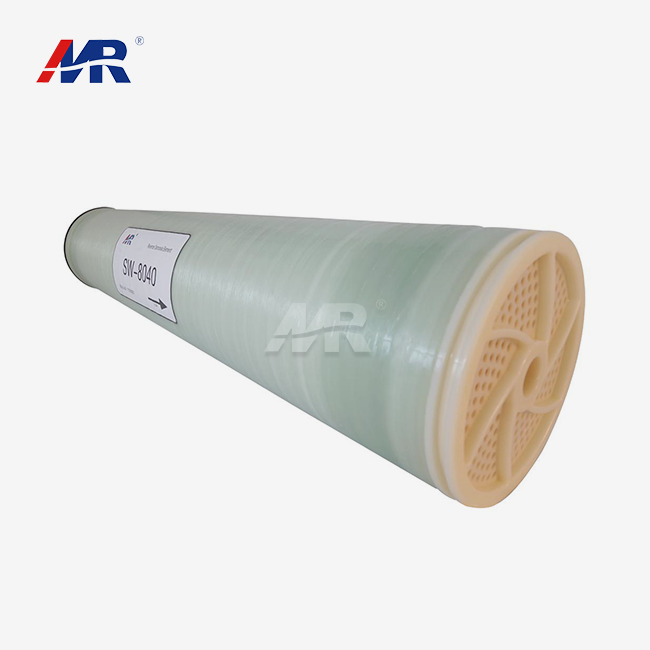
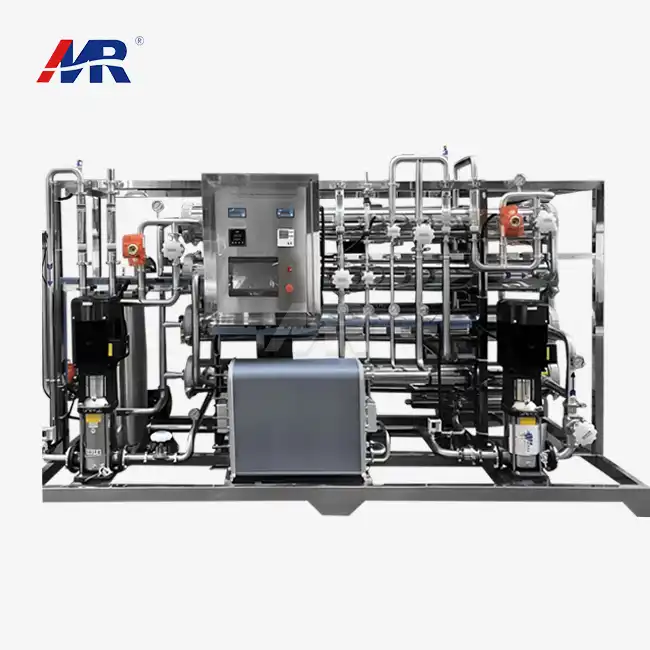
In two steps, a RO EDI water system gets rid of contaminants. It gets rid of up to 99% of the bulk ions, organics, and floating particles in the ro membrane step. After that, the EDI stage uses ion-exchange resins and semi-permeable membranes powered by a low-voltage direct current to continuously remove the remaining ions. There is no need for acidic or caustic regeneration chemicals. EDI is different from regular mixed-bed deionization because it can regenerate itself electrochemically. This makes a steady flow of ultrapure water that meets the conductivity standards needed by electronics factories, drug companies, and power plant boiler circuits.
How Industrial Distillation Works
When feed water is boiled and steam is condensed, dissolved solids, heavy metals, and most biological pollutants are left behind. Single-effect units are easy to use, but they use a lot of power. Multi-effect distillation (MED) and vapor compression types recover latent heat to make things work better. Distillation is a good way to get rid of some volatile organic chemicals and pyrogens, which is why it is still used in some pharmacy and lab settings where pharmacopeial standards require water-for-injection (WFI) to be made by distillation.
How Do Performance and Energy Efficiency Compare?
The table below presents a structured comparison across the criteria that procurement engineers and financial decision-makers weigh most heavily.
| Criterion | RO EDI System (MR-EDI-5TH) | Industrial Distillation |
|---|---|---|
| Output water purity | Up to 18.2 MΩ·cm | Typically 1–10 MΩ·cm |
| Salt rejection rate | 99.99% | ~99.9% (varies by design) |
| Energy consumption | 16 kW/hour | 25–80 kW/hour (scale-dependent) |
| Water recovery rate | 55% | 40–70% (process-dependent) |
| Chemical use | None (self-regenerating EDI) | Minimal, but descaling required |
| Continuous operation | Yes | Batch or semi-continuous |
| Startup time | Minutes | Hours (boiler warm-up) |
| Scalability | High | Moderate |
| Footprint | Compact | Large |
| Capital cost | Moderate | High |
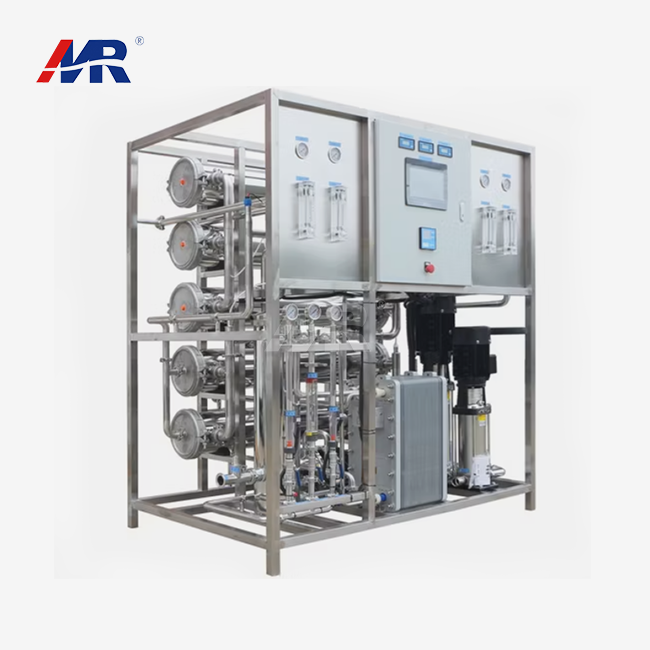
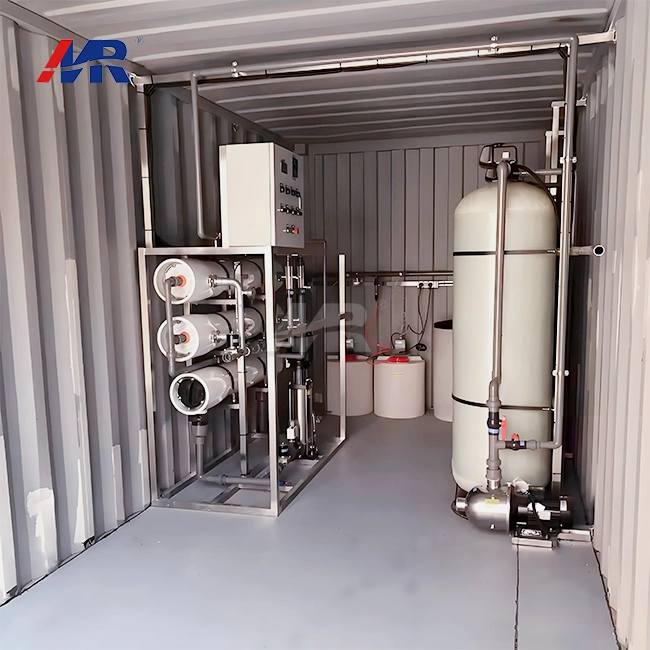
The information above shows the features of the Morui MR-EDI-5TH model. With a 16 kW/hour output, a 99.99% salt rejection rate, and a 55% recovery rate, this ro edi water system saves energy compared to thermal options while still producing ultrapure water.
Why Energy Consumption Matters More Than Most Buyers Expect
The U.S. Department of Energy says that hot water and water treatment use up a lot of industry energy costs in areas like making food and drinks and making medicines. Because distillation needs constant heat, it has an ongoing cost that grows over the life of the equipment, which can be many years. Because membrane separation happens at room temperature instead of boiling, a RO EDI water system doesn't have to deal with this thermal overhead at all.
Which Industries Are Better Served by Each Technology?
Where RO EDI Systems Consistently Outperform
RO EDI water systems are a good choice for industries that need to produce ultrapure water in large amounts and all the time. Here are some areas where this technology gives businesses a clear advantage:
- Electronics and semiconductors: In electronics and semiconductors, resistivity values of at least 18.2 MΩ·cm are needed for chip cleaning and device rinsing. With a 99.99% salt rejection rate, the MR-EDI-5TH consistently meets this standard without having to stop batches.
- Pharmaceuticals and biotechnology: The chemical-free regeneration cycle is helpful for GMP-compliant purified water production because it gets rid of the contamination risks that come with handling acids and bases in traditional ion exchange.
- Power generation: The boiler feed water for both thermal and nuclear power plants needs a steady supply of low-conductivity water. Variability that leads to scaling in turbines and boilers can't happen with continuous EDI output.
- Food and beverage processing: Facilities that bottle water and make drinks need to be as pure as FDA standards without adding chemical leftovers from regeneration processes.
These benefits make a strong case in a number of different areas. Consistent water quality, not having to handle dangerous chemicals, and a small system design all work together to lower operating risk and total cost of ownership in settings where production continues.
Where Distillation Retains Practical Value
In some controlled medicinal settings, distillation is still a valid method. In the past, some state pharmacopeias, like the United States Pharmacopeia (USP), allowed or required distillation for WFI production when making injected drugs. A bench-scale distillation unit might be a good deal in a lab where the volume needs to be kept small. However, distilling is not a good choice for large-scale use outside of these specific uses because it uses a lot of energy and takes a long time to get going.
What Should You Evaluate Before Making a Procurement Decision?
There's more to buying water cleaning equipment than just comparing detail sheets. The total cost of ownership for a ro edi water system includes the purchase of the equipment, its installation, maintenance, replacement cycles, energy use, and unplanned downtime.
The Morui MR-EDI-5TH is designed to produce ultrapure water with a 55% recovery rate. This means that it turns more than half of the feed water into useful output, which is important in areas that are short on water or at sites that are worried about the cost of discharge. EDI modules that have been properly treated with RO usually last three to five years before they need to be replaced. On the other hand, traditional ion-exchange resins need to be regenerated every few days when they are under a lot of load.
We should look closely at hidden costs. Scale builds up on the heat exchange surfaces of distillation units, which needs to be cleaned, which stops production. RO membranes need to be cleaned every so often, which is usually caused by a 10–15% drop in flux. These cleaning intervals can be planned for, which is very helpful for scheduling production.
Dependability of the supplier is also taken into account. Morui runs its own factories to make membranes and a number of factories to process equipment. This means that lead times and the availability of spare parts are controlled locally instead of relying on supply lines run by outside companies.
How Do You Keep Either System Running at Peak Performance?
RO EDI Maintenance Priorities
A RO EDI water system will only work well if the preparation and tracking are done correctly. If the feed water is very hard, you need to add a water filter or an antiscalant upstream. Calcium scaling on RO membranes is the most common reason why they lose efficiency too soon. When there is too much CO2 in the RO permeate, it can lower the EDI output resistance. This problem can be fixed by putting a degassing unit between the RO and EDI steps. When water goes into the EDI stage, its conductivity should stay below 40 µS/cm. Double-pass RO systems can handle high-salinity inputs that are higher than this limit.
When added to a preventive maintenance plan, regular membrane reviews, conductivity logging, and EDI module stability checks are easy to do. These steps make tools last longer and protect the investment over a longer period of time.
Distillation Maintenance Priorities
Boiler integrity must be checked on distillation units, condensers must be cleaned, and scale must be managed on evaporator surfaces. These jobs need a lot of work and, in big sites, need to be shut down on a regular basis. Over the course of five years, the total cost of downtime often exceeds the upkeep requirements of a similar RO edi system.
Conclusion
The two technologies both make very clean water, but they are used in different ways. Distillation is best for specific, controlled pharmaceutical uses where vapor-phase separation is required by pharmacopeial compliance. When constant output, energy efficiency, chemical-free operation, and the ability to grow are important, an ro edi water system is usually the better choice for commercial purchases. The MR-EDI-5TH rejects 99.99% of salt, uses only 16 kW/hour of energy, and has a recovery rate of 55%. This makes it a technically sound and cost-effective choice for chip factories, drug plants, power plants, and food processing facilities.
FAQ
1. Can an RO EDI system fully replace distillation in pharmaceutical manufacturing?
Yes, for most pharmaceutical uses, such as purified water for oral dosage and topical Products. Membrane-based methods are okay according to the USP standard for Purified Water. Several pharmacopeias have also changed their water-for-injection (WFI) standards to allow membrane processes. Talk to your legal affairs team to make sure you know which grade is right for your process. The RO EDI water system is increasingly favored for its efficiency in these applications.
2. How long does an EDI module typically last?
With regular RO preparation keeping the feed conductivity below 40 µS/cm, an EDI module can usually work for three to five years before it needs to be replaced, which is a lot longer than standard mixed-bed resin cycles.
3. Is CO2 a concern in RO EDI systems?
Yes, dissolved CO2 goes through RO membranes and lowers the resistivity of the EDI output. For ultrapure water uses that need resistivity above 15 MΩ·cm, it is common to put a membrane degasser or a CO2 degassing column between the RO and EDI steps.
4. What feed water conditions require a double-pass RO configuration?
If the conductivity of the feed water is more than 500 µS/cm after a single RO pass, it usually needs a second RO pass to get the conductivity of the EDI outlet below 40 µS/cm, which is the minimum level needed for reliable electrodeionization performance.
Partner With Morui for Your Next RO EDI Water System Project
Morui offers tried-and-true ultrapure water solutions backed by our own membrane production plant, 20 specialized engineers, and more than 14 branches that are open and running. As a full turnkey installation with startup assistance, our MR-EDI-5TH RO EDI water system is offered. Contact our technical team at benson@guangdongmorui.com to get a quote today, whether you are looking to source as a bulk ro edi water system supplier partner or considering direct procurement.
References
1. U.S. Pharmacopeia Convention. USP–NF General Chapter <1231>: Water for Pharmaceutical Purposes. United States Pharmacopeial Convention, 2023.
2. American Water Works Association. Reverse Osmosis and Nanofiltration: Manual of Water Supply Practices. AWWA, 2019.
3. Strathmann, H. Ion-Exchange Membrane Separation Processes. Elsevier, 2004.
4. U.S. Department of Energy, Office of Energy Efficiency and Renewable Energy. Industrial Water Use and Energy Efficiency in U.S. Manufacturing. DOE, 2021.
5. Baker, R. W. Membrane Technology and Applications, 3rd ed. Wiley, 2012.
6. International Society for Pharmaceutical Engineering (ISPE). ISPE Baseline Guide: Water and Steam Systems, 3rd ed. ISPE, 2019.