

_1745823981883.webp)

How to Select 3T/H Reverse Osmosis Equipment for Your Factory Today?
When your manufacturing line depends on clean water, choosing the correct water treatment system might seem daunting. I have been assisting plant managers and EPC contractors in accurately sizing 3T/H reverse osmosis equipment the first time for years, rather than paying for costly redesigns down the road. This article covers the arithmetic of capacity, feedwater laws, price reasoning, and how to inspect suppliers so you can compare bids with confidence. Whether you manage a PCB factory in Vietnam, a municipal utility in Kenya, or a bottling line in Peru, the same fundamental questions are asked before a purchase order is signed.
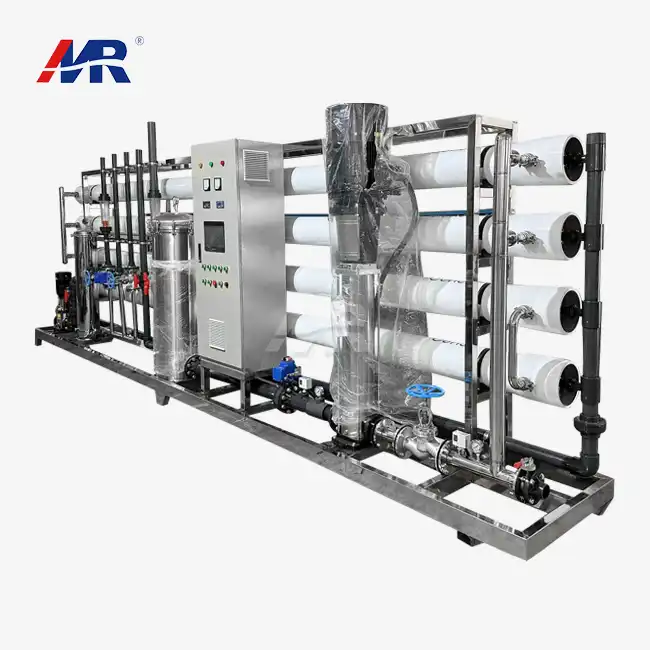
What Is 3T/H Reverse Osmosis Equipment?
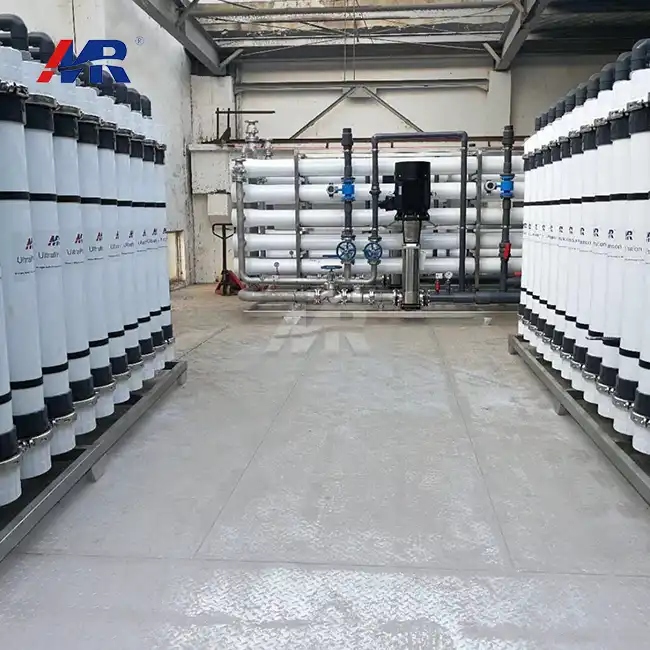
3T/H reverse osmosis equipment is a membrane-based water cleaning system capable of producing about 3 cubic meters (3,000 liters) of clean permeate water per hour, under the stated design parameters. It's not a whole ultrapure water plant. It's not a sterilizer. It's not a facility to burn off wastewater by itself." It is a pressure-driven filtration skid that transports raw water through semi-permeable membranes to remove salts, hardness ions, and most of the suspended particles. What is left is usable water.
The rejection of salt by industrial-grade 3T/H reverse osmosis equipment based on established reverse osmosis performance testing techniques is between 99.2% and 99.7% (ASTM International, 2021). The working pressure may vary from 150 to 1,200 psi, depending on the salinity of the feedwater. Ocean sources require more pressure than salty groundwater sources.
Feedwater Flow vs Permeate Flow vs Concentrate Flow
A lot of people think that the "3T/H" sign means "total water intake." It actually means the flow of water, not the input of water. A 3T/H reverse osmosis equipment permeate system usually takes in 4.5 to 6 cubic meters of raw water per hour and splits it into clean permeate and a smaller concentrate (reject) stream that gets rid of the salts and minerals that were not wanted.
How a 3T/H RO System Works
There are five steps to the process: preparation gets rid of particles and chlorine, a high-pressure pump forces water into the membrane housing, membranes separate salts from water, permeate is collected in a tank, and concentrate is sent to a secondary recovery stage or fed back in. It is important that each stage guards the membranes and keeps the flow steady during shifts.
How Much Water Can 3T/H Reverse Osmosis Equipment Produce Daily?
Run hours have no effect on daily output. It's easy math:
Daily permeate output = 3 m³/h times the number of hours the plant is open
| Operating Schedule | Theoretical Permeate Output |
|---|---|
| 8 hours/day | 24 m³/day |
| 16 hours/day | 48 m³/day |
| 24 hours/day | 72 m³/day |
At a recovery rate of 60%, this is how most 3T/H reverse osmosis equipment is set up:
| Flow Category | Approximate Flow |
|---|---|
| Permeate | 3.0 m³/h |
| Feedwater | 5.0 m³/h |
| Concentrate | 2.0 m³/h |
Factors That Lower Actual Output
Fouling slows flow between cleanings, cold feedwater slows membrane flux, and planned breaks for cartridge changes cut into your working hours. Buyers in North Africa and the Middle East should ask suppliers to guarantee output at both summer and winter temperatures, not just at 25°C. This is because the temperature of the feedwater can change with the seasons.
Which Industries Need 3T/H Reverse Osmosis Equipment?
This amount of water can be used by medium-sized businesses that need clean water in a steady flow but don't want the land-use of a big government plant. In the past two years, I've put this exact configuration into three very different plants, and the sizing was correct each time.
Industrial and Municipal Applications
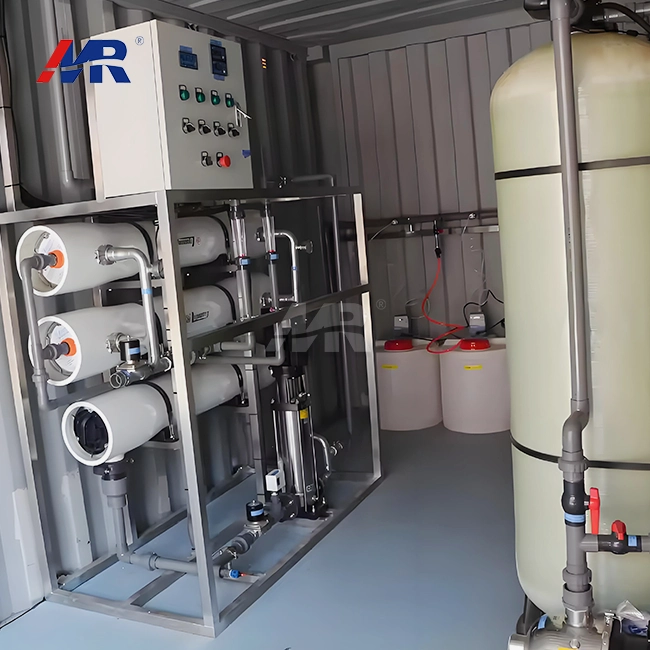
PCB and electronics rinse water, electroplating wastewater reuse, textile dyeing process water, boiler and cooling makeup water, making bottled water, and desalinating brackish groundwater for small municipal systems are all common uses. Iron ore mines and power plants in Latin America and the CIS often pair 3T/H reverse osmosis equipment with portable housing for places that don't have stable infrastructure.
Three Buyer Scenarios
| Buyer Type | Main Requirement | Evaluation Focus |
|---|---|---|
| OEM/Private Label | Repeatable specs, integration | Drawings, PLC interface, documentation |
| Distributor/Trader | Reliable supply, standardized models | Lead time, spare parts, warranty |
| End-User Plant | Stable operation, low downtime | Water analysis, training, maintenance |
This system can be used as a preparation step before EDI or distillation in pharmaceutical and high-purity settings, but it needs to be validated for that use and have a hygiene design review done before it can be put in place.
What Feedwater Quality Does 3T/H Reverse Osmosis Equipment Require?
Without a water report, it's hard to say what size 3T/H reverse osmosis equipment is needed. Before giving a customer a quote on a membrane design, I always ask for lab data. If I make the wrong choice for pretreatment, the membrane will foul within months.
Required Water Test Parameters
Temperature, pH, TDS or conductivity, total hardness, turbidity, SDI, iron and manganese, silica, free chlorine, and sulfate levels should all be in a useful feedwater report. If you don't have even one of these, especially silica, scaling problems can happen that a normal antiscalant program won't be able to detect in time.
Standard Pretreatment Sequence
- Raw-water tank and transfer pump
- Multimedia or sand filtration
- Activated carbon filtration
- Softener or antiscalant dosing
- Cartridge filter (5 micron typical)
- High-pressure pump feeding the membrane array
Feedwater Risks and Fixes
| Risk | Impact | Typical Fix |
|---|---|---|
| High hardness | Scaling, reduced flow | Softener or antiscalant dosing |
| Free chlorine | Membrane oxidation damage | Activated carbon filtration |
| High turbidity | Cartridge and membrane fouling | Multimedia filtration |
| High silica | Hard-to-remove scale | Specialized membrane design |
In coastal Southeast Asia and West Africa, groundwater sources often have a lot of iron and a modest amount of salt. This is why pretreatment design is more important than membrane brand in those places.
How Much Does 3T/H Reverse Osmosis Equipment Cost?
It's only possible to compare prices when the scale is the same. A softener-free bare skid costs a lot more than an automated full containerized unit, and buyers are always led astray when they compare the two prices next to each other.
Main Cost Drivers
The price is different for each configuration (single-pass vs. double-pass), the type of pretreatment, the brand of the membrane and pump, the material of the frame (stainless steel, FRP, or coated carbon steel), the level of automation, and whether polishing tools like EDI or UV are included. Tests, paperwork, and packing for export are extra costs that wholesalers may leave out of low-ball prices.
| Configuration | Relative Cost | Suitable Use |
|---|---|---|
| Basic single-pass RO | Lower | General process water |
| RO with softener and carbon filter | Moderate | Hard or chlorinated water |
| Double-pass RO | Higher | Low-conductivity applications |
| RO plus EDI or polishing | Higher | Pharma, lab-grade water |
| Fully integrated turnkey skid | Highest | Buyers needing full commissioning support |
Total Cost of Ownership
Besides the purchase price, you should also think about how much electricity it uses, how often the membrane needs to be replaced (every 3 to 5 years under normal fouling conditions), cartridge filters, cleaning chemicals, and the cost of getting rid of the concentrate. When you add up the costs of replacing the membrane and unexpected downtime, a cheaper unit up front that doesn't do a good job of cleaning usually costs more over three years.
Which Membranes and Pumps Suit 3T/H Reverse Osmosis Equipment?
Depending on the parts you choose, your system will either work as expected for five years or break down within eighteen months.
Membrane Selection Criteria
Compare membranes based on their nominal flow, salt rejection percentage, resistance to fouling, and how well their elements fit with the housing of your vessel. Instead of taking brand claims at face value, ask for up-to-date datasheets and batch traceability. Standard membranes with low fouling work well with salty groundwater, while fouling-resistant parts can handle reusing wastewater with more organic matter.
High-Pressure Pump Selection
| Component | Option A | Option B | Key Question |
|---|---|---|---|
| Pump drive | Fixed-speed | VFD-controlled | Is energy savings a priority? |
| Vessel material | FRP | Stainless steel | Is corrosion resistance critical? |
| Controls | Relay-based | PLC/HMI | Is remote monitoring needed? |
Tell us the pump flow rate in m³/h, the operating pressure in bar, and the motor power in kW. Also, make sure the power supply matches the grid where you'll be using it. For most of Asia and Africa, it should be 380–415V/50Hz, and in some parts of Latin America, it should be 460V/60Hz.
How Do You Choose a Reliable 3T/H Reverse Osmosis Equipment Manufacturer?
It's more important that the supplier is reliable than any one number on the spec sheet. People have saved 10% up front and then had to wait months for extra parts that were never in stock locally.
Supplier Evaluation Checklist
Look for written project references at a 3T/H scale, in-house engineering rather than trading-only operations, plant acceptance tests, and a clear way to get in touch with the company after the sale. Find out right away if the membranes and pumps are made by the company itself or if they are bought from outside sources. This will affect both quality control and wait time.
Why Morui Fits OEM and Wholesale Buyers
Guangdong Morui Environmental Technology Co., Ltd has its own cell membrane manufacturing and processing equipment factories. The firm has 25 years of experience, 500 workers and 20 engineers, and 14 branch companies. Morui can support market customers who require 3T/H reverse osmosis equipment with defined specs and in urgent demand, and also OEM/ODM buyers who have their own raw water reports and need custom pretreatment, private labeling, or PLC integration.
Morui is also an official representative of Products such as Shimge water pumps, Runxin valves, and Createc instruments. That implies that customers may obtain documented parts instead of generic parts without names. This is especially critical for Western customers who need to be able to trace component data for compliance checks, and for EPC firms that need to make sure they always have replacement parts for projects in more than one country.
What Should a 3T/H Reverse Osmosis Equipment Quote Include?
A quote that isn't clear is a red flag. When you get a serious quote for 3T/H reverse osmosis equipment, it should look like a technical document and not a price list.
Technical Information Checklist
Must know: rated permeate capacity, recovery rate, permeate conductivity guarantee, working pressure, power consumption, membrane type and quantity, pump specifications, pretreatment scope, construction materials, control system information. If you don't have any of them, you can't really compare the cost to what another supplier is offering.
Commercial and Documentation Terms
Check the amount of money being spent, what the contract does not cover, the wait time, the payment conditions, the guarantee duration, and any Incoterms such as EXW, FOB, CIF, or DAP. Request to see a general arrangement drawing, a pipeline and instrumentation diagram, an electrical schematic, an operating manual, and a factory test report before you pay any deposit. Buyers purchasing for CE, NSF, or UL-controlled markets should validate certification documentation in writing, not via telephone.
Building a Water Treatment Plan That Actually Works
When shopping for 3T/H reverse osmosis equipment, price comparison isn’t the only thing that counts. You must compare actual feedwater data with a supplier's engineering as well. Depending on the recovery rate, the design of the preparation, the membrane you pick, and the extensive after-sales assistance, your system will either perform well for years or become a maintenance nightmare after a few months. The greatest results are achieved by those who provide a water report before asking for a price and immediately ask vendors difficult questions regarding replacement parts and lead time.
FAQ
1. What does 3T/H mean in reverse osmosis equipment?
It means the system produces approximately 3 cubic meters, or 3,000 liters, of permeate per hour. Actual output shifts with temperature, feedwater quality, and membrane condition over time.
2. How much water does 3T/H reverse osmosis equipment produce per day?
Running 24 hours a day, theoretical output reaches 72,000 liters. An eight-hour shift schedule produces roughly 24,000 liters before accounting for cleaning downtime.
3. What recovery rate can 3T/H reverse osmosis equipment achieve?
Most industrial systems run between 50% and 75% recovery (NSF International, 2023), though the right figure depends on feedwater chemistry and concentrate disposal limits at your site.
4. Is 3T/H reverse osmosis equipment suitable for boiler feedwater?
Yes, when permeate quality matches the boiler manufacturer's requirements. Higher-pressure boilers often need additional softening, degassing, or polishing beyond a single RO pass.
5. What is the difference between single-pass and double-pass RO?
Single-pass RO sends feedwater through one membrane stage, which works for most general industrial water. Double-pass RO runs permeate through a second stage for lower conductivity and higher purity, typically needed in pharma or electronics rinse water.
6. How often should membranes be replaced?
Replacement should follow performance data — normalized flow, salt rejection, and pressure drop — rather than a fixed calendar schedule. Most industrial membranes last three to five years under proper pretreatment.
7. What documents should a supplier provide with 3T/H reverse osmosis equipment?
Expect datasheets, process flow diagrams, electrical schematics, operation manuals, membrane and pump specifications, warranty terms, and factory test reports before shipment.
Ready to Get a Technical Quote for 3T/H Reverse Osmosis Equipment?
If you're comparing suppliers right now, send your raw-water report to Morui before requesting a final price. As a 3T/H reverse osmosis equipment manufacturer with an in-house membrane plant and 20 engineers on staff, Morui can turn your water data into a matched pretreatment and membrane design within days. Reach the technical team directly at benson@guangdongmorui.com for a proposal built around your actual feedwater, not a generic spec sheet.
References
1. ASTM International. (2019). ASTM D4516-19A: Standard Practice for Standardizing Reverse Osmosis Performance Data. https://store.astm.org/standards/d4516
2. NSF International. (2025). NSF/ANSI 58: Reverse Osmosis Drinking Water Treatment Systems. https://www.nsf.org/knowledge-library/nsf-ansi-58-reverse-osmosis-drinking-water-treatment-systems
3. U.S. Environmental Protection Agency. (2020). Overview of Drinking Water Treatment Technologies. https://www.epa.gov/sdwa/overview-drinking-water-treatment-technologies
4. European Parliament and Council of the European Union. (2020). Directive (EU) 2020/2184 on the quality of water intended for human consumption. https://eur-lex.europa.eu/legal-content/EN/TXT/?uri=celex:32020L2184
5. Water Quality Association. (2019). Reverse Osmosis Technical Fact Sheet. https://wqa.org/wp-content/uploads/2022/09/2019_RO.pdf
6. International Organization for Standardization. (2024). ISO 24512:2024: Activities relating to drinking water and wastewater services — Guidelines for the management of drinking water utilities and for the assessment of drinking water services. https://www.iso.org/standard/82490.html
About the Author
Renjie Kuang is a Senior Overseas Water Treatment Technical Manager with hands-on experience sizing and commissioning industrial RO systems across Asia, Africa, and Latin America. He works directly with plant engineers and EPC contractors to match membrane and pretreatment design to raw-water conditions, drawing on years of field commissioning and supplier evaluation experience in the water treatment sector.
 VIEW MOREreverse osmosis water treatment equipment
 VIEW MOREUltrafiltration Systems
 VIEW MOREuf ultrafiltration
 VIEW MOREcontainerized reverse osmosis system
 VIEW MORELandfill Leachate Treatment Plant
 VIEW MOREDTRO Modules
 VIEW MORE60m3/hour reverse osmosis plant
 VIEW MORE2000m3/day ultrafiltration equipment
