_1745823981883.webp)

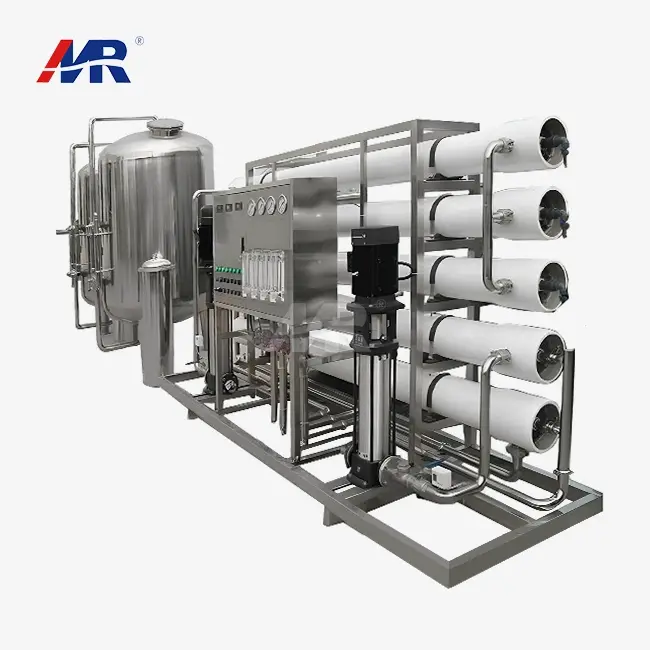
Get a Sizing Review Before You Buy. Send your feedwater report and daily demand to Morui at benson@guangdongmorui.com. Our engineers will confirm whether 3T/H reverse osmosis equipment fits your load. Buyers comparing 3T/H reverse osmosis equipment suppliers can also request drawings, membrane options, and delivery schedules through the same address.
What Is a 3T/H Reverse Osmosis System?
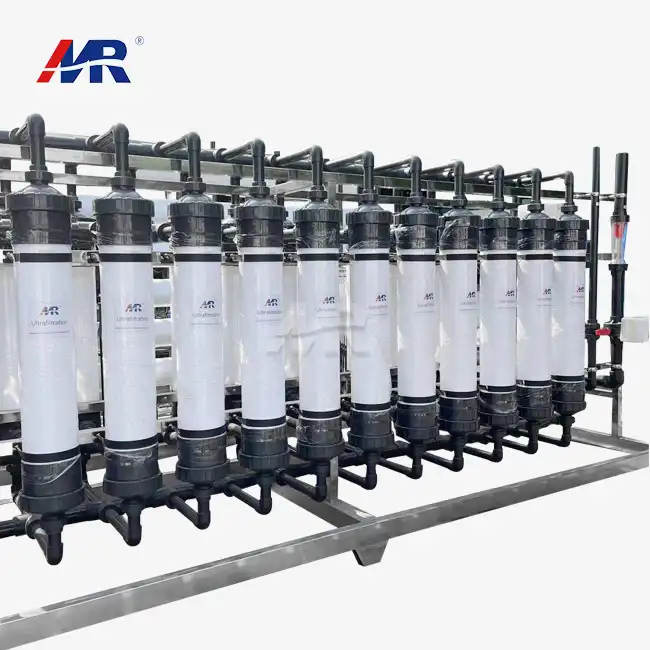
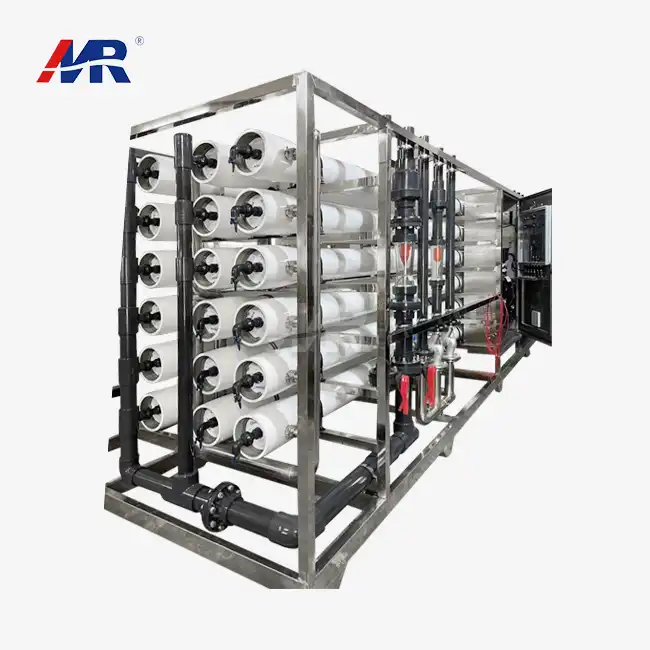
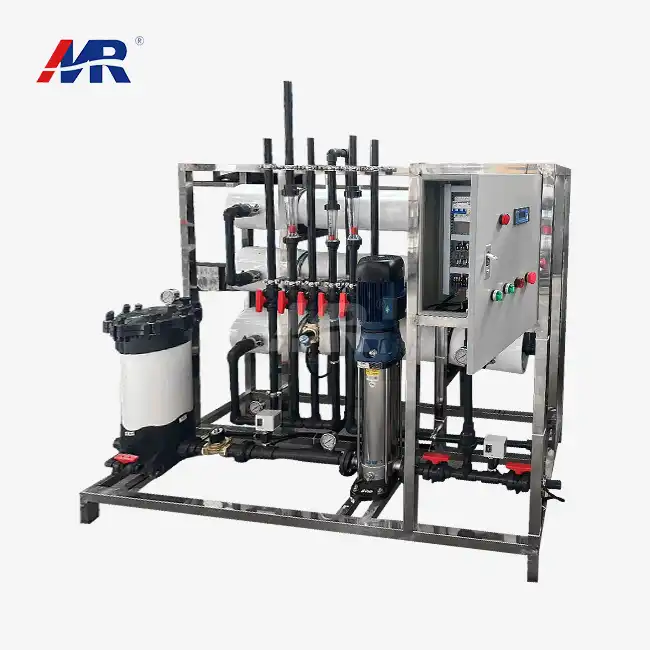
What is 3T/H reverse osmosis equipment? It is a packaged membrane treatment unit that produces 3 tons of purified water per hour. A high-pressure pump pushes feedwater across semipermeable membranes. The membranes hold back dissolved salts, organics, and fine particles. Clean permeate passes through, and a concentrate stream carries the rejected material to drain or reuse. At the recovery rate of up to 75% that Morui specifies, a 4 m³/h feed yields 3 m³/h of product and 1 m³/h of concentrate.
How Does a 3T/H RO Plant Work?
The process runs in five stages. Water passes through sediment and carbon filters that remove particles and chlorine. Chlorine matters because free chlorine above 0.1 mg/L can damage ro membranes. A high-pressure pump then drives the water into high-flux, low-fouling membranes. Post-treatment polishing improves the permeate for sensitive uses. Storage tanks and a distribution line hold the water ready for the plant. An intelligent control system runs the sequence, so operators watch a panel instead of turning valves.
What Do the Morui Specifications Include?
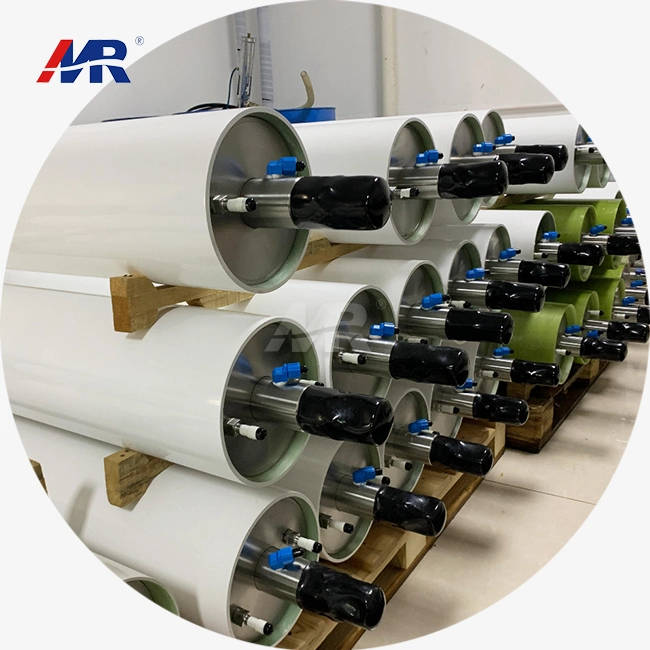
Morui's 3T/H reverse osmosis equipment combines 3 tons per hour of capacity, recovery up to 75%, and removal of up to 99% of dissolved solids. The frame uses high-grade stainless steel that resists corrosion. The layout is compact, so installation fits inside an existing utility room. Power use is tuned for efficiency, and the control panel supports fully automated operation. Buyers can also request custom configurations for a specific industry or feedwater.
Why Is 3T/H RO Suitable for Industrial Water?
3T/H reverse osmosis equipment sits in a practical middle range. It produces about 72 cubic meters per day during continuous operation. That volume covers a boiler house, a bottling line, or a laboratory complex. The 3T/H size works with standard 4040 or 8040 membrane elements, which keeps replacement parts easy to source.
The size also protects your equipment. Dissolved minerals form scale on heat-transfer surfaces and force extra boiler blowdown. Industry estimates for boiler feedwater RO cite 3 to 4 percent lower fuel cost and 4 to 5 percent less blowdown. They also cite 50 to 60 percent less chemical use. Those savings offset part of the operating budget.
Can a 3T/H System Handle Changing Demand?
Yes. 3T/H reverse osmosis equipment runs at full or partial output, so it follows daily or seasonal swings. When demand grows, you add another 3T/H skid in parallel. Two skids deliver 6 tons per hour and keep production alive while you service one unit. This staged path lets small and medium companies invest once and expand later.
How Does 3T/H RO Compare With Larger Systems?
Capacity choice shapes cost, footprint, and risk. The table below compares four common size classes. Daily output assumes 24 hours of operation. Use it as a planning guide, then confirm the numbers with your own demand data.
| Capacity class | Daily output (24 h) | Typical fit | Scaling approach | Main trade-off |
|---|---|---|---|---|
| 1T/H | 24 m³ | Laboratories, small food shops, clinics | Add units in parallel | Limited room for growth |
| 3T/H | 72 m³ | Mid-size factories, bottling lines, boiler feed, resorts | Add skids in parallel | Higher cost per m³ than large plants |
| 10T/H | 240 m³ | Large factories, hospitals, industrial parks | Multi-train design | Bigger pretreatment and capital outlay |
| 50T/H and above | 1,200 m³ and above | Municipal, power, and desalination projects | Engineered multi-train plant | Longer project schedule |
Larger plants lower the cost per cubic meter through scale. A study of Florida brackish water plants from 10,000 to 70,000 m³/day reported operating costs of USD 0.39 to 0.66 per m³. A unit of 3T/H reverse osmosis equipment makes 72 m³/day, so expect a higher cost per cubic meter. In return, you pay far less upfront and avoid idle capacity.
Morui supports this range with its own membrane production factory and several equipment processing factories. The company also acts as an agent for Shimge water pumps, Runxin valves, and Createc instruments. Pump, valve, and control parts come from one supply chain, which shortens lead times when you need spares.
What Water Quality Can 3T/H RO Equipment Achieve?
A well-designed 3T/H reverse osmosis equipment line removes up to 99% of dissolved solids. A feed with 1,000 mg/L of total dissolved solids produces permeate near 10 mg/L. That level suits boiler makeup, beverage blending, and many process rinses. Results still depend on feed chemistry, membrane age, and recovery settings.
Can One RO Pass Meet Pharmaceutical Standards?
Pharmaceutical users face tighter limits. USP purified water allows conductivity up to 1.3 µS/cm at 25°C and total organic carbon up to 500 ppb. The most common production train combines RO, electrodeionization, and ultraviolet treatment. RO removes the bulk of the ions and protects the polishing stages downstream. Morui adds post-treatment polishing to the workflow for exactly this reason.
What About Electronics and Ultrapure Water?
Electronics plants clean chips and boards with ultrapure water. RO forms the backbone of that system, and electrodeionization or mixed-bed polishing follows it. 3T/H reverse osmosis equipment gives a small component plant a dependable RO stage.
Which Industries Need 3T/H Reverse Osmosis Equipment?
Demand for 3T/H reverse osmosis equipment spans manufacturing, food, health care, energy, and public utilities. Morui lists electronics manufacturing, pharmaceutical production, food and beverage processing, municipal water treatment, industrial process water, and boiler feed water as core applications. The scenarios below show how the size fits real duty cycles.
Food and Beverage Plants
Bottled water and beverage lines need consistent taste and safe water. Here is a sizing example for 3T/H reverse osmosis equipment. A line that fills 20,000 one-liter bottles per shift needs 20 m³. A 3T/H unit produces that volume in about seven hours.
Pharmaceutical and Laboratory Users
Drug makers, hospitals, and research institutes use RO as the initial purification step. Dialysis and disinfection tasks in hospitals also depend on treated water. 3T/H reverse osmosis equipment suits a mid-size formulation site or a hospital block when polishing stages follow it.
Boiler Feed and Process Water
Power, petrochemical, and textile sites feed boilers with RO permeate to cut scale. The 3 to 4 percent fuel savings cited earlier apply here. 3T/H reverse osmosis equipment fits a single mid-size boiler house or a group of small boilers.
Municipal, Marine, and Remote Sites
Small water plants, island communities, and offshore platforms need compact, automated units. Brackish groundwater irrigation and aquaculture circulation systems also fit this size. Morui offers one-stop installation and commissioning.
What Feedwater Conditions Affect 3T/H RO Performance?
Any 3T/H reverse osmosis equipment performs only as well as its feedwater. Feedwater quality decides membrane life more than any other factor. In my experience, most performance complaints trace back to pretreatment, not to the membranes themselves. Manufacturers publish clear limits. The table below summarizes the guideline values from LG Water Solutions.
| Parameter | Guideline | Why it matters | Common fix |
|---|---|---|---|
| Silt density index (SDI, 15 min) | 5 or lower | Predicts colloidal fouling | Media and cartridge filtration |
| Turbidity | 1 NTU or lower | Cloudy water carries particles | Coagulation and media filters |
| Free chlorine | 0.1 mg/L or lower | Oxidizes and damages membranes | Activated carbon or bisulfite dosing |
| Ferric iron | 0.05 mg/L or lower | Iron deposits foul the surface | Oxidation and filtration |
| Total organic carbon | 2 mg/L or lower | Feeds biological growth | Carbon filtration |
| Oil and grease | None allowed in principle | Coats the membrane | Oil removal upstream |
| Langelier saturation index | 0 or lower without antiscalant | Signals scale risk | Antiscalant dosing or softening |
Manufacturers differ slightly. Aquaporin's manual also sets a 1 NTU turbidity limit and an SDI limit of 5. It allows total organic carbon up to 3 mg/L. Treat these values as targets, and share your own water analysis with your supplier before you order.
How Should You Pretreat Difficult Feedwater?
Start with a full water test that covers TDS, hardness, iron, chlorine, SDI, and organics. If the Langelier index runs above zero, add antiscalant or softening. Add carbon filtration where chlorine appears. Morui engineers design the pretreatment train around your report, so the RO stage receives water within the limits.
How Much Does a 3T/H RO System Cost to Operate?
Running 3T/H reverse osmosis equipment has five main cost parts: electricity, membranes, pretreatment consumables, cleaning chemicals, and labor. Electricity is the easiest to estimate. Take a 4 m³/h feed at 12 to 15 bar with 60% combined pump and motor efficiency. My calculation gives about 0.7 to 0.9 kWh per cubic meter of permeate. Seawater RO plants run much higher, at 2.5 to 4.0 kWh/m³, so confirm your source water type.
| Cost item | What drives it | How to estimate |
|---|---|---|
| Electricity | Pump pressure and feed salinity | About 0.7 to 0.9 kWh/m³ in the estimate above; roughly USD 0.07 to 0.09/m³ at USD 0.10 per kWh |
| Membranes | Feed quality and cleaning discipline | Well-maintained thin-film composite membranes last about 3 years |
| Pretreatment consumables | SDI, chlorine, and hardness | Cartridge filters, carbon, and antiscalant; cost rises with worse feedwater |
| Cleaning chemicals | Fouling frequency | Set by the cleaning schedule and pressure-drop trends |
| Concentrate and feed water | Recovery rate | At 75% recovery, 1 m³/h of the 4 m³/h feed leaves as concentrate |
| Labor and service | Automation level | Low, with an automated control system and remote support |
Concentrate deserves attention. Roughly 20 to 25 percent of feed goes to drain when no reuse exists. Also remember the scale point from earlier. The Florida figures of USD 0.39 to 0.66 per m³ come from plants hundreds of times larger. Use them only as a floor for comparison.
How Should You Select a 3T/H RO Equipment Supplier?
A good supplier sells a result, not a box. The best 3T/H reverse osmosis equipment purchase starts with a clear checklist for selecting an industrial RO plant. Buyers who work through these four checks avoid most post-installation surprises.
- Design from your water analysis. Ask for a written design that lists projected permeate quality, recovery rate, membrane count, and pretreatment steps. A supplier who quotes without seeing your feedwater report is guessing. Reject proposals that skip SDI, chlorine, and hardness data, because those numbers decide whether the membranes last one year or three.
- Component transparency. Request the brand and model of pumps, valves, instruments, and membranes. Morui manufactures membranes in its own factory and represents Shimge pumps, Runxin valves, and Createc instruments. Named components let your maintenance team source spares locally and compare quotes without guessing at hidden substitutions.
- Service capacity. Confirm who handles installation, commissioning, training, and spare parts. Morui operates more than 14 branches and employs 500 people, including 20 engineers. That footprint matters when a pump fails at night, and a remote site needs guidance. Ask each supplier for response times in writing.
- Build quality and documentation. Check the stainless steel grade, weld quality, and control panel wiring. Ask for material certificates, test records, and warranty terms. Verify company details on moruiwater.com and request references from buyers in your region. Clear paperwork signals a supplier that expects to be held accountable.
Once a supplier passes these checks, compare total cost over five years, not only the purchase price. Include membranes, consumables, and service.
Conclusion
3T/H reverse osmosis equipment suits plants that need about 72 cubic meters of clean water per day and want room to grow. Success depends on two habits: testing your feedwater and pretreating it to manufacturer limits. Buyers who follow those habits get membrane life near three years and predictable operating costs. Morui supplies this equipment with installation and commissioning, and you can reach the team at benson@guangdongmorui.com.
FAQ
1. How much water does a 3T/H RO system produce per day?
3T/H reverse osmosis equipment produces 3 cubic meters of permeate per hour. Running 24 hours gives 72 cubic meters daily. Real output drops with cleaning cycles, low feed temperature, and part-load operation, so plan storage for peak demand.
2. What recovery rate should I expect?
Morui specifies recovery up to 75%. That means a 4 m³/h feed produces 3 m³/h of permeate and 1 m³/h of concentrate. Higher recovery raises scaling risk, so your water analysis should set the final design value.
3. Can 3T/H reverse osmosis equipment supply a boiler?
Yes, with proper pretreatment. 3T/H reverse osmosis equipment supplies permeate free of most scale-forming minerals, which reduces blowdown and fuel use. High-pressure boilers may need extra polishing, so confirm the required feedwater conductivity with your boiler maker.
4. Does RO alone meet USP purified water limits?
Usually not. The limit of 1.3 µS/cm at 25°C often requires electrodeionization or mixed-bed polishing after RO. A 3T/H unit serves as the opening stage of that train.
5. Which feedwater tests should I complete before ordering?
Test TDS, hardness, iron, free chlorine, turbidity, SDI, total organic carbon, and the Langelier index. Send the results to your supplier so the design matches your water.
6. Can I expand capacity later?
Yes. You can add another 3T/H skid in parallel and share pretreatment and storage where the design allows. Tell your supplier about expansion plans early, so pipe sizes and electrical capacity leave room.
Ready to Size a 3T/H RO System With Morui?
Share your feedwater report, daily demand, and target water quality with Morui at benson@guangdongmorui.com. Our engineers will recommend a configuration and quote 3T/H reverse osmosis equipment for sale, with installation and commissioning. Whether you want a manufacturer, a supplier, or a full turnkey package, the team will reply with drawings, membrane options, and delivery timing.
References
1. LG Water Solutions (2025). Technical Applications Bulletin 106: Feed Water Quality Guidelines.
2. Aquaporin (2023). Industrial RO Element User Manual and Operation Guide.
3. Pearson, J.L., Michael, P.R., Ghaffour, N., Missimer, T.M. (2021). Economics and Energy Consumption of Brackish Water Reverse Osmosis Desalination. Membranes, 11(8), 616. https://www.ncbi.nlm.nih.gov/pmc/articles/PMC8399043/
4. Water Online (2018). Boiler Feedwater: Making the Case for Reverse Osmosis. https://www.wateronline.com/doc/boiler-feedwater-making-the-case-for-reverse-osmosis-0001
5. Feo-García, J., Pulido-Alonso, A., Florido-Betancor, A., Florido-Suárez, N.R. (2024). Cost Studies of Reverse Osmosis Desalination Plants in the Range of 23,000–33,000 m³/day. Water, 16(6), 910. https://doi.org/10.3390/w16060910
6. Lab Manager (2026). Pharmaceutical-Grade Water: Meeting USP Purified Water and WFI Standards in the Lab. https://www.labmanager.com/pharmaceutical-grade-water-meeting-usp-purified-water-and-wfi-standards-in-the-lab-35260