



Ultrafiltration Skid vs RO: Which System Fits Your Process?
An ultrafiltration skid fits your process when the main problem is turbidity, suspended solids, colloids, or bacteria. Reverse osmosis (RO) fits when you must remove dissolved salts, hardness, or ions. They solve different problems, so I never treat them as direct substitutes. In many plants, the best answer is both: the ultrafiltration skid cleans the feedwater, and RO polishes it. This guide compares the two technologies, shares the specifications of our Morui MR-UF-30TH for RO pretreatment, and lists the checks I suggest before you buy. Use it to match the right system to your water and your goals.
Start With the Treatment Objective
What an Ultrafiltration Skid Removes
If you want to do ultrafiltration, you need a membrane that works with low pressure. Straws, colloids, bacteria, and many viruses can't get through because it's made of hollow-fiber membranes with holes that are 0.01 to 0.1 microns wide. The U.S. Environmental Protection Agency (EPA) says that low-pressure membranes like UF can get rid of Giardia and Cryptosporidium in drinking water. People are given credit based on challenge tests and loyalty tests. The UF doesn't get rid of the salts, so it stays close to the feed. People should think of UF as a fine filter, not as a way to get rid of salt. If you use an ultrafiltration skid, your test result should show that there is a lot of sediment or bugs but good salt.
What Reverse Osmosis Removes
RO does not work the same way. Because its wall is so thick, it keeps out ions, hardness, many metals, and other small molecules that would raise TDS. Having that strength costs something. RO makes a stream of concentrate that you need to steer or let out. It's under a lot more pressure than UF. Also, RO filters get stopped up very quickly if the feed has particles, colloids, or bacteria in it. Because of this, companies that make membranes have strict rules about what kinds of water can go into them. The SDI should be less than 3 for a RO system to be safe to run. Most of the time, RO systems stop working quickly because they don't clean the water well enough first.
Where Each Technology Fits in Real Projects
It tells you a lot about the application. When drinking water in a city or town is cloudy or has germs in it, UF is the only way to clean it. It can also be used to clean swimming pool and farm water. Salts that have been dissolved are the only thing that can go wrong with clean feed. To treat industrial wastewater and recovered water, desalinate seawater, and clean boiler or process water, it is best to use a combination train. This sorts out both particles and dissolved salts. In these projects, the ultrafiltration skid stands in front of the RO unit to keep it safe. People often compare them by price, but the ro membrane's life depends on how well it was made. Once you know what you want to treat, get the tools you will need.
How an Ultrafiltration Skid Works
What Sits on the Skid
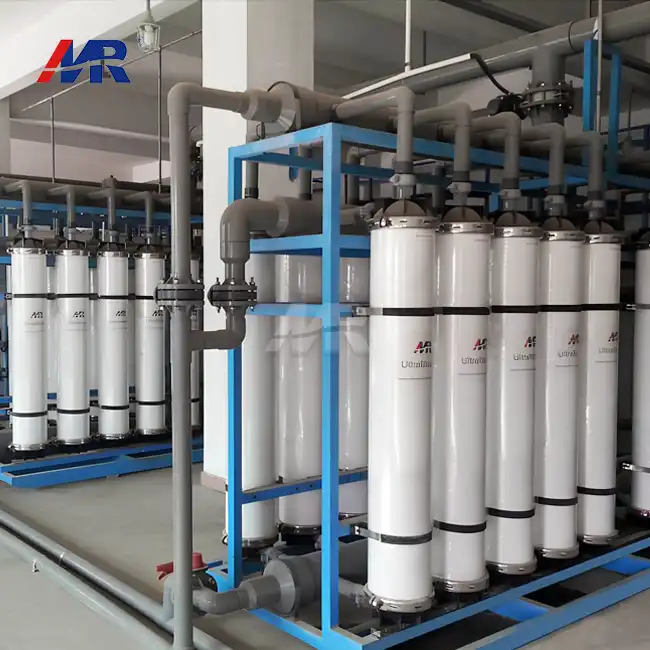
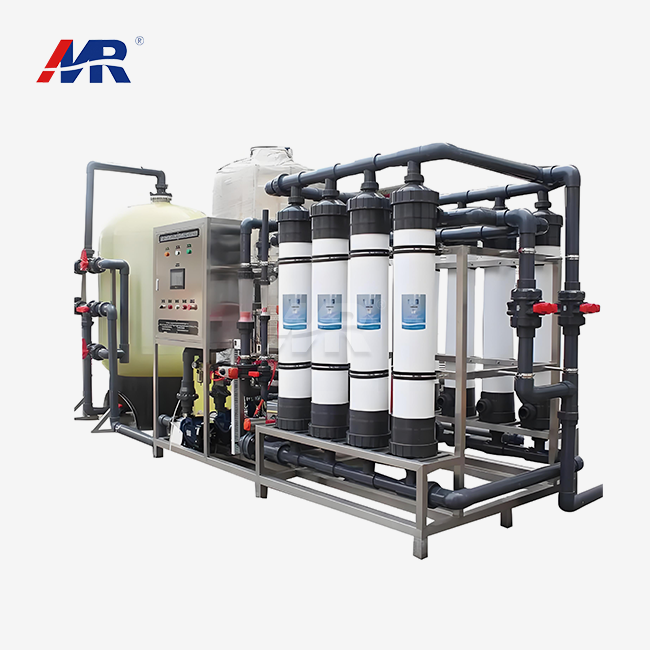
A "skid" is a unit that is already put together; all of its main parts are already attached to a frame. A lot of ultrafiltration skids come with a feed pump, sensors, a PLC control screen, and cleaning lines. They also have UF units made of hollow-fiber membranes. Before the unit is sent to the customer, it is lined up, wired, and tested at the plant. In the field, all that's left to do is connect the power, drain, input, and exit. When pipes are joined together on-site, they are more likely to work correctly and take less time to put together. Find out what kind of frame material will work best for your site. What Morui does is make its own membranes and plan how the skids will be set up around them. This way, the module and system always fit together perfectly.
How Filtration and Cleaning Cycles Run
The feed pump moves water through the hollow threads while the filtering is going on. It keeps the particles and germs inside, but water can get through. Transmembrane pressure (TMP) goes up as solids build up over time. It is the PLC that controls auto-backwashing. This changes the direction of the flow to get rid of the buildup on the membrane's surface. A lot of systems make it possible to clean-in-place (CIP), use air scrubbing, or boost the backwash with chemicals to get rid of tough dirt. The cleaning steps use a lot of water, which helps you get cleaner faster. Between 80% and 90% of the feed can be used again by this machine. This means that most of it can be used as water. The water is stored, filtered, or RO'd after it has been cleaned.
Numbers to Watch During Operation
A number of readings can be used to figure out how well UF is doing. Every day, check the turbidity, feed pressure, permeate flow, and TMP. The cleaning tool will work as long as the TMP stays the same. What does a quick rise in TMP mean? It means there is a lot of fouling, the pretreatment is weak, or the backwash is not finished. It is important to do integrity checks because a sudden rise in turbidity in the permeate could mean that a fiber is broken. The flux, which is the flow of permeate through a membrane, is another way to set the design. If the flux is low, fouling is less likely to happen, but the membrane area needs to be bigger. Let us know about the raw water, and we'll set the cleaning times and flow rate so that it works with groundwater, surface water, or secondary waste.
Ultrafiltration Skid vs. RO: Technical Comparison
Pressure, Energy, and Concentrate
How they handle pressure is the main difference between them. The MR-UF-30TH works at 0.2 to 0.3 MPa, which is about 2 to 3 bar. RO doesn't usually have enough power to get water through its thick membrane. A lot of the time, more power per cubic meter and bigger high-pressure pumps mean more pressure. More of the feed back is made as product if you only run backwash water through UF. You have to throw away the salty concentrate that comes out of RO. Companies that set flow limits need to know the difference. RO can still be used after UF, but UF alone can't get rid of RO. It just means it costs less to do the same job.
Water Quality Results
In simple terms, this is the difference in quality. UF extract is much less likely than feed to have particles, silt, germs, and colloids. Things don't change much about how salty it is or how hard it is. RO water has a lot less TDS, hardness, and ions. You can get a clear stream at UF that is safer for germs to clean further. Whether you need water for drinking, process rinses, or boiler feed, RO is the best choice. There are also many things that need to be cleaned. If you clean UF, you get rid of particles and organics. If you clean RO, you get rid of biofouling and scale. Make sure that each choice fits with the water quality goal you wrote down.
MR-UF-30TH Specifications for RO Pretreatment
The MR-UF-30TH is an ultrafiltration skid with hollow-fiber membranes that is used to make RO water. When it works at 0.2 to 0.3 MPa, it needs 5.5 kW of power and gets back 80 to 90% of that power. Some plants need strong RO water but don't need a lot of power. This range works well for them. We can talk about the material (like PVDF or PES) and the size of the pores in terms of your raw water, since Morui makes its own membranes. It is possible to change the structure of the box or container, the control system, and the way things are monitored from afar. A RO train from the same company can also be used with the skid. We'll see if this model fits your flow after you send us your water work.
Choosing, Running, and Buying the Right System
Decision Guide: UF, RO, or Both
Use three questions.
- Are the germs and particles the problem in the first place? Pick UF.
- In the second place, is it the ions, the hardness, the dissolved salts, or the silica? Check the feed for dirt before you choose RO.
- Third, do both issues happen when water is used in a process, desalinated, or used again? Pick a train that goes by ultrafiltration skid and RO.
Before you buy, find out about the site's conditions, its maximum flow rate, its recovery goal, how it will handle concentrates, its utilities, and an analysis of the feedwater. You can also let it do some things for you while you watch from afar. When the raw water changes with the seasons, you might want to do a quick test. This test lets you see how the membranes work before you decide.
Maintenance and Lifecycle Cost
A UF system stays the same if you do the same things every day. Write down the flow, pressure, and turbidity every day, and check the alarms once a week. Pick how long to wait between backwashes based on how long the machine has been running, how much the flow has dropped, or how much the pressure has gone up. Also, check to see if the cleaners are safe for the foulant and the membrane material. Strong cleaners can damage some plastics. A lot of problems happen, like not enough backwash, bad preparation, unsteady feed pressure, and giving the wrong amount of chemicals. Not only do you pay for the unit itself, but also for things like replacing the membrane, power, cleaning chemicals, labor, extra parts, and getting rid of the wastewater. MR-UF-30TH gives you a clear electricity number of 5.5 kW, which you can use to do the math. If you have extra parts on hand, you can fix things faster.
Procurement Checks for U.S. Buyers
Buy-ins from the US often need money and tools. You should ask for a flow chart of the process, a list of the tools, the membrane's datasheet, instructions on how to clean it, an inventory of extra parts, and a way for the plant to test it. Make sure that any parts that come in contact with the water meet NSF/ANSI 61 or your state's standards if people are going to drink it. Be sure you know what the terms are for getting the electricity, shipping it, installing it, training the workers, and getting help from far away. For a fair price, the first step is to do a water study in the lab. Along with the price, there should be a list of what is not included and the design flow, recovery, working pressure, and expected permeate quality. We'll tell you what we can do to assist you with your job. Just tell us what form of paper you need.
Conclusion
Based on what you want to get rid of, you can pick between an ultrafiltration skid and a RO system. When the pressure is low, UF gets rid of colloids, bacteria, a lot of viruses, and solids that are floating in the water. Rising pressure makes RO get rid of dissolved salts, hardness, and ions, which makes the stream more concentrated. They need to work together to fix them so that different projects that use, desalinate, and deal with water can go ahead. The uf membranes protect the RO membranes. It works with 0.2 to 0.3 MPa of pressure, has 5.5 kW of power, and has an 80–90% recovery rate, so the MR-UF-30TH is a good choice for this pretreatment job. Look at the water, make clear goals for treatment, make a plan for upkeep, figure out how much it will cost over its whole life, and keep all of your records.
FAQ
1. Can an ultrafiltration skid replace RO?
No, UF doesn't get rid of salts that have already been broken down. Bugs, dust, dirt, and many kinds of sickness are killed by it. You still need RO even if your process needs less hardness or low conductivity. A lot of plants choose UF over RO.
2. Is UF a good pretreatment for RO?
Yes. UF does lower turbidity, suspended solids, and the number of microbes in the water. This makes it less likely that RO membranes will get clogged. The MR-UF-30TH takes the RO water and gets it ready to use. It also helps the RO feedwater stay steady.
3. What are the MR-UF-30TH specifications?
At 0.2 to 0.3 MPa, it needs 5.5 kW of power to work and can return 80% to 90% of its weight. The ultrafiltration skid is made of thin strands and gets the water ready for RO.
4. Can Morui customize the system?
Yes. We can talk about PVDF or PES membranes, pore size, automated tracking from afar, and a UF and RO train that works together based on the test results of your water.
5. What data do I send for a quote?
Send your water source, lab test results, your needed flow, your high demand, the type of water you want, your business hours, and an address where the water can be provided. These details will help our experts come up with a good setup.
Match Your Process With a Morui Ultrafiltration Skid
A company called Morui Environmental Technology Co., Ltd. in Guangdong can help you decide whether to use a UF, RO, or combined train. Our company makes ultrafiltration skids and has its own membranes, 20 engineers, and more than 14 branches. We help with planning, setting up, and starting up. If you want to learn more about the MR-UF-30TH, email benson@guangdongmorui.com with your water analysis and flow goal.
References
1. Membrane Filtration Guidance Manual, U.S. Environmental Protection Agency, 2005
2. Water Quality and Treatment: A Handbook on Drinking Water, American Water Works Association, 2011
3. Pretreatment for Reverse Osmosis Desalination, Elsevier, 2017
4. Basic Principles of Membrane Technology, Kluwer Academic Publishers, 1996
5. Membrane Technology and Applications, Wiley, 2012
6. Wastewater Engineering: Treatment and Resource Recovery, McGraw-Hill Education, 2014
 VIEW MOREosmosis drinking water system
 VIEW MOREro edi system
 VIEW MOREContainerized Mobile Water Treatment Systems
 VIEW MOREindustrial ultrafiltration systems
 VIEW MOREbioreactor wastewater treatment
 VIEW MOREadvanced wastewater treatment system
 VIEW MORELandfill Leachate Treatment System
 VIEW MOREuf ultrafiltration