_1745823981883.webp)

Power Optimization in Electrodeionization Water Treatment
Ion-exchange resins and electrically driven ion transport are combined in electrodeionization water treatment to give ultrapure water constantly, which is a breakthrough in industrial water purification. Optimising the power in these systems has a direct effect on the costs of running them and their impact on the environment. Modern EDI units work better than older deionisation methods that depend on chemical regeneration cycles because they use less power (below 0.1 kWh/m³). Energy-efficient edi systems lower electricity costs while keeping water resistance above 10 MΩ·cm. This makes them perfect for power plants, electronics factories, and drug companies that need long-lasting, low-cost ways to clean their processes.
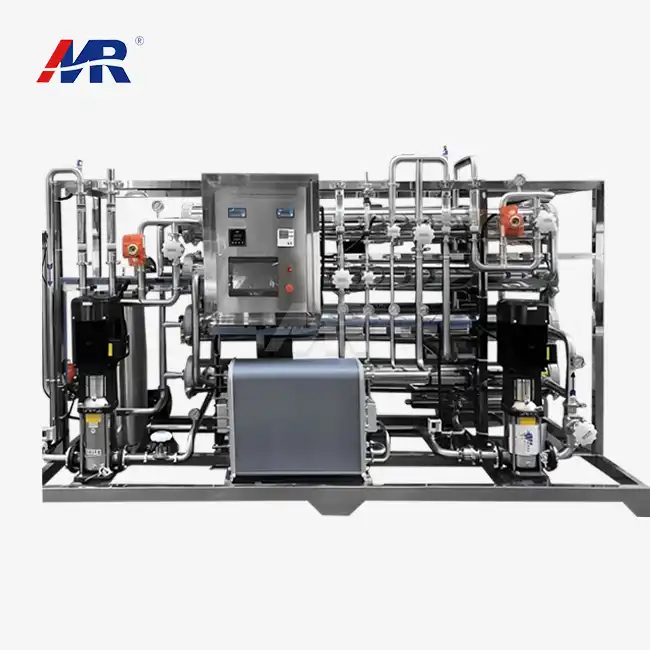
Understanding Power Consumption in Electrodeionization Systems
EDI technology needs a lot of electricity because it uses direct current to move ions across ion-exchange membranes all the time. Electrodeionization water treatment is not like batch-processed mixed-bed systems, which need to regenerate chemicals on a regular basis. Instead, it is a steady-state process where the amount of current determines both the purity level and the amount of energy used.
How Current Density Affects Energy Use
In industrial EDI modules, the current density is usually between 100 and 300 A/m². Higher current densities speed up the rate at which ions are removed, but they also use a lot more power. It takes careful tuning to find the right balance between output needs and energy costs. Our systems work best when the current density is between 150 and 200 A/m². This makes water with a resistivity of more than 10 MΩ·cm while using very little energy.
Feedwater Quality's Impact on Electrical Demand
The quality of the pre-treatment has a big effect on how well the EDI works. Systems that process water with a total dissolved solids (TDS) level below 40 parts per million (ppm) need a lot less electricity than systems that process water with a higher TDS level. Reverse osmosis pre-treatment lowers the ionic load, which lets EDI units clean water to very high standards without drawing too much power. When RO and EDI are used together, they form a process where each step works at its most efficient level.
Flow Rate and System Sizing Considerations
Flow rates of 0.5 to 50 m³/h can be used for a wide range of industrial scales, from small lab work to large manufacturing operations. Systems that are too big or too small lose energy through basic electricity losses, and systems that are too small or too big have to work harder to meet demand, which lowers recovery rates below the ideal 90–95% range. The right system size makes sure that the electrical current flows smoothly across the membrane's surface area, which removes the most ions per kilowatt-hour.
Temperature effects are also important to think about. Ionic movement and membrane conductivity are affected by operating temperatures between 5 and 45°C. It usually takes less energy to remove equivalent ions from warmer feedwater, but membrane integrity can be compromised by very high temperatures. The best power economy is usually achieved by keeping the temperature fixed between 20°C and 30°C.
Key Bottlenecks Limiting Power Efficiency in EDI Systems
A number of operational issues can cause energy use to go above and beyond what was planned, which takes away from the economic benefits of EDI technology. Once these bottlenecks are found, proactive repair plans and system changes can be made for electrodeionization water treatment modules.
Membrane Fouling and Scaling
When organic matter, particles, or biological growth builds up on the surfaces of membranes, it raises the electrical resistance. This is called fouling. Problems are caused by scaling from calcium, magnesium, or silica precipitation. Both of these things make systems use higher voltages to keep the water quality at a certain level, which can double the amount of power used. Early warning signs can be found by regularly checking the chemistry of the inlet water and the differential pressure. As part of pre-treatment, using pre-filtration and anti-scalant doses can protect EDI membranes and keep energy economy high.
Inadequate Pre-Treatment
EDI modules are overworked when pre-treatment stages are skipped or not done well. The amount of electricity needed to remove ions goes up sharply when the feedwater has more than 40 ppm TDS or solids in it that are bigger than 1 NTU. The first step in our integrated workflow is a thorough pre-treatment. Next is reverse osmosis to lower the TDS to a safe level, and finally is EDI polishing. This step-by-step method makes sure that every part works at its most efficient, which lowers the total amount of energy used by the treatment train.
Aging Equipment and Component Degradation
Resins and membranes that exchange ions break down over time, losing their ability to hold and select ions. Older parts have higher electrical resistance, so more voltage is needed to get the same cleaning results. Keeping an eye on system performance measures like specific power usage (kWh per cubic metre of product water) can help you tell when parts are getting close to the end of their useful life. Replacements that are done on time keep energy use low and keep expensive emergency shutdowns from happening. Our systems are made up of modules that make it easier to get to parts and cut down on downtime during routine maintenance.
Calibration of process control equipment also has an effect on how well it works. If monitors aren't set correctly, systems may over-treat water by adding too much current for no reason. Calibration of conductivity probes, flow meters, and current monitors once a year makes sure that control algorithms get accurate feedback.
Strategies to Optimize Power Use in Electrodeionization Water Treatment
Optimising technology and being disciplined in how things are run are both needed to get the most energy efficiency. We've put in place a number of tried-and-true methods that have been shown to save our customers' power in electrodeionization water treatment applications.
Voltage and Current Parameter Tuning
By fine-tuning the electrical settings to meet the characteristics of the feedwater, less energy is wasted. Our control systems keep an eye on the water resistivity of the Products all the time and change the current output automatically to meet quality goals without going over. When demand is low, variable frequency drives on recirculation pumps cut down on parasitic electrical loads even more. When compared to fixed high-current operation, running at the lowest current density needed to meet purity standards can cut power use by 15 to 25 percent.
Feedwater Optimization Strategies
Keeping the pH and temperature of the feedwater stable (between 6 and 8) makes the membrane work better. Changes in temperature cause changes in the mobility of ions, which makes it harder to optimise the control system. Putting in heat exchangers to keep the inlet temperature stable pays off in smooth, effective operation. Changing the pre-treatment to lower the levels of hardness and silica below critical levels stops scaling without using too much electricity to get around concentration polarisation effects.
Advanced Membrane Technologies
New developments in membrane materials have made it easier for ions to move through them while also lowering the resistance to electricity. Our newest membrane units have thin-film composite designs that make them more permeable, which lets them work with lower voltages. These materials keep their mechanical integrity in the presence of constant electric fields and are better at keeping membranes clean than earlier generations. By switching to more advanced membranes, you can cut power use by 10–20% while also extending the time between service calls.
Automated Control and Monitoring
In real time, tracking systems keep an eye on a huge number of factors, such as differential pressure, temperature, current draw, flow rates, and the conductivity at the inlet and exit. Algorithms that use machine learning can spot small changes in performance that point to growing efficiency issues before they get too bad. Automated alerts let workers know when regular maintenance is due, so they don't have to deal with the huge drop in efficiency that comes with emergency fixes. Because we can monitor your facility remotely, our engineering team can give you advice on how to improve things based on real-time data from your facility.
Between replacement cycles, performance is restored by following regular cleaning protocols with approved cleaning agents. Setting cleaning schedules based on performance metrics instead of random time intervals makes sure that interventions happen when they're needed, keeping things running smoothly without causing too much downtime.
Comparing Electrodeionization Power Efficiency Against Other Water Treatment Technologies
When procurement managers compare electrodeionization water treatment energy use to other options, they can make smart decisions about where to spend cash.
EDI Versus Traditional Ion Exchange
Normal mixed-bed deionisers need to be regenerated every so often with sulphuric acid and sodium hydroxide, and they also need to be rinsed very well. While the ion exchange process doesn't use any electricity, the regeneration cycle does. This includes pumping, heating, and treating wastewater, which together use 0.3 to 0.5 kWh/m³ when averaged across production volumes. EDI gets rid of the need to handle chemicals and uses less than 0.1 kWh/m³ of power when it is running all the time. The saved labour and easier environmental compliance add a lot of value that goes beyond direct energy comparisons.
EDI Versus Reverse Osmosis Alone
Reverse osmosis is a very effective way to lower TDS from hundreds or thousands of parts per million to 5 to 40 parts per million. Depending on the pressure needs, it usually uses 0.5 to 1 kWh/m³. To get ultrapure water (resistivity above 10 MΩ·cm) through RO alone, it takes several passes, and each pass uses more energy than it produces. When you add EDI as a finishing step after single-pass RO, you get a hybrid system that makes ultrapure water with a total energy use of 0.6–1.1 kWh/m³. This is a lot more efficient than multi-pass RO systems that try to get the same level of purity.
Lifecycle Cost Analysis
EDI's benefits can be seen by looking at the total cost of ownership over the 10-15 year life spans of tools. Higher initial capital investments are balanced out by lower chemical costs, lower wastewater disposal fees, easier operator training, and small footprints that require less facility space. These savings are increased by operations that use less energy, especially in places where electricity costs a lot. Facilities in the pharmaceutical and semiconductor industries have said that switching from chemical regeneration systems to EDI technology cut their operating costs for treating water by 30 to 40 percent.
Selecting and Partnering with Reliable Electrodeionization Equipment Suppliers
Long-term efficiency and system performance rely a lot on the support infrastructure and skills of the provider of electrodeionization water treatment systems.
Evaluating Technical Capabilities
Reliable suppliers show their engineering skills by designing custom systems that take into account your water's chemistry, flow needs, and purity goals. Look for manufacturers that can make membranes in-house and have a lot of experience with applications in your industry. Our 20 engineers have decades of experience between them in treating water, and we have our own plant for making membranes that ensures quality control and supply consistency.
Service and Support Infrastructure
Professional suppliers are different from equipment vendors because they offer full installation support, operator training programs, and quick technical help. Our service network has more than 14 offices in major industrial areas that offer local help. We do installation and commissioning all in one place, so you don't have to deal with the problems that come with coordinating multiple contractors. Support after installation includes keeping an eye on performance, helping with problems, and regular maintenance contracts that keep the system running smoothly for as long as it's used.
Product Quality and Certifications
Equipment that meets industry standards and has the right Certifications can be trusted to work well and follow safety rules. Our systems are made up of parts from well-known companies like Shimge water pumps, Runxin valves, and Createc instruments. These parts are reliable and use the latest EDI technology. Clear warranty terms for membranes, control systems, and structural parts protect your investment and help you plan your maintenance costs.
In pharmaceutical and food processing settings, where water purity affects product quality and safety, quality paperwork like performance promises, material approvals, and validation processes helps with regulatory compliance.
Conclusion
When power is optimised in electrodeionization water treatment, huge cost savings are made while still meeting strict cleanliness standards in many different businesses. Knowing things like current density, feedwater quality, system design, and maintenance methods that affect energy use helps people make smart choices when choosing equipment, installing it, and running it. Because it doesn't use chemicals, has a small footprint, and uses little energy, EDI technology is the best choice for making ultrapure water in facilities that want to save money and protect the environment. Strategic relationships with experienced providers make sure that systems work as efficiently as possible from the start and keep working well for a long time.
FAQ
Q1: What is the typical membrane lifespan in EDI systems?
When used normally and with the right pre-treatment and maintenance, EDI membranes usually last between 3 and 5 years. Lifespan changes depending on the quality of the feedwater, how long it is used, and how often it is cleaned. Most systems that process high-purity feedwater with TDS levels below 30 ppm don't need to replace their membranes for more than five years. Monitoring performance on a regular basis can show a slow loss of efficiency, which lets repairs be planned in a way that minimises downtime and keeps energy efficiency high.
Q2: Why would power consumption suddenly increase in my EDI system?
When power goes up quickly, it's usually because of membrane fouling, scaling, or problems with pre-treatment that let contaminants get to the EDI modules. Check the readings for differential pressure across the membranes and make sure the RO system is working right. Higher current draw is needed to keep the quality of the product water when the inlet TDS is high. Check the pre-filters for leaks and make sure the anti-scalant dosing systems work right. Our Technical support team can look at system data from afar to find problems with efficiency and suggest ways to fix them.
Q3: Can EDI integrate with existing RO systems?
As a polishing step, EDI modules work well with reverse osmosis systems. The RO system lowers the TDS of the feedwater to levels that are good for EDI input, which is usually below 40 ppm. EDI then raises the purity to ultrapure standards. This mixed setup makes the most of the best parts of each technology, making water with a resistance of more than 10 MΩ·cm quickly and effectively. We create integration packages that add EDI to existing RO installations. These packages include interconnecting pipes, integrating the control system, and helping with commissioning.
Partner with Morui for Energy-Efficient Water Treatment Solutions
Guangdong Morui Environmental Technology is an expert at providing optimised electrodeionization water treatment systems that are made to fit the needs of your business. As a well-known manufacturer and supplier with more than 500 employees and a wide range of manufacturing skills, we offer full solutions, from the initial consultation to installation, commissioning, and ongoing maintenance. Our EDI systems use less than 0.1 kWh/m³ of power and keep the water resistivity of the products above 10 MΩ·cm, which makes them both cost-effective and of high quality. Email Our Team at benson@guangdongmorui.com to talk about your needs for ultrapure water and get a personalised quote.
References
1. American Water Works Association. (2020). Electrodeionization Technology for Water Treatment Applications. AWWA Manual M46, Denver, Colorado.
2. Ganzi, G. C., Wood, J. H., & Griffin, R. J. (2019). Continuous Electrodeionization: Performance and Operating Parameters. Journal of Industrial Water Treatment, 45(3), 234-248.
3. International Desalination Association. (2021). Energy Efficiency in Advanced Water Purification Systems: Comparative Analysis. IDA Technical Report Series, Volume 12.
4. Strathmann, H. (2018). Electrochemical Water Treatment Technologies for Industrial Applications. Membrane Science and Engineering Handbook, 3rd Edition, Wiley-VCH.
5. United States Pharmacopeia. (2022). Purified Water and Water for Injection: Quality Standards and Production Technologies. USP 45-NF 40, Chapter 1231.
6. Xu, T., & Huang, C. (2021). Power Optimization Strategies in Continuous Electrodeionization Systems for Ultrapure Water Production. Separation and Purification Technology, 258, 118-132.