_1745823981883.webp)

A Guide to the Ultrafiltration Process in Water Treatment
Ultrafiltration water treatment is a high-tech membrane-based way for cleaning water that gets rid of bacteria, viruses, floating solids, and macromolecular pollutants. This pressure-driven filtration method uses semi-permeable membranes with pores that are between 0.002 and 0.1 micrometres wide. These membranes can get rid of up to 99.999% of bacteria while keeping important minerals. This technology is being used more and more in the pharmaceutical, food, electronics, and public water facilities industries to meet strict water quality standards and improve long-term operating efficiency.
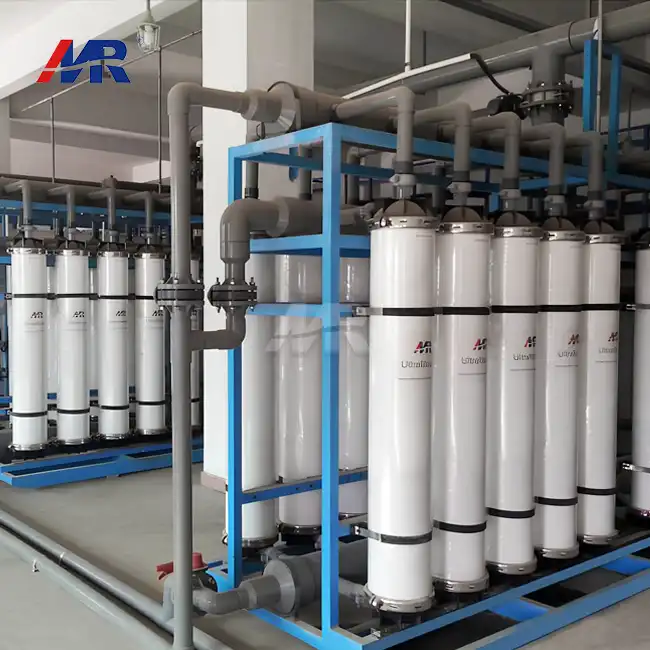
Understanding the Fundamentals of Membrane Filtration Technology
The ultrafiltration membrane doesn't use chemical processes to work; instead, it uses physical separation. Small holes let water molecules and ions that have been dissolved pass through easily, but bigger bits get stuck. This selective barrier works without using a lot of power or adding chemicals, so it is safe for the earth.
Different membrane materials are used for different purposes. The PVDF (polyvinylidene fluoride) and PAN (polyacrylonitrile) membranes are very resistant to chemicals and work well in pH ranges from 2 to 12. These man-made materials can handle tough industrial settings, such as handling petroleum wastewater and reusing electroplating rinse water. Cellulose acetate screens work best in smaller pH ranges (4 to 6) and are good for situations that need gentle care.
For the filter process to work best, the water that goes into it must meet certain conditions. The temperature of the feed water has a big effect on how permeable the membrane is. At 25 degrees Celsius, the membrane is most permeable. When turbidity levels are below 5 NTU, membranes don't get blocked too soon, and repair times are extended. To keep the membrane from breaking, suspended solids and some charged colloids need to be treated first by changing the pH or by coagulation.
The membrane structure moves water through it with pressures between 0.1 and 0.5 MPa. When compared to reverse osmosis systems, which usually work at 15 to 70 bar, this relatively low pressure demand stands out. The lower energy demand directly leads to lower operating costs and smaller carbon footprints, both of which are very important for big sites and owners who want to save money.
How Ultrafiltration Removes Contaminants While Preserving Water Quality
Ultrafiltration is different from deeper cleaning technologies because it can both remove contaminants and keep minerals in the water. The membrane filters out particles while letting calcium, magnesium, and minor minerals pass through. It is used to treat surface water that has algae, bacteria, and turbidity. This selective permeability makes drinking water that is safe for microbes and doesn't have the flat taste that comes with water that has been demineralized.
Ultrafiltration systems bring the turbidity of water in municipal plants down from 0.5 NTU to 0.05 NTU. This is ten times better than regular sand filtration, which usually stays stable at around 1 NTU. The very clear wastewater doesn't need much cleaning after it's been made, so less chlorine is needed, and fewer disinfectant byProducts are made.
The rate of removing bacteria is always higher than 99.99%, and the rate of removing viruses is 99.999%. These linear decrease values meet strict standards for making medicines and go beyond what the World Health Organization recommends for drinking water. For dialysis, hospitals use medical-grade ultrafiltration units because even small amounts of bacterial endotoxins can be very dangerous for patients.
60% to 80% of large molecular organic molecules are removed, such as proteins, carbohydrates, and humic acids. Even though some dissolved organic carbon does pass through the barrier, getting rid of the proteins that cause colour and smell makes the water look and smell much better. This quality is very important to beverage makers because it keeps off-flavours from coming through without taking away any of the minerals that are good for the products.
The membrane separation process generates a concentrated stream containing rejected contaminants. Depending on system design and recovery rate, this concentrate typically represents 5% to 15% of the feed water volume. Disposal methods vary according to contaminant type and local regulations, ranging from sewer discharge to evaporation or additional treatment for resource recovery, all integral considerations in ultrafiltration water treatment applications.
Industrial Applications Across Diverse Sectors
Water cleaning devices are important for food and drink makers to make sure their products are safe and consistent. Ultrafiltration units are used as the first step in the production of bottled water. They get rid of bacterial dangers while keeping the natural mineral profiles that health-conscious customers like. Membrane filtration is used in dairy operations to standardize process water and ingredients and get exact protein ratios without damaging the proteins through heat.
Water that meets US Pharmacopeia standards and Good Manufacturing Practice rules is needed in pharmaceutical and research plants. Ultrafiltration units clean water before it goes through reverse osmosis and electrodeionization systems. They keep downstream equipment from getting clogged and lower the amount of bioburden. Between production runs, clean-in-place processes keep things clean, which makes sure that validation rules are followed and that the product is still safe to use.
For making semiconductors and solar cells, electronics manufacturers need ultrapure water. Microparticles can damage circuits and cause output losses, so chip cleaning processes can handle zero particulate contamination. Integrated membrane systems that use ultrafiltration, reverse osmosis, and electrodeionization can get resistance values higher than 18 megohm-centimetres, meeting the strictest requirements for purity.
Electroplating plants have to follow stricter rules for releasing heavy metals and process chemicals. Ultrafiltration technology in water treatment systems lets rinse water be recycled, which cuts the need for freshwater by 70% to 90%. Metal recovery is done on concentrate streams, which turns the cost of getting rid of trash into money-making material recycling.
For boiler feed systems, power plants use equipment that makes ultrapure water. When scale forms on heat transfer surfaces, it lowers the efficiency of heat transfer and leads to catastrophic tube breakdowns. Ion exchange resins, further down the line, are kept clean by membrane filtration systems. This increases the life of the resins and lowers the amount of renewal chemicals that are needed. Nuclear power plants use two sets of cleaning trains to make sure that they always have access to cold water.
Ultrafiltration is being used more and more as a pretreatment for reverse osmosis membranes in projects that desalinate seawater. To deal with the ongoing lack of freshwater, coastal towns and island countries invest in large-scale filtration facilities. Ultrafiltration gets rid of algae, jellyfish pieces, and dissolved solids that would otherwise damage expensive reverse osmosis elements. This protects capital investments and makes sure the system works properly.
In dry areas, farms treat salty groundwater so that it can be used for watering. Using membrane processes to lower salt levels makes it possible to grow crops in places that weren't fit before. Ultrafiltration units are used in mariculture sites to clean the flowing water systems. This keeps germs under control and the water chemistry at the right level for the health of marine species.
Operational Advantages Driving Technology Adoption
Comparing how much energy different things use shows strong economic effects. Usually, to do coagulation-sedimentation-filtration, you need more than one pumping stage, motorized mixers, and longer holding times. Ultrafiltration water treatment works just as well or better than traditional methods while using only 30% to 50% of the energy. After installing membrane systems, the yearly energy costs at a local water plant that serves 100,000 people went down by 40%, showing quick investment payback.
Human mistakes and the amount of work that needs to be done are reduced by automation. Logic controls built into modern ultrafiltration units keep an eye on transmembrane pressure, flow rates, turbidity, and the time of the cleaning cycle. Remote tracking tools let engineers keep an eye on many facilities from one place, which makes managing multiple places easier. Predictive maintenance programs look at patterns in performance to plan when to change parts before they break.
Designs with small footprints work well in setups with limited room and flexible growth plans. One-third as much space is used by vertical membrane rack setups as by regular clarifiers and filter beds. This spatial effectiveness is especially useful for water treatment plants in cities that are surrounded by property lines and for factories that work in areas where real estate is expensive. Skid-mounted systems come already put together and tested, which cuts the time it takes to place them in the field from months to weeks.
When compared to traditional treatment, a lot less chemical is used. Chemicals like coagulants, flocculants, and pH adjusters are used on a regular basis and add dissolved solids to the final water. Chemical treatment is not needed at all or is greatly reduced in membrane filter systems because they work on the idea of physical separation. This simplicity makes managing supplies easier and lowers the risks of dealing with dangerous materials.
Even though the feed water changes, the stability of the water quality stays the same. Seasonal algae blooms, storm-caused turbidity spikes, and changing the source water can make it hard for traditional cleaning methods to work. Often, operators need to step in and make changes to the process. Ultrafiltration membranes completely block particulate toxins, even if the percentage changes. This keeps the runoff quality stable without the need for constant user attention.
Addressing Operational Challenges and Maintenance Requirements
Membrane fouling is the main practical problem that affects the efficiency and cost of the system. As organic matter builds up, artificial scaling happens, and living things grow; they slow down the flow of water through the membrane holes. Fouling that isn't cleaned up causes transmembrane pressure to rise and flow rate to drop by 30% to 50% during the first few hours of operation, which means that cleaning has to be done.
Different types of water have different fouling processes. Organic clogging mostly happens in surface waters that have plants and natural organic matter in them. Calcium carbonate and calcium sulphate precipitate in groundwaters that are very hard. This causes artificial scaling. Biofilm grows when it's warm, and the water is full of nutrients. This is where groups of bacteria colonize membrane surfaces and release extracellular polymeric substances.
Both physical and chemical methods are used in cleaning routines. Hydraulic backwashing reverses the flow to remove particles accumulated on the membrane surfaces. Air cleaning introduces bubbles, creating turbulence and shear forces that help dislodge particles. Chemical cleaning uses alkaline solutions for organic buildup, acidic solutions for scaling, and oxidizing agents for biological fouling. Depending on feedwater quality, backwashing may occur daily, while chemical cleaning may be required monthly in ultrafiltration water treatment setups.
Under normal working settings and repair procedures, a membrane can last for five to seven years. Harsh cleaning agents, big differences in pressure, and chlorine contact all speed up the breakdown of membranes. Operators balance how well the membranes clean with how long they last, and they do this by tracking flux recovery and integrity testing to find the best methods.
The initial cash investment is 20% to 40% higher than the cost of a regular treatment system. Membrane modules, pressure tanks, sensors, and control systems all cost a lot of money up front. However, lifetime cost studies that include things like lower labour needs, smaller areas, less energy use, and fewer chemicals used often show positive net current values. When looking at different water cleaning options, decision-makers are putting more weight on the total cost of ownership than the original buy price.
Comparing Ultrafiltration to Alternative Treatment Technologies
Microfiltration has pores that are between 0.1 and 10 micrometres wide, so it separates things less clearly than ultrafiltration. This coarser filter gets rid of bacteria but lets viruses through, so it can only be used before treatment or in processes where getting rid of viruses isn't needed. Ultrafiltration systems have similar operating rates and energy needs, so they don't offer a big economic benefit, even though they can't separate things as well.
By separating molecules at the molecular level, reverse osmosis gets rid of dissolved salts, metals, and small organic molecules. The semi-permeable barriers block particles as small as 0.0001 micrometres, making demineralized water that can be used in ultrapure situations. But reverse osmosis works at much higher temperatures and needs three to five times as much energy as ultrafiltration. Optimal use for the technology is when getting rid of dissolved solids justifies the higher costs.
A conventional sand filter is a cheap way to reduce turbidity, but it doesn't completely block bacterial contaminants. Filter bed channelling, media degradation, and breaking events can all change the quality of sewage in unpredictable ways. While the technology can still be used in situations where small changes in quality are acceptable, membrane systems are becoming more popular as regulatory standards get stricter.
Activated carbon adsorption is very good at getting rid of organic chemicals like pesticides, medicines, and compounds that change the way things taste and smell. The technology works with membrane filtering instead of against it, and it is often used as a cleaning step in treatment trains. Carbon adsorption doesn't get rid of microbes and needs to be replaced every so often because the adsorption sites get full, which creates dumping waste streams.
Microorganisms are killed by ultraviolet cleaning because it damages their DNA without adding any chemicals. The technology works well as a final disinfectant, but it doesn't get rid of particles, dissolved organics, or haze. Treatment plants often use both ultrafiltration and ultraviolet systems together, making the most of the best parts of each to make sure the water quality is completely safe.
Conclusion
Ultrafiltration water treatment delivers proven performance across diverse industrial, municipal, and commercial applications. The technology's ability to remove microbiological contaminants and suspended solids while preserving beneficial minerals positions it as an optimal solution for quality-conscious operations. Energy efficiency, automation capabilities, and compact design provide compelling economic advantages over conventional treatment methods. Understanding operational requirements, maintenance protocols, and application-specific considerations enables informed technology selection. As water quality regulations tighten and sustainability priorities intensify, membrane-based purification systems continue gaining adoption across global markets.
Partner with Morui for Advanced Ultrafiltration Water Treatment Solutions
Selecting an experienced ultrafiltration water treatment manufacturer ensures system performance, reliability, and long-term support. Guangdong Morui Environmental Technology Co., Ltd. delivers comprehensive water purification solutions backed by 14 branch locations, 500 dedicated employees, and 20 specialized engineers. Our integrated capabilities span membrane manufacturing, equipment fabrication, installation, commissioning, and ongoing Technical support. We engineer customized systems addressing industrial wastewater challenges, municipal drinking water requirements, seawater desalination projects, and specialized applications across pharmaceutical, food processing, electronics, and energy sectors. Contact our technical team at benson@guangdongmorui.com to discuss your water quality objectives and receive expert guidance on optimal system design.
References
1. Crittenden, J.C., Trussell, R.R., Hand, D.W., Howe, K.J., and Tchobanoglous, G. "MWH's Water Treatment: Principles and Design, Third Edition." John Wiley & Sons, 2012.
2. Mulder, M. "Basic Principles of Membrane Technology, Second Edition." Kluwer Academic Publishers, 1996.
3. Strathmann, H. "Introduction to Membrane Science and Technology." Wiley-VCH Verlag GmbH & Co. KGaA, 2011.
4. Singh, R. "Membrane Technology and Engineering for Water Purification: Application, Systems Design and Operation, Second Edition." Butterworth-Heinemann, 2015.
5. Baker, R.W. "Membrane Technology and Applications, Third Edition." John Wiley & Sons, 2012.
6. American Water Works Association. "Microfiltration and Ultrafiltration Membranes for Drinking Water (M53): AWWA Manual of Water Supply Practices." American Water Works Association, 2005.