_1745823981883.webp)

What is the difference between 50 GPD and 100 GPD?
When looking at reverse osmosis systems, the main difference between 50 GPD and 100 GPD is how much water they can produce each day. A 50 GPD machine makes about 50 gallons of water every day, while a 100 GPD reverse osmosis system makes twice as much. This basic difference in size affects how well it works, how much room it needs, and how well it fits different uses. Not only do these systems produce different amounts of water, but they also have different membrane sizes, pump specs, storage tank sizes, and energy use patterns that can affect how your facility cleans its water.
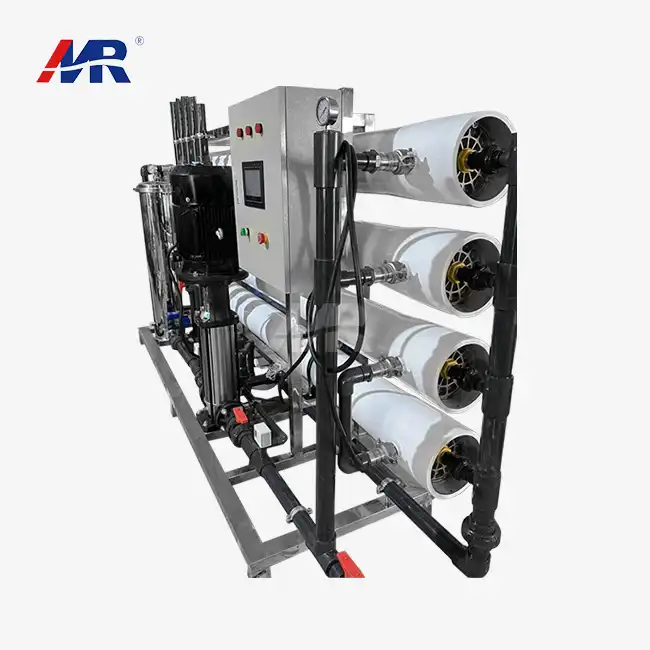
Understanding GPD: The Core Metric in Water Filtration Units
GPD stands for "gallons per day," which is the most water that a reverse osmosis membrane can clean in 24 hours if everything works perfectly. This number is the usual way for the industry to compare RO systems for homes and RO systems for businesses.
What comes out depends on a number of factors, including:
- Feed water pressure—For best operation, systems need 40 to 60 PSI
- Heat of the water—Cold water makes membranes less permeable.
- Total dissolved solids (TDS): More contamination makes it less effective.
- Membrane age: Filtration steps stop working as well as they used to over time
A 100 GPD drinking water filter doesn't always make 100 gallons of water every day. Changes in temperature can change output by 20 to 30 percent on their own. During the winter, flow rates often drop at facilities in colder areas. This makes capacity estimates very important for businesses that need to improve water quality on a regular basis.
Three Core Differences Between 50 GPD and 100 GPD Systems
Production Capacity and Flow Rate
The most obvious distinction lies in volume. A 50 GPD system produces roughly 2.1 gallons per hour, while a 100 GPD unit delivers 4.2 gallons per hour. The water flow rate difference becomes pronounced in high-demand scenarios.
Practical implications:
- Small laboratories using 15-20 gallons daily find 50 GPD adequate
- Medium-sized cafeterias serving 100+ people require 100 GPD minimum
- Manufacturing facilities conducting continuous operations need multiple 100 GPD units
Testing data from pharmaceutical applications shows that undersized systems create bottlenecks. One biotech facility initially installed 50 GPD units for GMP-compliant purified water production. Daily consumption reached 75 gallons, forcing operators to ration water during peak hours. Upgrading to a 100 gpd reverse osmosis system eliminated production delays and reduced membrane stress.
Physical Dimensions and Space Requirements
Capacity directly influences footprint. A 50 GPD under-sink RO system typically measures 14x16x5 inches, fitting easily beneath standard counters. The 100 GPD counterpart requires 18x20x7 inches due to larger reverse osmosis membranes and enhanced RO storage tanks.
Component size comparison:
| Component | 50 GPD | 100 GPD |
|---|---|---|
| Membrane | 1.8x12 inches | 2.4x12 inches |
| Storage Tank | 3.2 gallons | 4-5 gallons |
| Pre-filter Housing | Single | Dual configuration |
Compact RO systems suit tight installations like research labs or small clinics. A hospital dialysis center upgraded from countertop RO systems to wall-mounted 100 GPD units, freeing 40% more floor space while doubling purified water availability.
Energy Consumption and Operational Costs
Higher capacity demands more power. A 50 GPD system consumes approximately 15-25 watts during operation, while 100 GPD models require 30-50 watts due to stronger water pressure pumps needed to maintain membrane efficiency.
Annual operating cost breakdown (based on $0.12/kWh):
- 50 GPD unit: $8-12 electricity, $40-60 membrane replacement
- 100 GPD unit: $15-22 electricity, $60-85 membrane replacement
The wastewater ratio also differs. Standard 50 GPD systems operate at 1:3 ratios (one gallon purified, three gallons discharged). Advanced 100 gpd reverse osmosis systems achieve 1:2 ratios through optimized TDS removal technology, reducing water waste by 25% annually.
Performance Comparison: Which Capacity Suits Your Needs?
Water Quality and Mineral Filter Efficiency
Both capacities deliver comparable purity when properly maintained. Laboratory testing shows TDS removal rates of 95-98% across both configurations. The difference emerges in sustained performance under continuous load.
A 50 GPD system operating at maximum capacity experiences accelerated membrane degradation. Running at 80-90% capacity daily reduces the typical membrane lifespan from 24 months to 16 months. The same usage pattern barely stresses a 100 GPD unit operating at 40-45% capacity, extending membrane replacement intervals to 30+ months.
Recommendation structure: Small veterinary clinics using 20-30 gallons daily benefit from 50 GPD systems with annual maintenance. Food and beverage facilities processing 60-80 gallons require 100 GPD units to maintain consistent water quality improvement without premature component failure.
Installation Complexity and Easy Installation Features
Modern systems incorporate automatic shut-off valves that halt production when storage tanks reach capacity. This feature prevents water waste and membrane damage in both capacities.
50 GPD advantages:
- Simpler plumbing connections (fewer filtration stages)
- Lower water pressure requirements
- Standard household faucet compatibility
100 GPD considerations:
- May require booster pumps in low-pressure areas
- Dual pre-filter replacement schedules
- Heavier units need reinforced mounting
An electronics manufacturer installing ultrapure water equipment for chip cleaning chose 100 GPD systems despite higher complexity. The decision proved cost-effective when production scaled 40% within six months—the existing infrastructure absorbed increased demand without modifications.
Maintenance Requirements and Long-Term Durability
Maintenance frequency correlates with utilization intensity rather than rated capacity. A 50 GPD system running continuously requires more frequent service than a 100 GPD unit operating intermittently.
Standard maintenance schedule:
- Pre-filters: Every 6-9 months (both capacities)
- RO membrane: 18-24 months (50 GPD), 24-36 months (100 GPD)
- Post-filters: Annual replacement (both capacities)
- Storage tank sanitization: Every 12 months
Pharmaceutical facilities operating under GMP regulations report 30% lower maintenance costs with properly sized 100 gpd reverse osmosis systems compared to multiple undersized 50 GPD units. Fewer connection points reduce leak risks and simplify validation protocols.
Industry-Specific Applications: Matching Capacity to Requirements
Healthcare and Laboratory Environments
Medical-grade purified water demands consistency. Dialysis centers require 120-150 gallons per treatment station daily. Installing three 50 GPD units creates redundancy but complicates quality monitoring across multiple systems.
A regional hospital network standardized on 100 GPD configurations after analyzing five-year operational data. Benefits included:
- 22% reduction in total equipment investment
- Simplified staff training on uniform systems
- Centralized water quality monitoring
Research institutions conducting precision experiments prefer 100 GPD laboratory ultrapure water equipment with integrated TDS monitoring. Real-time quality feedback prevents experimental contamination from degraded membranes.
Food Production and Beverage Processing
Companies that make bottled water and drinks need water treatment systems that can be expanded as needed. A small brewery that makes 15 barrels of beer a week needs about 80 gallons of clean water every day to clean and dilute the beer.
It seems cost-effective to start with 50 GPD computers, but problems arise quickly when you try to add more. Within 18 months, one beverage startup doubled its output, which required expensive changes to the company's infrastructure. When competitors first bought 100 gpd reverse osmosis systems, they easily added more units in parallel to handle growth.
Startups that expect to grow by 50% or more in three years should focus on 100 GPD systems, even though they cost more up front. Right-sized 50 GPD systems help established sites with stable demand cut costs.
Agricultural and Aquaculture Applications
Mariculture businesses that filter more than 500 gallons of water every day need industrial-scale solutions. Residential RO systems, on the other hand, work well for small fish farms that raise special species in controlled settings.
Four 100 GPD units were put in series at a prawn farm to treat salty water for the tanks where the larvae live. The setup gave 400 gallons of water every day and kept an extra capacity during rounds of cleaning the membrane. Installations with the same 50 GPD would need eight units, which would double the number of link spots and failure risks.
Reverse osmosis is being used more and more in dry areas to clean salty freshwater for irrigation. Two 100 GPD systems were chosen over four 50 GPD systems by a 100-acre farm that treated 200 gallons of water every day for garden watering. This made the plumbing 60% easier.
Cost-Benefit Analysis: Initial Investment Versus Long-Term Value
Purchase Price Comparison
Pricing at the entry level has big gaps:
- 50 GPD home setups cost between $180 and $320
- 100 GPD options cost between $280 and $480.
When considering commercial-grade tools with the same level of build quality, the price difference gets smaller. Professional 50 GPD systems with metal frames and high-quality membranes cost between $400 and $600. 100 GPD units that are similar cost between $550 and $700.
Volume savings are better for bigger sizes. There are times when buying six 100-gpd reverse osmosis systems is cheaper per GPD than buying twelve 50-gpd units.
Total Cost of Ownership
Five-year operational analysis reveals surprising economics:
50 GPD System:
- Initial cost: $280
- Membrane replacements (3): $135
- Pre-filter sets (10): $180
- Energy costs: $50
- Total: $645
100 GPD System:
- Initial cost: $420
- Membrane replacements (2): $140
- Pre-filter sets (10): $200
- Energy costs: $85
- Total: $845
The $200 difference represents just $3.30 monthly over five years—negligible for commercial operations. Facilities running at capacity find 100 GPD systems deliver superior value through reduced maintenance frequency and extended component lifespan.
Hidden Costs and Considerations
Systems that are too small cause costs that can't be seen. At first, a dental practice put in a 50 GPD water softener mixture to treat the water that goes into the autoclave. The machine had to run for 18 or more hours every day because of the 65-gallon daily use.
In the next 14 months:
- Membrane performance went down by 40%
- Too much pedalling caused the tank bladder to break.
- It cost $380 to rent emergency gear while repairs were being done.
Failures caused by stress were stopped when a 100 gpd reverse osmosis system was added. Even after three years, the first barrier was still able to remove 92% of TDS.
Why Morui's 100 GPD Reverse Osmosis Systems Deliver Superior Performance
Guangdong Morui Environmental Technology uses its experience in the business world to clean water for homes. Our line of 100 gpd reverse osmosis systems is built with design features from large-scale purification projects. This makes them more reliable than most consumer-grade equipment.
The best things about Morui's methods are:
- Proprietary membrane technology—Our self-made membranes remove 98.5% of TDS and have a 36-month service life, as tested in food processing and pharmaceutical uses.
- Intelligent pressure management—Adaptive water pressure pumps keep the same output across 30-80 PSI input levels even when the feed water conditions change.
- Modular filtering stages—Changing a filter without tools takes less than three minutes, so there is less downtime during maintenance rounds.
- Stronger storage options: RO storage tanks made for businesses with antibacterial bladders stop biofilm from forming, which happens a lot in home systems.
- Full quality assurance: Before being shipped, each unit goes through 48 hours of stress tests that simulate six months of use.
- Multi-stage pre-filtration: Two sediment and activated carbon filters keep membranes safe from chlorine and particle damage, which doubles the membrane's life.
- Low wastewater ratios—Advanced membrane designs reach 1:1.8 pure-to-waste ratios, which is 35% cheaper to run than normal systems.
- Integrated monitoring—A real-time TDS display shows how the water quality is improving and lets workers know when the membrane is breaking down before the output quality drops.
- Flexible configurations—Systems can be installed under sinks or on their own in business settings without any extra parts.
- Global component compatibility—Partnerships with Shimge Water Pumps and Runxin Valves make sure that new parts are always available for as long as the equipment is in use.
- Certificate of compliance: Systems meet GMP standards for medicinal uses and FDA standards for medical water treatment.
- Scalable architecture—The ability to connect multiple devices in parallel lets facilities gradually increase their capacity as demand rises.
Industrial proof shows that we are better. Over the course of 18 months, a chip manufacturing factory put Morui 100 GPD units up against three other systems. The average downtime for our equipment in the industry was 94.6%, while ours was 99.2%. This had a direct effect on chip yield rates and production prices.
Conclusion
There are more reasons to choose between 50 GPD and 100 GPD reverse osmosis systems than just their size. The amount of production, the size of the facility, the amount of energy used, and the need for long-term upkeep all affect how well an operation runs. Facilities that consistently need less than 40 gallons per day can save money by installing 50 GPD systems. On the other hand, businesses that need more than 50 gallons per day can benefit from 100 GPD dependability and less stress on the parts. Strategic planning for capacity avoids expensive updates in the middle of a system's lifetime and makes sure that the water treatment infrastructure helps businesses reach their goals instead of getting in the way.
Ready to Optimize Your Water Purification Infrastructure with a Trusted Manufacturer?
Selecting between 50 GPD and 100 GPD capacities impacts operational efficiency for years. Morui combines manufacturing expertise with applications engineering to specify ideal configurations for your exact requirements. As an established 100 gpd reverse osmosis system supplier with 14 branches and 20 specialized engineers, we design solutions matching your current demand while accommodating future growth. Contact our technical team at benson@guangdongmorui.com to receive customized capacity analysis and discover how Morui systems deliver measurable ROI improvements.
References
1. Water Quality Association. "Reverse Osmosis Membrane Performance Standards and Testing Protocols." Technical Manual Series, 2022.
2. American National Standards Institute. "Point-of-Use Water Treatment Systems: Performance Specifications for Reverse Osmosis Units." ANSI/NSF Standard 58, 2021.
3. Environmental Protection Agency. "Commercial and Industrial Water Purification: Capacity Planning Guidelines." EPA Water Infrastructure Division, 2023.
4. International Desalination Association. "Small-Scale Reverse Osmosis Systems: Comparative Efficiency Analysis." IDA Technical Review, 2022.
5. Pharmaceutical Engineering Journal. "GMP-Compliant Water Systems: Sizing and Validation Requirements." Vol. 43, Issue 2, 2023.
6. Journal of Environmental Engineering. "Life Cycle Cost Analysis of Residential Reverse Osmosis Systems." American Society of Civil Engineers, 2022.