



What Makes a New RO System More Efficient for Industry?
A new ro system becomes more efficient for industry when it turns more feed water into usable permeate, holds salt rejection steady, and uses less energy, chemicals, and labor for each unit of output. Efficiency comes from the whole design, not from the membrane alone. Pretreatment, pump selection, control logic, and maintenance planning all shape the result. I wrote this guide for plant managers, engineers, and EPC contractors who want to judge a reverse osmosis system by measured performance and lifecycle cost. I use the Morui MR-BWRO-50TH for pharmaceutical water production as the working example.

How a New RO System Improves Water Purification Efficiency
Start With a Measured Baseline
I ask buyers to rate how well the current plant works before I compare any offers. It can be helpful to have numbers for things like permeate flow, salt rejection, working pressure, energy use, cleaning frequency, and downtime. Facts about feed water are just as important. The amount of pretreatment a membrane needs depends on how hard it is, how much silica, iron, chlorine, and solids are in the fluid. The seasons can change these things. The buyer can write down the water quality readings before and after pretreatment. This helps the engineer figure out what size equipment is needed in the real world. They can also see how much they said they would save against how much the old plant actually used in this step.
Pretreatment Protects Membrane Performance
Screens stop working when scale, particles, or chlorine get on top of them. A good pretreatment step includes media filters, activated carbon, antiscalant dosing, and cartridge filters. These are all chosen with the help of the feed-water report. Each part does something. Carbon gets rid of oxidants that hurt polyamide membranes, antiscalant slows down mineral deposits, and cartridge filters catch small particles before they get to the high-pressure pump. This document from the U.S. Environmental Protection Agency talks about fouling and the part that pretreatment plays. The people who work at the company see the same trend every day. It takes less time and chemicals to clean the membrane, and it lasts longer. This is where most of the real gain in efficiency can be seen.
Pumps, Controls, and Real-Time Monitoring
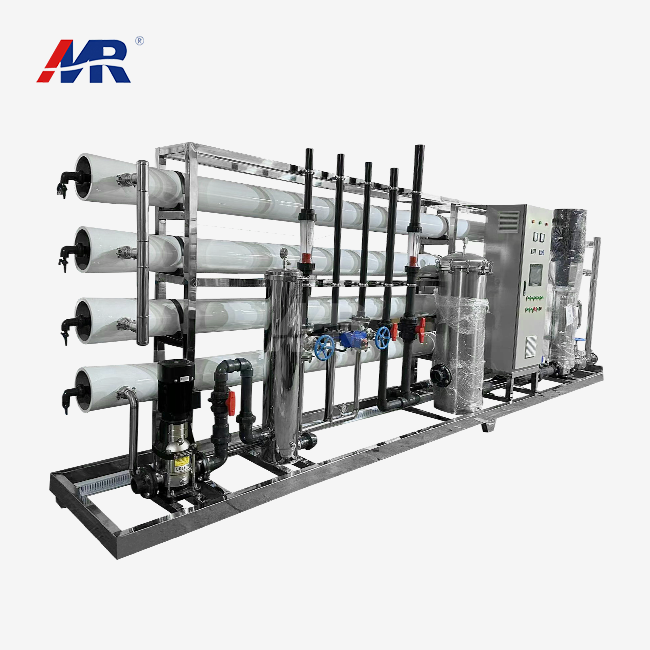
A lot of the power on a RO skid goes to the high-pressure pump, so getting the right size and making sure the pump works well are very important for cost. Changes in demand can be met by variable-frequency drives instead of valves that slow flow. It has buttons that let you add a new layer. People who work with a PLC that has monitors for temperature, flow, conductivity, and pressure can see how rejection and recovery change over time. They know about drift before it stops production because of alarms. Monitoring from afar lets an expert look at data without having to stand on the skid. A review by Elimelech and Phillips in 2011 in Science says that one of the major costs of distillation is the energy used. This is the reason why the pump and control new ro system need to be carefully planned.
Applying the MR-BWRO-50TH to Pharmaceutical Water Production
Model Specifications at a Glance
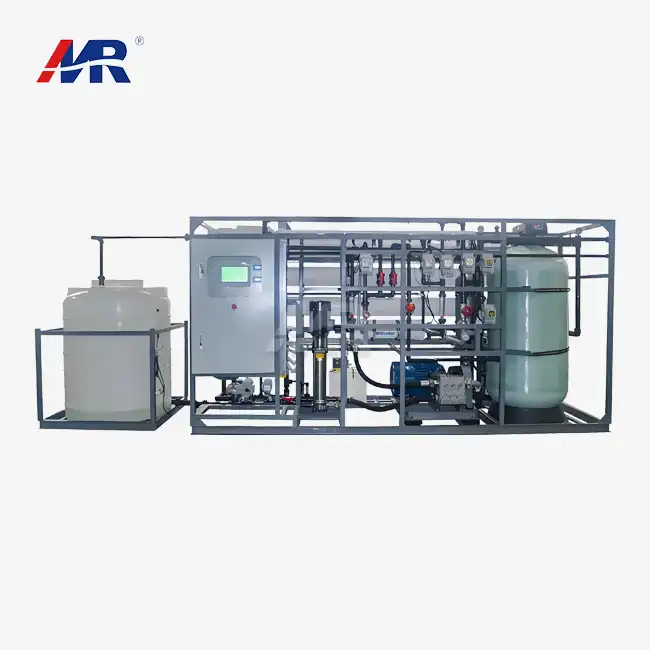
It is a full reverse osmosis system that was set up here to make water for pharmaceutical use. It is said to use 55 kW of power, reject 99% of salt, and have a recovery rate of 55 to 65%. That's a good way for a buyer to figure out how much it will cost to run, how much water it will need, and how good the permeate will be. Morui builds the system as a membrane-based desalination plant, which means it can work with either salty water or freshwater. It can also be changed to fit the customer's raw water report. When I sell something, I always tell people that the feed water, the pretreatment, and the working conditions all affect the quality of the final permeate. That's why we check these things out before choosing a configuration.
What a 55–65% Recovery Rate Means in Practice
Recovery is the amount of feed water that is converted into permeate. For every 100 gallons of feed that is 55 to 65%, 55 to 65 gallons of liquid are made. It leaves as a mixture with the other 35 to 45 gallons. If the rejection is almost total, the concentration is about 2.2 to 2.9 times more concentrated than the feed because it contains the salts that were turned down. That's why there's a safe cap on healing. If you raise it, it can get scaled, so you have to clean it more often and with more force. A salt rejection rate of 99% means that only 1% of the dissolved salts get through. A drug factory might add polishing steps further down the line to get the water it needs.
Where the System Fits in a Pharmaceutical Treatment Train
Drug factory water systems usually have more than one stage, and RO is usually in the middle. By getting ready, the membranes are kept safe upstream. To finish the job, you have to polish, store, distribute, and keep an eye on the work further down the line, depending on the grade the site needs. What the US Pharmacopeia says about water used in drugs and the FDA's Guide to Inspections of High Purity Water Systems don't talk about water as a single machine. The water is instead seen as a system that can be controlled. That's the view I think buyers should keep. This step is taken care of by the MR-BWRO-50TH. Our engineers can talk about the other parts to make sure the whole line fits the customer's plan for validation.
Answering Common Concerns Before You Place an Order
Verify Efficiency Claims With Testing
People who want to buy something in the US often ask for proof that they own it first, which makes sense. There are three places to check speed claims. When you get to the plant, check the stated capacity, recovery, rejection, operating pressure, part specs, and alarm features. Test the new ro system with low, normal, and high demand for water and write down the permeate conductivity, flow, and pH in the system. While the system is running, keep an eye on the standardized permeate flow, salt rejection, pressure drop, and fuel use. When the normal flow starts to slowly go down, that's an early sign of fouling. Cleaning can start before the flow goes down. Ask each seller what records and test reports come with the gear.
Plan Maintenance and Spare Parts
No matter how well it was planned, the new RO system needs to be serviced regularly. The workers need to check for leaks, make sure the pressure gauges are working properly, listen for any odd sounds coming from the pumps, and look back at past alarms. Not just the date should tell you when to change the capsule filters. You should also look at the water quality and pressure drop. When normalized performance goes down, use chemicals that are safe for the membrane material to clean them. Service life isn't a single number because it depends on the quality of the feed, the number of hours it is used, the pretreatment it goes through, and how well it is maintained. You should plan ahead and check with the seller to make sure they have seals, sensors, valves, filters, membranes, and cleaning chemicals in stock. It helps that Morui has its own plant for making membranes, which keeps it stocked.
Choose a Manufacturer That Can Customize and Document
They should tell you more than just the price. Guangdong Morui Environmental Technology is a company that has been around for 25 years and has 14 branch companies, 500 workers, 20 engineers, its own membrane production plant, and a number of equipment processing plants. We offer both OEM and ODM services, so we can either use the customer's raw-water report to suggest parts and steps in the process, or we can use the customer's own design to make a finished skid. Pumps, controls, instruments, pipe materials, and online tracking can be added or taken away at any time. Make tools, Runxin valves, and Shimge water pumps are some of the other things we sell. A company that sells to distributors and EPC contractors can find out about technical files, wait times, and warranty terms before they place an order.
Conclusion
You can get a better new ro system if you build the whole treatment line around conditions that you measure. The amount of pretreatment is set by the analysis of the feed water. It is stable because of protected membranes, and pumps and controls that work well save time and energy. The MR-BWRO-50TH uses 55 kW of power, recovers 55–65% of that power, and rejects 99% of salt. This tells buyers how much it costs to run, how much water it needs, and the quality of the permeate it makes for making healing water. Recovery can only go so far, and because of the salt passage, steps further downstream are still necessary. The equipment is tested in the factory, put into use on-site, and kept track of all the time. Regular maintenance is then done to keep it in good shape. In the real world, this means less trash, more stable water quality, and an easier way to compare prices between service providers.
FAQ
1. What makes a new RO system more efficient than an older unit?
Better preparation, the right-sized pumps, automatic controls, and a recovery goal that doesn't go over the limits of scale. They used less energy, chemicals, and wastewater for every gallon of permeate.
2. Is the MR-BWRO-50TH suitable for pharmaceutical water production?
It is ready for that use with a salt rejection rate of 99% and a return rate of 55–65%. The final water grade depends on the feed water, how it is prepared and cleaned further downstream, and what the customer needs for proof.
3. What information do you need for a quotation?
Please send your report on the quality of the raw water, the flow rate you need, the quality you want the permeate to be, your working plan, the site's conditions, and any changes you need, such as controls or monitoring from afar.
4. Can Morui customize the system?
Yes. Based on your needs, we can add or take away pumps, controls, instruments, piping materials, and monitoring from afar. We do both OEM and ODM work.
Request a New RO System Quote From Morui
Contact Morui if you want to buy a new RO system from a company that has its own membrane plant and offers OEM/ODM engineering. We will look at the MR-BWRO-50TH or a configuration that is made just for your site if you email benson@guangdongmorui.com with your raw-water report, flow target, and project details. Just let us know what you need, and we'll get back to you with a plan.
References
1. Water Research, 2009. Greenlee, L. F., et al., "Reverse Osmosis Desalination: Water Sources, Technology, and Today's Challenges."
2 Science, 2011. Elimelech, M., and Phillip, W. A., "The Future of Seawater Desalination: Energy, Technology, and the Environment."
3. U.S. Environmental Protection Agency, 2005. Membrane Filtration Guidance Manual.
4. U.S. Food and Drug Administration, 1993. Guide to Inspections of High Purity Water Systems.
5. United States Pharmacopeia–National Formulary, 2023. General Chapter <1231> Water for Pharmaceutical Purposes.
6. Balaban Desalination Publications, 2007. Wilf, M., The Guidebook to Membrane Desalination Technology.
 VIEW MORELandfill Leachate Treatment System
 VIEW MORE80 40 ro membrane
 VIEW MOREreverse osmosis plant
 VIEW MOREindustrial sewage treatment plant
 VIEW MORE5m3/hour seawater desalination equipment
 VIEW MOREcontainerized ro system
 VIEW MOREcontainerized desalination plant
 VIEW MOREultrafiltration water treatment system
