

_1745823981883.webp)

What Is the Wastewater Treatment Secondary Treatment Process?
Wastewater treatment secondary treatment is a biological purification stage that follows primary sedimentation, where indigenous aquatic microorganisms—primarily bacteria and protozoa—consume biodegradable organic contaminants in a controlled environment. This process dramatically reduces Biological Oxygen Demand (BOD), Chemical Oxygen Demand (COD), and Total Suspended Solids (TSS), typically achieving removal efficiencies between 85% and 95%. The biological stage transforms dissolved organic matter into biomass and stable end Products, protecting receiving water bodies from oxygen depletion and safeguarding public health.
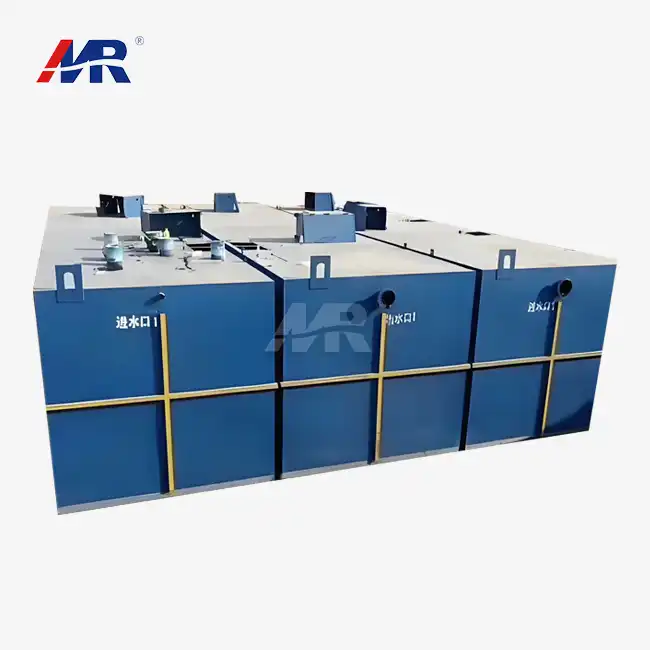
Understanding Secondary Treatment in Wastewater Treatment
The metabolic heart of modern wastewater treatment plants is secondary treatment. In contrast to the earlier stages of mechanical separation, this phase uses living things to break down pollutants that can't be physically removed by screening or gravity settling.
The Biological Foundation of Secondary Treatment
The microorganisms that make secondary treatment systems work are their heart. Heterotrophic bacteria break down chemicals that are made of carbon, and autotrophic bacteria help nitrogen change forms by nitrifying. Protozoa and rotifers eat bacteria that are floating freely, which makes the wastewater clearer and the system more stable. When managed correctly with enough oxygen, nutrients, and environmental conditions, this ecological balance creates a treatment system that works on its own.
Understanding these basic concepts is especially helpful for places that work with chemicals. A pharmaceutical plant that makes antibiotic residues needs special biomass acclimatisation, and a food processing plant that works with a lot of sugar needs to keep a close eye on the Food-to-Microorganism (F/M) ratio to make sure things don't get out of hand.
Key Secondary Treatment Technologies
Three main types of technology are used most often in business and government:
- Activated Sludge Systems are still the most flexible choice because they can be set up in a number of different ways, such as with a conventional plug flow, a complete mix, an oxidation ditch, or a sequencing batch reactor. The levels of Mixed Liquor Suspended Solids (MLSS) are usually between 2,500 and 4,500 mg/L, and the biomass is kept up by reusing return activated sludge (RAS). This technology works well with different loading conditions and can be changed to get rid of nutrients.
- Trickling filters use fixed-film biological growth on media surfaces. Wastewater flows over stone or man-made materials that are colonized by biofilms of microbes. Because they use less energy than activated sludge, these systems work great for smaller local tasks or as a first step before more advanced processes. Because they are easy to use, they are good for places that don't have a lot of technical staff.
- Membrane bioreactors (MBR) combine biological treatment with membrane filtering. When MBRs work with higher MLSS levels—often 8,000 to 12,000 mg/L—they produce better sewage with much smaller environmental impacts. Even though they cost more to buy, they always work well for uses with strict discharge standards or that reuse water.
Knowing the differences between these technologies helps procurement managers match the system's features to the type of wastewater, available space, and treatment goals. A small electronics factory might choose MBR technology because it has a small size, but a city plant with a lot of land might choose activated sludge systems because they are cheaper.
How Does the Secondary Treatment Process Work?
Biological principles for cleaning wastewater can be used in the real world through the activated sludge process, which is used in about 90% of wastewater treatment secondary treatment plants in the United States.
The Aeration Phase and Microbial Metabolism
When wastewater goes into the aeration basin, dissolved oxygen levels are kept between 1.5 and 3.0 mg/L by motorized aerators or distributed air systems. Bacteria break down organic matter into carbon dioxide, water, and new cell mass through aerobic respiration, which is supported by this oxygen supply. The process follows basic stoichiometric relationships, and about 40–50% of the BOD that comes in turns into biomass. The rest is completely oxidized.
At this point, it's very important that the oxygen flow works well in wastewater treatment secondary treatment processes. Not enough aeration can leave behind untreated materials and smells, while too much aeration loses energy and can kill useful microorganisms. Modern facilities use automatic dissolved oxygen tracking to make the blowers work better, which cuts the amount of energy needed to treat one cubic metre down to 0.3 to 0.5 kWh.
Critical Operational Parameters
The hydraulic retention time (HRT) tells us how long the wastewater stays in the treatment area. In most Cases, this time is between 4 and 8 hours. Sludge Retention Time (SRT), which is also known as mean cell residence time, controls how long material stays in the system before it is wasted. Usually, it stays there for 5 to 15 days for carbon oxidation and for 15 to 30 days when nitrification is needed.
The F/M ratio finds a balance between the amount of food available and the number of microbes. High F/M ratios (above 0.5 kg BOD/kg MLSS/day) encourage fast growth but make treatment less effective. Low ratios (below 0.1) encourage spontaneous respiration, which produces high oxygen needs but good waste quality. Temperature has a direct effect on metabolic rates—a drop of 10°C roughly halves cellular activity. This is why SRT needs to be changed for winter operation.
Clarification and Sludge Management
After agitation, the mixed liquor moves to secondary clarifiers, which are quiet enough to let the biomass clump together and settle by gravity. The Sludge Volume Index (SVI) of well-settling sludge is between 80 and 150 mL/g, which means it is well-compressed. Return-activated sludge recycles the settled biomass back into the aeration basin, which keeps the MLSS concentrations at the right level. To keep the system from getting too full and to keep the desired SRT values, waste activated sludge (WAS) is used to get rid of extra biomass.
Comparing Secondary Treatment Technologies for Optimal Procurement Decisions
To choose the right wastewater treatment secondary treatment technology, you need to carefully weigh the technology's performance, operational needs, and lifetime costs against the needs of the particular project.
Technology Performance Comparison
Activated sludge systems remove BOD and TSS with an 85-75% success rate, which meets EPA Secondary Treatment Standards (30 mg/L BOD5 and TSS in effluent). They usually need between 0.5 and 1.5 square meters of space per cubic meter of daily flow, so they can be used in medium- to big-sized facilities that have land available. Operational complexity requires skilled operators who can handle a lot of different process variables and deal with upset situations.
Trickling filters can get rid of 80–90% of BOD with little help from an operator and use less energy, but they leave bigger marks (1.5–3 m²/m³/day), which makes them hard to use in places with limited room. Because they can handle toxic shocks well, they are useful for preparation in factories or for city plants that get different quality inputs.
MBR technology is very good at treating wastewater; it gets rid of more than 95% of BOD, COD, and TSS, and the wastewater is safe to use again. Advantages in footprint (0.2 to 0.5 m²/m³/day) allow installation in cities or building growth without buying new land. However, managing membrane fouling, using more energy, and needing special maintenance make operations more difficult and cost more.
Application Scenarios and Decision Frameworks
A local beverage factory that processes 500 m³/day and has strict discharge limits might choose MBR technology even though it costs more because it produces consistent effluent quality and is smaller. On the other hand, a city wastewater plant that treats 5,000 m³/day, has modest discharge standards, and has a lot of land would probably choose conventional activated sludge because it meets all the regulations and has the lowest lifecycle costs.
At Morui, our wastewater treatment secondary treatment systems can handle treatment capacities ranging from 50 to 10,000 m³/day and can be expanded in a modular way to meet changing production needs. The fully automated design with remote tracking makes operations simpler, so centers that don't have a lot of technical staff can still offer advanced care.
Cost Considerations Across the Treatment Lifecycle
The cost of capital changes a lot. For example, activated sludge systems usually cost between $800 and $1,500 per m³/day, trickling filters between $600 and $1,000 per m³/day, and MBRs between $1,500 and $2,500 per m³/day to install. Different technologies have different running costs. For example, trickle screens use 0.2 kWh/m³ of energy, MBRs use 0.5 to 0.8 kWh/m³, and activated sludge uses 0.3 to 0.5 kWh/m³.
The cost of getting rid of sludge is another ongoing cost to think about. Higher-rate methods make more extra waste that needs to be dewatered, hauled, and thrown away. This costs an average of $50 to $150 per dry tonne. Over the course of 20 years, these ongoing costs can add up to more than the initial capital investment. This shows how important it is to look at the whole total cost of an asset instead of just looking at the purchase price.
Advantages and Challenges of Secondary Treatment in Wastewater Management
Biological wastewater treatment secondary treatment has huge advantages for managing wastewater in cities and factories, but it can be hard to use, so managers need to be proactive.
Proven Environmental and Compliance Benefits
Wastewater treatment secondary treatment regularly lowers BOD5 levels from the normal range of 200–400 mg/L in raw wastewater to below 30 mg/L in effluent, which is in line with strict rules set by the Clean Water Act and other international agreements. This big drop in pollution keeps receiving waters from losing dissolved oxygen, which protects marine species and people who use water downstream.
Because the technology is flexible, it can handle the different loading patterns that come up in industrial settings. Flow changes in semiconductor production plants when shifts change, and it changes with the seasons in food processing plants when harvests happen. When wastewater treatment secondary treatment systems are properly built, they can handle these changes in load by reducing holding time and managing biomass inventories.
Through improved biological process control, Morui's systems are able to get rid of up to 99% of BOD, COD, and TSS. These performance standards help clients get more stringent discharge permits while keeping operating freedom across a wide range of uses, such as pharmaceutical manufacturing that needs GMP-compliant water and textile operations that treat dyehouse effluents.
Operational Challenges and Management Solutions
One of the most common problems in operations is sludge bulking, which happens when filamentous bacteria beat out floc-forming species, making waste that doesn't settle well. Low F/M ratios, nutrient deficiencies (most often nitrogen or phosphorus), or low dissolved oxygen are the main causes of this condition. To stop filamentous growth, solutions include changing the conditions in the aeration basin choice zone or chlorinating the return activated sludge in a controlled way.
When heavy metals, chemicals, or biocides from factories get into the treatment plant, they can cause toxic shock loading, which is bad for living things. Equalization basins protect against these events by mixing heavy waste over time, and improved tracking finds problems early. Some facilities keep seed sludge on hand in case of an emergency to speed up recovery if biomass dies off.
Temperature sensitivity is especially important for nitrification because autotrophic bacteria grow slowly when it's below 15°C. Increasing SRT in the winter keeps the number of nitrifiers at a healthy level, but this method needs more aeration pond volume. Some sites in northern climates change their working modes with the seasons so that they only remove carbon during the winter and fully nitrify the water during the warmer months.
About 45 to 75 percent of all the electricity used in a treatment plant is used for aeration. In wastewater treatment secondary treatment, energy consumption is lowered by high-efficiency fans, fine-bubble diffusers, and automated dissolved oxygen control. These optimization features are built into our systems, which reliably clean water at 0.3 to 0.5 kWh/m³, which is much less than the average for the industry.
Conclusion
The biological core of modern water purification is wastewater treatment secondary treatment, which uses carefully regulated microbial metabolism to significantly reduce pollutants. Knowing the basics of a process helps you choose the right technology for your treatment goals, site limitations, and budget. Problems with operations like sludge building up and changes in temperature during different times of the year need to be managed proactively, but tried-and-true solutions and automation technologies keep performance stable. The success of procurement depends on a full lifecycle cost analysis, the ability of vendors to provide service, and the quality of the equipment being checked. As rules for water disposal get stricter and reusing water becomes more important, secondary treatment technologies keep improving, providing more compact and effective options for business and city uses.
FAQ
1. How does temperature affect biological treatment efficiency?
In secondary wastewater treatment methods, metabolic rates are directly affected by temperature. Biological activity drops by about half for every 10°C drop in temperature. This is especially true for nitrification bacteria that are sensitive to cold. Facilities in northern areas make up for slower growth rates by raising sludge retention time during the winter. This keeps the biomass stockpile at a good level. Some businesses change their treatment goals based on the time of year. For example, when temperatures drop below 15°C, they focus on getting rid of carbon, and when temperatures rise, they do full nitrification. Monitoring the temperature and making changes to the process control automatically are part of modern systems.
2. What causes sludge bulking and how can it be prevented?
When filamentous bacteria beat out floc-forming species, they make biomass that doesn't settle well in clarifiers. This is called sludge thickening. Low F/M ratios, not enough nutrients (nitrogen or phosphorus), low dissolved oxygen, and some features of wastewater can all help fungal growth. Maintaining the right F/M ratios (0.2 to 0.5), making sure there are enough nutrients, improving the spread of dissolved oxygen, and adding selector zones at the entrance to the aeration area are all ways to stop this from happening. Controlled chlorination of return activated sludge or brief increases in the F/M ratio can bring back the settling properties when bulking happens.
3. Can secondary treatment remove heavy metals and toxic compounds?
A second biological treatment removes some heavy metals by biosorption onto biomass. This process usually gets rid of 20–40% of the metals, but it depends on the type of metal and the properties of the sludge. However, bacteria are killed by high metal amounts, which makes treatment less effective. Before biological processing can happen, industrial sites that produce wastewater that contains metals need to do physical and chemical pretreatment, such as precipitation, ion exchange, or membrane separation. To stop shock loading that hurts biomass populations, organic solvents, biocides, and other harmful chemicals need source control or equalisation.
Partner with Morui for Advanced Secondary Treatment Solutions
To get the most out of your wastewater treatment secondary treatment facilities, you need a partner who has both technical knowledge and a track record of getting things done. Morui makes fully integrated systems that can treat 50 to 10,000 m³/day and get rid of up to 99% of BOD, COD, and TSS. Our flexible design can be changed to meet growing production needs while still having a small effect on the environment thanks to its energy-efficient operation at 0.3 to 0.5 kWh/m³. We are a well-known supplier with our own membrane manufacturing facilities, multiple equipment processing facilities, and strong brand partnerships. We offer complete turnkey solutions, from engineering to commissioning and ongoing support. Contact our expert team at benson@guangdongmorui.com to talk about your unique treatment needs and find out how our experience in the municipal, pharmaceutical, food and beverage, and chemical industries can help your facility meet environmental standards and do what the law says it must do.
References
1. Metcalf & Eddy, Inc. (2013). Wastewater Engineering: Treatment and Resource Recovery, 5th Edition. McGraw-Hill Education.
2. United States Environmental Protection Agency (2021). Principles of Design and Operations of Wastewater Treatment Pond Systems for Plant Operators, Engineers, and Managers. EPA/600/R-11/088.
3. Water Environment Federation (2018). Design of Municipal Wastewater Treatment Plants: WEF Manual of Practice No. 8, 6th Edition. McGraw-Hill Professional.
4. Tchobanoglous, G., Stensel, H.D., Tsuchihashi, R., and Burton, F. (2014). Wastewater Engineering: Treatment and Resource Recovery, McGraw-Hill Education.
5. Judd, S. and Judd, C. (2011). The MBR Book: Principles and Applications of Membrane Bioreactors for Water and Wastewater Treatment, 2nd Edition. Elsevier.
6. Henze, M., van Loosdrecht, M.C.M., Ekama, G.A., and Brdjanovic, D. (2008). Biological Wastewater Treatment: Principles, Modelling and Design. IWA Publishing.
 VIEW MOREseawater desalination system
 VIEW MOREcontainerized RO equipment
 VIEW MOREContainerized Reverse Osmosis Systems
 VIEW MORE1000LPH EDI plant
 VIEW MOREultra filter membrane
 VIEW MORELandfill Leachate Treatment System
 VIEW MORE25m3/hour reverse osmosis equipment
 VIEW MOREindustrial reverse osmosis membrane
