_1745823981883.webp)

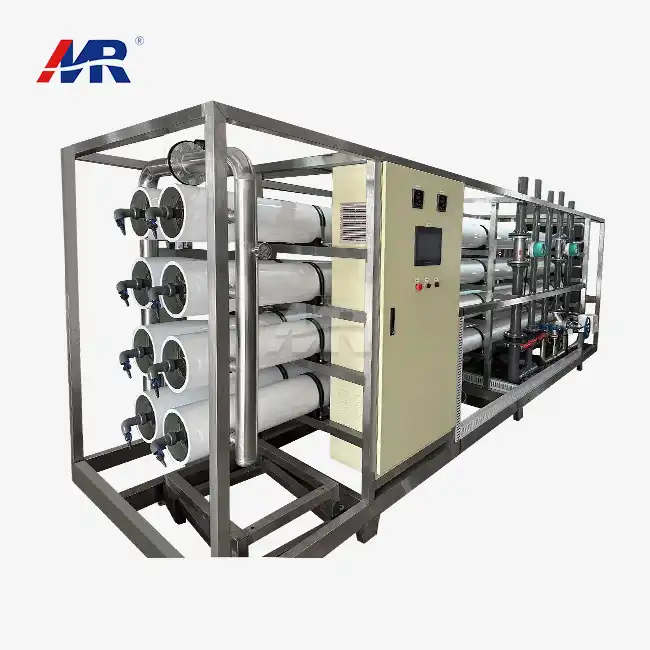
| Parameter | Standard Specification |
|---|---|
| Daily capacity | 500 m³/day (~20.8 m³/hour) |
| Recovery rate | Up to 75% |
| Power consumption | ≤1.5 kWh/m³ |
| Inlet TDS tolerance | Up to 12,000 ppm |
| Permeate TDS output | ≤150 ppm |
| Operating pressure | 12–15 bar |
| Salt rejection rate | 98%–99.5% |
Recovery Rate Explained
Recovery rate is a measure of how much feed water becomes useful permeate compared to reject concentrate. For a 500m3/day reverse osmosis RO plant, if the recovery is 75%, then for every 500 m³ of raw feed water, the system will produce 375 m³ of clean water, while 125 m³ will be used to carry away the removed salts and pollutants in the reject concentrate.
Total Dissolved Solids and Why It Matters
The total dissolved solids (TDS) in water is the total concentration of minerals, salts, and metals dissolved in it. The permeate TDS is less than 150 ppm, which is under drinking water regulations specified by the World Health Organization and fulfills most industrial process water needs, including boiler feed and pharmaceutical rinse water (WHO, 2022).
Operating Pressure and Its Effect on Energy Use
The fact that the operating pressure is 12 to 15 bar indicates that the system is built for brackish water and not for saltwater, which usually demands 55 to 70 bar. This is because the lower the working pressure, the lower the pump energy demand, and this is one reason why brackish water systems of this capacity are so much more efficient than saltwater desalination units of comparable size.
Key Components Inside a 500 m³/day RO Plant
The successful operation of any 500 m³/day reverse osmosis (RO) plant requires the integration of five treatment steps. If any one of these phases is missed or undersized, the membrane life is shortened, and downtime increased.
- Pretreatment filtration: Suspended particles and turbidity are removed by multimedia filters with sand and anthracite, while chlorine and organic compounds are stripped by activated carbon filters prior to the water reaching the membranes. In a 500m3/day reverse osmosis RO plant, the membrane surface is protected from mechanical harm due to tiny particles by a final polishing using 5-micron-rated micro-cartridge filters.
- Chemical dosing systems: Injection of antiscalants to avoid formation of calcium carbonate and silica scale on membrane surfaces. pH adjustment chemicals or coagulants for water sources with unique mineral profiles. Accurate dosing pumps automatically adjust the amount of chemicals to the flow rate, so there is no underdosing and no wasting chemicals.
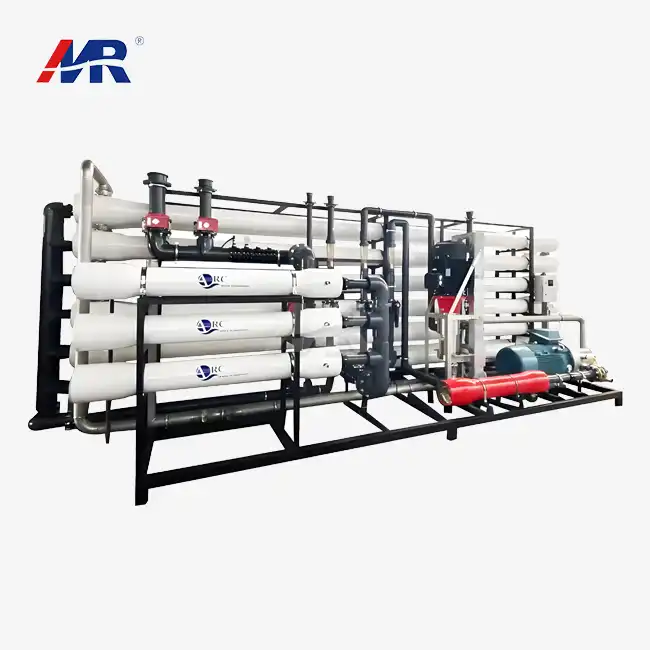
- High-pressure pumping: Multi-stage centrifugal pumps create pressure of 12-15 bar to force water through spiral-wound membrane parts. Variable frequency drives may vary the speed of pumps in real time depending on feed water conditions, reducing energy lost during times of lesser demand.
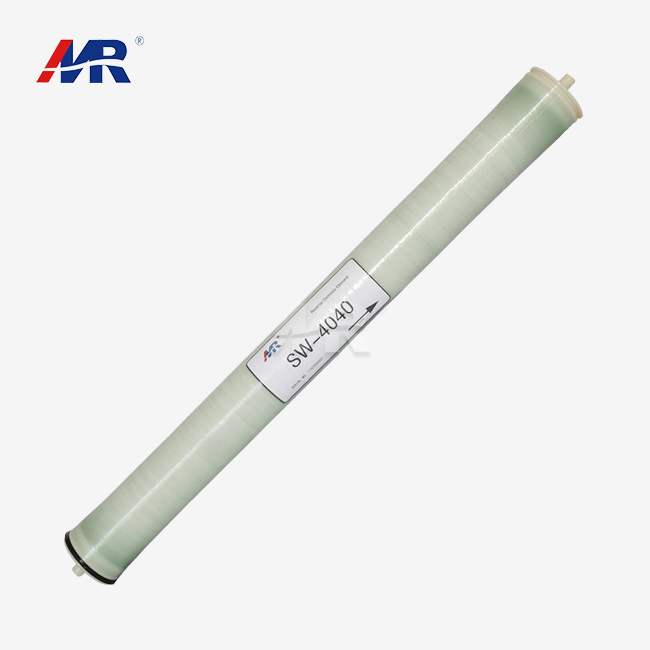
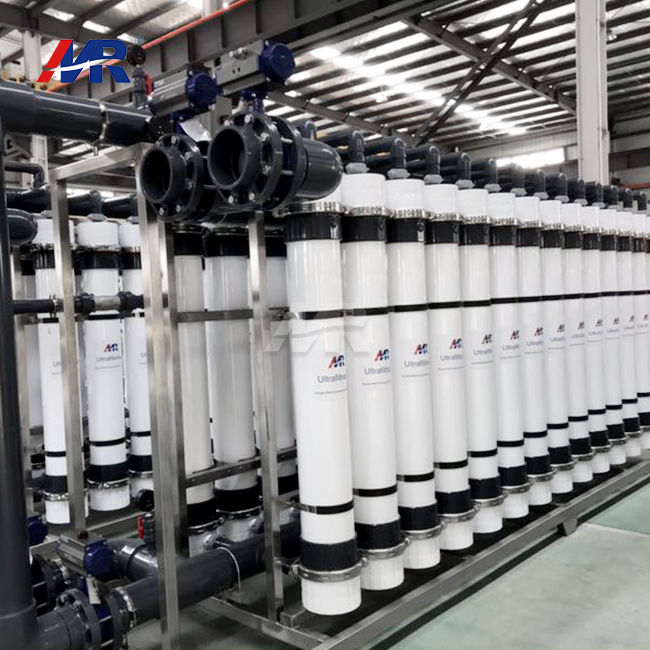
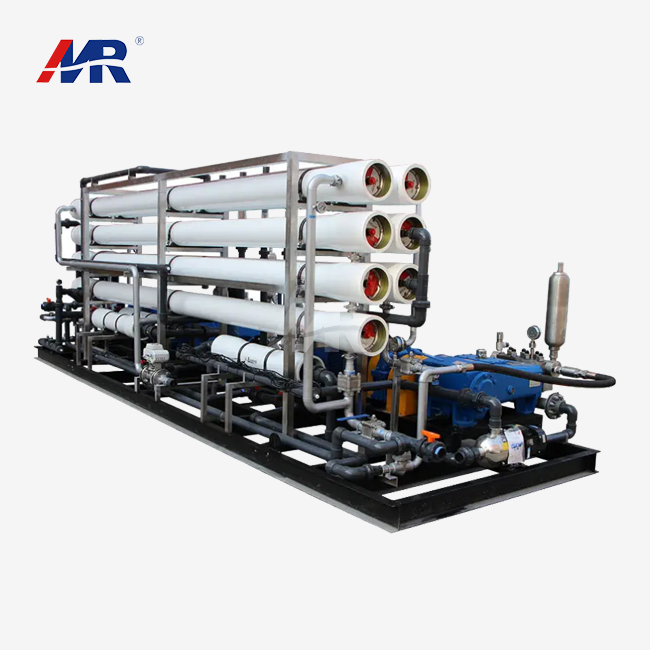
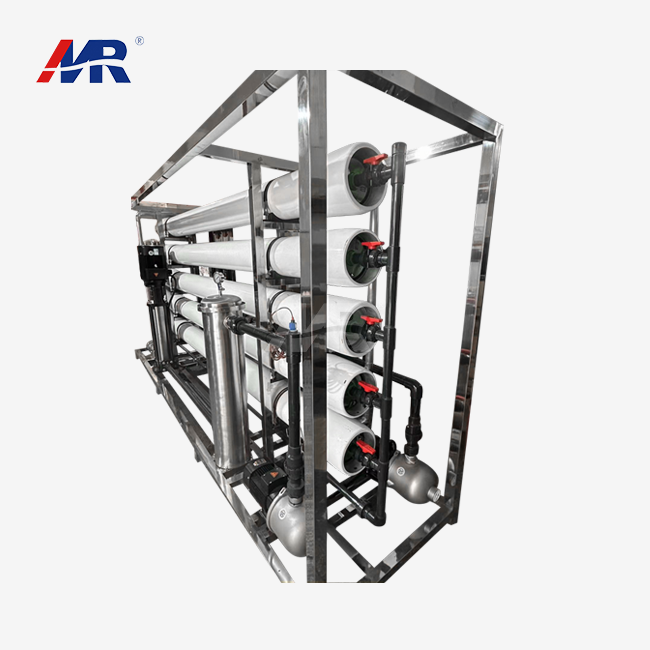
- RO membrane skids: Spiral-wound thin-film composite membranes contained in pressure vessels in arrays designed for brackish or mildly salty water. These membranes are the technological heart of the whole system and represent a considerable portion of the overall equipment costs.
- Post-treatment and control: pH adjustment, UV or chlorine disinfection, and PLC-based automated control panels monitor flow, pressure, and conductivity continually, warning operators before small problems become expensive failures.
These five steps do not function independently but as a unified system. Any weakness in any step- small pretreatment, poor dosing precision, or an underpowered pump decreases the performance of the whole plant.
Why Pretreatment Sizing Gets Overlooked?
A lot of consumers concentrate just on the membrane specs, treating pretreatment as an afterthought. In actuality, pretreatment failures account for more membrane replacement claims than any other single reason, according to warranty data trends we analyze across deployed systems in Southeast Asia and West Africa. This is especially important for systems such as a 500m3/day reverse osmosis RO plant, where inadequate pretreatment can quickly reduce membrane performance, increase operating costs, and shorten the overall service life of the equipment.
Skid-Mounted vs. Containerized Design: Which Fits Your Site?
Choosing a skid-mounted frame or a complete ISO container relies on your site circumstances, climate, and installation timeframe.
When Skid-Mounted Systems Make Sense?
Skid-mounted units are a good choice for interior installations where existing building infrastructure may be used, such as a manufacturing floor or a utility room. They are cheaper than containerized versions since they do not have the steel shell, and they can be simply integrated into existing pipe systems.
When Containerized Systems Make Sense?
When containerized systems make sense, containerized 500 m³/day reverse osmosis (RO) plant units are a good fit for offshore platforms, mining locations, or disaster relief operations where weather protection and ease of mobility are more important than initial cost. Typically, the whole treatment train, including pre-treatment, membranes, and control panel, is housed in a 40-foot container and within days of arrival may be connected to electricity and water.
Climate Considerations for Outdoor Installation
Containerized designs with built-in climate control are ideal for sites in high-humidity coastal regions or in areas with extreme swings in temperature. For example, a 500m3/day reverse osmosis RO plant installed in a containerized configuration can benefit from controlled environmental conditions, helping to protect sensitive electronics and PLC components from corrosion and heat stress that shorten the life of equipment in unprotected outdoor skid installations.
How Recovery Rate and Salt Rejection Affect Water Quality?
Recovery rate and salt rejection are the two parameters that determine whether a system will truly fulfill your application’s water quality standards.
Balancing Recovery Against Membrane Lifespan
Recovery rates greater than design increase the danger of fouling and decrease service life. There is a technical maximum for brackish water systems, but reputable manufacturers stay with a recovery of around 75 percent to safeguard long-term membrane performance, while greater rates may be obtained in brief bursts.
Salt Rejection Standards by Application
Pharmaceutical and semiconductor applications are frequently more demanding with >99% salt rejection, whereas agricultural irrigation systems that treat brackish groundwater often perform efficiently at 98% rejection. Matching the rejection rate to the real application needs prevents spending for membrane grades not needed.
How Does Feed Water Quality Shift These Numbers?
Although the membrane itself is rated for improved performance, feed water with larger levels of organics or iron affects the effective recovery rate. A good water analysis before purchase, not after installation, avoids misaligned expectations between design specification and actual field findings.
Real-World Applications Across Industries
The market for a 500m3/day reverse osmosis RO plant is vast, since it covers almost every industry in Asia, South America, and Africa. These are the four situations we encounter most commonly.
Food and Beverage Production
That’s the capability bottling facilities and beverage producers depend on to consistently provide low-mineral water for product formulation. A 500 m³/day unit is often enough for a medium-sized bottling plant with two shifts a day, covering product water and equipment washing cycles.
Hospitals and Medical Facilities
Purified water fulfilling stringent pharmacopoeia requirements is required for dialysis centers and hospital sterilizing departments. This capacity easily handles the combined dialysis and central sterile supply requirements of a 200-300 bed hospital.
Hotels and Resort Properties
In water-scarce areas, this scale of system is used in coastal resorts to treat brackish well water or to be blended with pre-desalinated saltwater for guest rooms, laundry operations, and pool maintenance, without exerting pressure on municipal connections.
Mining and Remote Industrial Sites
African and South American remote mining operations often have no dependable access to municipal water. Process water and worker camp supply will be provided via a containerized 500m3/day reverse osmosis RO plant unit, avoiding the need for trucked-in water, which the International Council on Mining and Metals estimates may cost operations three to five times more than on-site treatment (ICMM, 2023).
Agricultural Irrigation in Arid Regions
Some farms in arid areas of North Africa and portions of South America employ this capability to work with brackish groundwater and turn useless saltwater into irrigation-grade supplies, expanding the area of cultivable land without relying just on rainfall or municipal water allocation.
Case Study: Solving Water Scarcity for a Beverage Plant in Vietnam
In early 2024, a regional soft drink bottler in Da Nang, Vietnam, reached out to Guangdong Morui Environmental Technology with a production bottleneck directly related to water availability.
The Situation
The facility was fed with municipal water with TDS in the range of 800 to 2,200 ppm depending on the season. Their current treatment apparatus couldn’t cope with the unpredictability, resulting in inconsistent product quality and production slowdowns during the high salinity months.
The Installation
Our technical team designed a skid-mounted 500 m³/day reverse osmosis RO system with additional pretreatment capacity to accommodate seasonal TDS fluctuations. The system included antiscalant dosage adjusted to varying feed conditions and a PLC control panel with automatic modification of recovery rate based on real-time conductivity measurements.
Measured Results
The industrial RO plant achieved TDS permeate levels stabilized consistently below 100 ppm within 3 months of commissioning, irrespective of seasonal feed fluctuations. Water quality concerns cut production downtime from an average of 18 hours a month to less than 2 hours. • Energy usage of 1.3 kWh per cubic meter, below the design level of 1.5 kWh/m³.
| Metric | Before Installation | After Installation |
|---|---|---|
| Permeate TDS consistency | Variable, 300–600 ppm | Stable, under 100 ppm |
| Water-related downtime | 18 hours/month | Under 2 hours/month |
| Energy use per m³ | Not measured (older system) | 1.3 kWh/m³ |
| Production quality rejects | 4.2% of batches | 0.6% of batches |
The plant’s production manager put it simply: “We used to plan our bottling schedule around the water report. Now we merely run the line. That’s the kind of operational simplicity that distinguishes a competently designed system from one that satisfies minimal specs on paper.
What This Case Reveals About Sizing Decisions?
Initially, the customer sought a smaller system of 300 m³/day based on typical daily use. Our technical examination demonstrated that the peak hour demand during bottling runs really needed the bigger 500 m³/day capacity (an easy oversight without evaluating hour-by-hour production schedules rather than just daily averages).
Comparing Top-Rated 500 m³/day RO Systems: What Separates Leaders from Laggards?
Not all systems sold at this capacity work identically when deployed. Three things reliably differentiate the disappointing from the dependable.
Membrane Brand and Element Quality
High-quality thin-film composite membranes used in an industrial RO plant from leading manufacturers may be expected to last 5 to 7 years with adequate maintenance, while cheaper versions often last just 2 to 3 years. Up front, there is normally a 15-20% difference in cost; however, when replacement frequency is taken into account, the overall cost of ownership is in favor of superior membranes.
Automation Depth and Remote Monitoring
Basic systems provide manual valve operation and local monitoring only. Top solutions incorporate PLC automation with remote access so operators may examine performance on a mobile device and be alerted before an issue becomes a shutdown. This one feature has been found to considerably cut the average repair response time for multi-site operations.
Pretreatment Flexibility
Variable or unexpected input water requires changeable pretreatment capacity, not a set arrangement based on one water sample. Modular pretreatment phases of systems adjust to seasonal variations without complete redesign.
After-Sales Service Network Coverage
A provider with a nearby RO water purification system branch and stored replacement parts reacts to a membrane fouling incident in days, not weeks. This is something you don’t typically see on a spec sheet, but it may be the difference between one day of downtime and one month.
These four differentiators explain how two systems with similar nameplate capacity might function in very different ways during a five-year operation period.
Total Cost of Ownership: Energy, Maintenance, and ROI
Purchase price tells only part of the story. Energy consumption, membrane replacement, and chemical usage determine the real cost of running a 500 m3/day reverse osmosis RO plant over its operating life.
Energy as the Largest Recurring Cost
At 1.5 kWh per cubic meter, a system running at full 500 m³/day capacity consumes 750 kWh daily. Over a year, that's roughly 273,750 kWh, a substantial line item on any industrial energy budget. Systems with variable frequency drives and energy recovery devices can cut this figure by 15-20% compared to fixed-speed pump configurations.
Membrane and Chemical Replacement Cycles
Budgeting for membrane replacement every 5-7 years and antiscalant/cleaning chemical costs monthly gives a realistic five-year cost projection. Buyers who skip this calculation often underestimate total ownership cost by 25-30% compared to the initial equipment quote.
Calculating a Realistic Five-Year Budget
A complete five-year budget for an RO water purification system should include the initial equipment cost, annual energy expenditure, one membrane replacement cycle, routine chemical dosing, and an allowance for pump maintenance. Buyers who request this breakdown from suppliers upfront avoid unpleasant surprises during year three or four of operation.
Common Mistakes Buyers Make When Selecting a 500 m³/day RO Plant
After reviewing installations across multiple markets, a handful of recurring errors show up again and again.
Sizing Based on Average Demand Instead of Peak Demand
Designing around average daily consumption instead of peak-hour demand leaves systems unable to keep pace during high-production periods, forcing costly emergency upgrades within the first two years of operation.
Overlooking Local Power Grid Stability
Voltage fluctuations common in parts of Africa and South America can damage unprotected PLC components. A properly specified system includes voltage stabilization and surge protection as standard equipment, not an optional extra.
Choosing Equipment Without After-Sales Support Plans
A system without accessible spare parts and trained local service support turns a minor membrane fouling issue in a reverse osmosis plant into weeks of downtime. Verifying supplier response times before purchase prevents this exact scenario.
Underestimating Water Analysis Requirements
Some buyers submit a single water sample taken on a dry season day, missing seasonal variation entirely. A complete design process should request water quality data across at least two seasons before finalizing membrane and pretreatment specifications.
Conclusion
A well-specified 500m3/day reverse osmosis RO plant delivers reliable, consistent water quality across industries ranging from beverage bottling to hospital dialysis units. The difference between a top-rated system and an underperforming one comes down to membrane quality, pretreatment flexibility, and automation depth—not just the capacity number on the spec sheet. Buyers who evaluate total cost of ownership alongside upfront price and who verify after-sales support before signing consistently report smoother operations and fewer surprises over the system's working life.
FAQ
1. How much does a 500 m³/day RO plant cost?
Complete systems typically range from $45,000 to $95,000 USD depending on materials, automation level, and pretreatment complexity, with containerized units generally priced higher than skid-mounted equivalents.
2. How long does it take to install a 500 m³/day system?
Containerized units can be operational within 2-3 weeks of arrival, while skid-mounted systems requiring site-specific piping usually take 4-6 weeks from delivery to commissioning.
3. What feedwater sources work with this capacity?
These systems handle brackish groundwater, municipal water, and moderately saline surface water up to 12,000 ppm TDS, though seawater applications require a different membrane configuration and higher operating pressure.
4. How often do membranes need replacement?
Quality thin-film composite membranes last 5-7 years with proper pretreatment and cleaning schedules, while lower-grade elements may require replacement every 2-3 years.
5. Can a 500 m³/day RO plant operate continuously for industrial production?
Yes, a properly designed 500 m³/day RO plant can support 24/7 industrial operation when equipped with suitable pretreatment, reliable pumps, and automated monitoring. Regular membrane cleaning, performance checks, and preventive maintenance help maintain stable output quality while minimizing unexpected downtime and extending equipment lifespan.
Get a Custom Quote for Your Water Treatment Project
Sourcing a dependable 500 m3/day reverse osmosis RO plant manufacturer starts with checking for in-house membrane production and verifiable infeedwater records. Guangdong Morui Environmental Technology Co., Ltd. operates its own membrane factory alongside several equipment processing plants, supported by 14 branches, 500 employees, and 20 in-house engineers across our network. We're also the authorized agent for Shimge Water Pumps, Runxin Valves, and Createc Instruments, giving clients trusted components within one integrated project quote. Email our engineering team at benson@guangdongmorui.com to request a proposal built around your specific feedwater report.
Every water treatment project starts with a different feedwater profile, production goal, and site constraint. Morui's team provides customized system design, full installation and commissioning support, operator training, and ongoing preventive maintenance programs across Asia, South America, and Africa. Whether you're comparing a 500m3/day reverse osmosis RO plant for sale from multiple vendors or planning your first industrial water treatment installation, request a documented performance guarantee and site-specific water analysis before finalizing any purchase decision.
References
1. World Health Organization. "Guidelines for Drinking-water Quality," 2022. https://www.who.int/publications/i/item/9789241549950
2. UN Water. "World Water Development Report 2023." https://www.unwater.org/publications/un-world-water-development-report-2023
3. International Council on Mining and Metals. "Water Management in Mining Report," 2023. https://www.icmm.com/en-gb/our-work/environmental-resilience/water
4. U.S. Environmental Protection Agency. "Membrane Filtration Guidance Manual." https://www.epa.gov/dwreginfo/long-term-2-enhanced-surface-water-treatment-rule-documents
5. International Desalination Association. "Desalination Yearbook 2024." https://idadesal.org/
6. Journal of Membrane Science. "Thin-Film Composite Membrane Performance in Brackish Water Treatment," 2023. https://www.sciencedirect.com/journal/journal-of-membrane-science
Author: Bin Liu, Senior Water Treatment Process Engineer
Bin Liu has spent over 12 years designing industrial RO, UF, and desalination systems across Southeast Asia, South America, and West Africa. He holds a degree in Chemical Engineering and has led commissioning projects for beverage, pharmaceutical, and municipal water clients across three continents. Visit moruiwater.com to learn more about our professional engineering team.