_1745823981883.webp)

Does the EDI Water Treatment Process Remove Heavy Metals?
Yes, the electrolytic ion removal method in the EDI water treatment process does a good job of getting rid of heavy metals from water. Ion exchange resins and ion-selective membranes are put together in a DC electrical field. This process catches and gets rid of heavy metal ions like lead, copper, cadmium, and zinc. This technology doesn't use any chemicals and can achieve amazing resistance levels of 10 to 18.2 MΩ·cm. This shows that it can lower heavy metal concentrations to trace levels that are good for making medicines, semiconductors, and other uses involving ultrapure water.
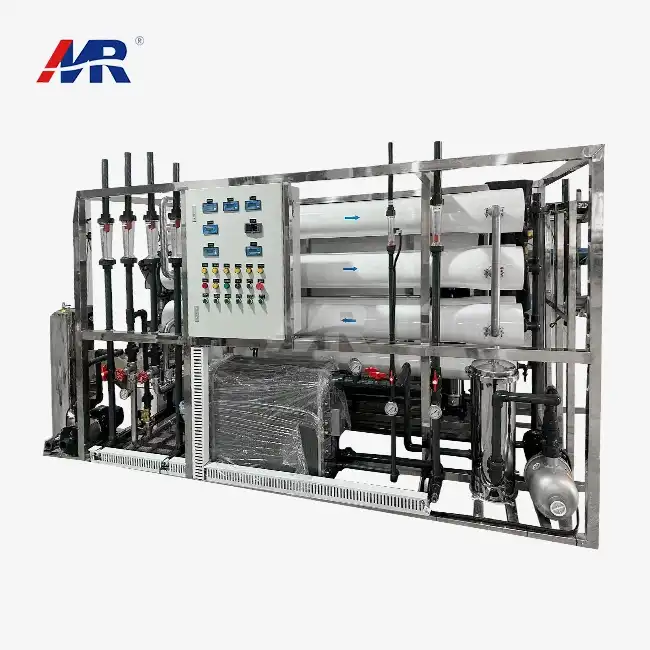
Introduction
There is a hidden danger in water systems that can be found in factories, drug labs, and power plants: heavy metal pollution. Lead, cadmium, mercury, or arsenic can lower the quality of your Products, break down sensitive equipment, and cause expensive regulatory violations. This is true whether you're in the food and beverage industry making bottled water or a thermal power plant managing boiler feed systems.
The EDI water treatment process has become a high-tech way to deal with these problems. EDI is a high-tech electrochemical cleaning method that combines ion exchange technology with electrical fields to remove ionic contaminants over and over again without having to use dangerous chemicals again. When looking at investments in water treatment that need to meet safety standards and run smoothly, it's important to know how this technology gets rid of heavy metals. This guide explains how EDI can help get rid of heavy metals. It gives procurement workers, engineers, and building managers the information they need to feel positive about implementing this technology in their businesses.
Understanding the EDI Water Treatment Process
Core Components and Operating Principles
The EDI water treatment process is made up of three parts that work together to make it work. The dilution sections are filled with ion exchange resins that catch charged particles as water passes through them. Ion-selective barriers split these areas, letting only certain ions through but not others. The healing process is run by a DC electrical field, which pulls ions out of the resins and flushes them through concentrate pathways. Unlike the old method of mixed-bed deionization, which needed regeneration with acids and caustics in batches, this electrical regeneration happens all the time while the system is running.
With this setup, there is no longer any downtime for operations during chemical refill processes. You don't have to store dangerous chemicals on-site, which lowers the chance of accidents and the work needed to meet environmental standards. The process recovers between 90% and 95% of the water that is used, which means that compared to other ways of cleaning, very little water is wasted.
Comparison with Reverse Osmosis and UV Treatment
When looking at different types of purification systems, each one deals with different kinds of pollution. Through membrane filtering under pressure, reverse osmosis is very good at getting rid of dissolved solids, chemical compounds, and bigger molecules. Microorganisms can be killed by ultraviolet light, but ions and minerals that are dissolved in water can't be removed. Ionic species are the main focus of the EDI water treatment process, which makes it the best cleaning step after RO pretreatment.
In heavy metal removal scenarios, RO usually gets rid of 90–98% of the heavy metal ions, but the small amounts that are left may be higher than what is allowed in ultrapure water. EDI fills in this gap by catching heavy metal ions that get through ro membranes. When RO and EDI are used together, they produce uniform resistivity levels that neither technology can achieve on its own. This is especially useful in semiconductor manufacturing, where contamination as small as a few parts in a billion can ruin product yields.
Step-by-Step Ion Removal Mechanism
Before water goes into the EDI module, it is pretreated to lower the conductivity of the feedwater to less than 40 μS/cm. There is ion exchange as it moves through resin-filled sections, just like in normal systems. Cations swap with hydrogen ions, and anions swap with hydroxyl ions. At the same time, the DC electrical field pulls these ions away from the plastic beads. Through cation-selective membranes, cations move toward the cathode into concentrate cells. Anions, on the other hand, move toward the anode through anion-selective membranes. This constant electrical regeneration keeps the plastic in its active state without using chemicals, so it can keep working for months without stopping for upkeep.
Heavy metal cations like copper (Cu²⁺), lead (Pb²⁺), and cadmium (Cd²⁺) move along this path and gather in the reject stream as the clean water leaves the module. The electrical motive force makes sure that these metallic ions don't stay in the product water. If the feedwater cleaning is done correctly, removal rates can be over 99%.
Can EDI Remove Heavy Metals Effectively? — Analysis and Evidence
Electrochemical Principles for Metal Ion Elimination
Heavy metals can be taken out of water electrochemically because they are charged cations. The electrical potential used in the EDI water treatment process takes advantage of this ionic nature. Heavy metal cations are pushed toward the cathode by an electromotive force when voltage is applied across the EDI stack. Positively charged metal ions can move into concentrate chambers, but they can't go back to the product water pathways because of cation-selective membranes placed all over the module.
The ion exchange plastics make this process better by briefly holding heavy metals while they move. This two-part system—electrical transport and ion exchange—makes sure that all the waste is removed, even if one process is temporarily not working well. Studies done in chip factories have shown that lead levels can be reduced from 15 parts per billion (ppb) in RO permeate to less than 0.1 parts per billion (ppb) in EDI product water. This shows how well the technology works at getting rid of metal ions.
Performance Comparison with Alternative Technologies
Reverse osmosis can get rid of a lot of heavy metals, but the performance of the membrane depends on the temperature, pressure, and chemistry of the feed water. Sometimes, tiny hydrated ions can get through RO membranes, and as the membranes wear down over time, rejection rates can drop. Chemical precipitation gets rid of heavy metals well, but it leaves behind coagulant leftovers that are contaminated and creates dangerous mud that needs to be thrown away.
Once the feedwater meets basic quality standards, the EDI water treatment process keeps working the same way no matter what these factors are. The electrical recycling keeps the ion exchange capacity new, so the performance doesn't slowly go down like it does with regular deionization. edi systems regularly meet discharge limits for chromium, nickel, and zinc in electroplating plants that treat metal-contaminated process water. Other methods have a hard time meeting these limits without a lot of chemical dosing and settling time.
Real-World Validation from Industrial Applications
A Californian company that makes semiconductors showed that its ultrapure water system, which combines RO with electrodeionization, could remove copper. Copper levels dropped from 180 parts per billion to 8 parts per billion after RO treatment. The EDI stage then dropped them even more, to 0.3 parts per billion, which is well below the 1 part per billion limit for chip rinse uses. The system worked nonstop for 11 months between cleaning rounds of the membranes and didn't lose any function.
A pharmaceutical plant that makes Water for Injection said the same thing happened when they tried to get rid of lead. Their two-pass RO method cut the amount of lead to 2–3 ppb, which was higher than the goal of 1 ppb for injectable products. Adding an electrodeionization polishing stage lowered the amount of lead to below 0.5 ppb during all tracking times, making sure that the process followed USP monographs. EDI has been proven to be able to meet strict heavy metal standards in tough industry settings by these implementations.
Common Challenges and Solutions in EDI Water Treatment for Heavy Metals
Addressing Scaling and Fouling Issues
Calcium and magnesium hardness build up on membrane and resin surfaces when amounts are too high to dissolve. This makes scale layers that stop ions from moving and lowers the effectiveness of heavy metal removal. To keep this from happening, the hardness of the feedwater must stay below 1 ppm as calcium carbonate. The EDI system can be kept from growing by adding softeners or making sure the RO preparation works well.
Ion exchange sites get dirty from organic matter like leftover oils, biological growth, or humic substances. This makes them less effective at catching heavy metal ions. Keeping the amount of free chlorine in the EDI feedwater below 0.05 ppm stops reactive resin damage and limits biological growth. Monitoring the Silt Density Index on a regular basis keeps the amount of particulate pollution below SDI 3. This lowers the amount of physical fouling that stops flow channels and makes flow lines that skip resin beds.
Optimizing Pretreatment for Heavy Metal Applications
When getting rid of heavy metals is the main goal, pretreatment planning is very important. RO systems should work at recovery rates that get rid of enough multivalent cations. For salty water sources, this is usually between 75 and 80% recovery. This makes sure that most of the heavy metals are removed by the RO concentrate before the water gets to the EDI modules.
Before RO, carbon filtration gets rid of organic molecules that might combine with heavy metals and make them harder to get rid of through ionic processes. Dosing antiscalant stops metal hydroxides and carbonates from forming in the pores of an RO membrane. These steps taken before treatment protect both the RO and EDI water treatment process stages and make the whole treatment train better at getting rid of heavy metals.
Preventative Maintenance for Sustained Performance
By putting in place a tracking system, performance loss can be caught before heavy metal levels get too high. We keep an eye on the water resistance of the product all the time, and when it changes, we look into the module voltage, current, flow rates, and pressure drops. Lab tests done on a regular basis show that the levels of heavy metals stay within the desired ranges. This proves that the resistivity readings properly show the removal of ions.
When dirt starts to lower the quality of the output, cleaning methods bring it back to normal. Scale and organic layers can be taken off of membranes and resins by using allowed chemical cleaning solutions. How often you clean an EDI system depends on the quality of the feedwater, but most industrial systems need to be cleaned every 6 to 12 months when they are working normally. Setting these repair times stops the slow loss of performance that could lead to heavy metal breakthrough.
Purchasing and Implementing EDI Systems for Heavy Metal Removal
Key Evaluation Criteria for Procurement Teams
The initial cash input is only one part of the total cost of ownership. We figure out the running costs, which include how much power is used (usually 0.1 to 0.5 kWh/m³), how much pretreatment chemicals are used, how often the resin needs to be replaced, and how much it costs to clean the membrane. When compared to traditional ion exchange, this method saves money on both buying and getting rid of trash because it doesn't use regeneration chemicals. Over a period of 5 to 7 years, these operating savings more than make up for the higher equipment costs.
The system's ability needs to match your production needs while also leaving room for future growth. EDI units come in standard sizes, and industrial systems can handle anything from 1 m³/h for lab use to 100 m³/h or more for power plant makeup water. Adding parallel modules to a modular design system is a way to increase its capacity without having to rethink the whole thing. We make sure that the voltage and current capabilities match the properties of your water, since more conductivity in the feedwater means that the electrical capacity needs to be higher.
Supplier Selection and Support Considerations
Reliable providers offer full technical help for the whole lifecycle of the tools. We judge manufacturers by how much experience they have in your business. For example, pharmaceutical EDI systems need different validation methods than power generation applications. By looking at case studies from suppliers who have worked on similar projects in the past, you can see how well they handle heavy metal removal issues that are important to your building.
Support after the sale is what makes the difference between a smooth operation and a long period of downtime. Strong providers offer the ability to watch from afar, quick access to extra parts, and trained service workers who know how to fix problems with electrodeionization. The warranty should cover both the modules and the power sources, and it should be clear under what conditions the guarantee stays good. When choosing an EDI system seller, these service factors are just as important as the specs of the equipment.
Installation Planning and Integration
Adding electrodeionization to water treatment systems that are already in place needs careful planning to account for limited room, utility links, and the order of process flows. EDI modules take up 50% less floor room than mixed-bed deionization systems of the same type, but they still need enough space for upkeep and replacing modules. We work with the building engineering teams to make sure there is enough electricity service (usually 480V three-phase power) and space for condensate streams to drain.
Before the system (EDI water treatment process) is used in production, commissioning processes make sure that all of its features meet the design requirements. We check how well heavy metals are being removed by comparing the amounts of key contaminants in your source water that go into and come out of the system. Setting these performance standards gives practical tracking and ongoing points of reference and helps figure out when maintenance is needed.
Conclusion
The EDI water treatment process has been shown to remove heavy metals through an electrochemical ion separation mechanism. It can reach concentrations of parts per billion that meet the strictest industry standards. EDI gives companies that make medicines, semiconductors, power plants, and other things a long-term way to make ultrapure water by constantly renewing ion exchange resins with electrical fields instead of dangerous chemicals. When set up correctly with the right preparation and kept up according to best practices, electrodeionization systems get rid of heavy metals reliably, helping with both regulatory compliance and operating excellence. As membrane technology and process automation keep getting better, EDI will play a bigger part in treating water in industries where clean water has a direct effect on product quality and caring for the environment.
FAQ
1. Which specific heavy metals can EDI systems remove?
Heavy metals that are cationic, like lead, cadmium, copper, zinc, nickel, chromium, mercury, and arsenic, can be removed successfully through electrodeionization. The rate of removal relies on the ionic charge and hydrated radius of the metal. Usually, multivalent cations have higher removal rates. Anion exchange processes in the EDI module can also take in metals that are in anionic forms, such as arsenate.
2. How does EDI performance compare to reverse osmosis for heavy metals?
After RO, 90–98% of the heavy metals are usually gone, and the EDI water treatment process lowers the amounts that are left to levels that can't be detected. RO is an important pretreatment step that cuts down on bulk contamination. EDI then picks up the small amounts that get through RO filters. Because they work well together, RO plus EDI is the best combination for uses that need parts-per-billion heavy metal requirements.
Partner with Morui for Reliable EDI Water Treatment Systems
Guangdong Morui Environmental Technology offers complete options for industrial sites that need to get rid of heavy metals reliably. For more than 20 years, our engineering team has been creating electrodeionization systems for use in the production of drugs, semiconductors, electricity, and other specialized industrial tasks. We offer turnkey solutions, from the initial inspection to commissioning and ongoing upkeep. Our 14 branches hire 500 people, including 20 specialized engineers.
Morui has specific facilities for making membranes and equipment for the EDI water treatment process. This gives us direct control over the quality of the parts and lets us keep our prices low as both an EDI system seller and a technology integrator. Because we work with top brands like Shimge Water Pumps, Runxin Valves, and Createc Instruments, you can be sure that your system will have tried-and-true parts and solid support. Our flexible designs can be changed to fit your exact needs, whether you need a small 1 m³/hour lab system or a 100+ m³/hour industrial installation.
Email our expert team at benson@guangdongmorui.com to talk about your water quality goals and problems with removing heavy metals. We'll look at the features of your source water, your production needs, and your compliance goals to come up with the best treatment setup for you.
References
1. Wood, J. and Gifford, J. (2018). "Electrodeionization Technology for Ultrapure Water Production in Semiconductor Manufacturing." Journal of Water Process Engineering, Volume 26, pp. 112-124.
2. Strathmann, H. (2020). "Ion-Exchange Membrane Processes in Water Treatment." Membrane Science and Technology Series, Elsevier Publishing, pp. 387-429.
3. American Society for Testing and Materials (2019). "ASTM D5127-19: Standard Guide for Ultra-Pure Water Used in the Electronics and Semiconductor Industries." ASTM International Standards.
4. Ganzi, G. and Jha, A. (2017). "Practical Aspects of EDI System Operation for Industrial Water Treatment." Industrial Water Treatment, Volume 35, Issue 4, pp. 28-41.
5. United States Pharmacopeial Convention (2021). "USP-NF General Chapter <1231> Water for Pharmaceutical Purposes." United States Pharmacopeia 44-National Formulary 39.
6. Towe, E. and Lozier, J. (2016). "Heavy Metal Removal Performance in Combined RO-EDI Systems for Power Plant Applications." Power Engineering Journal, Volume 120, Issue 9, pp. 56-67.