_1745823981883.webp)

What Are the Unique Properties of DTRO Technology?
DTRO (Disk Tube Reverse Osmosis) Technology is a huge step forward in how water is treated. It has special features that make it different from other reverse osmosis systems. This new technology takes the best parts of disc-shaped membrane modules and mixes them with high-pressure operation to give better results in tough garbage situations. DTRO systems are great at cleaning complicated, high-salinity, and high-COD industrial wastewater that would quickly clog up other types of membrane systems. DTRO achieves impressive fouling resistance and concentration factors while keeping a small size by using specially designed flow paths and spacers that create turbulence. DTRO Technology is a reliable and efficient way for businesses that have to follow strict rules about wastewater discharge or want to achieve zero liquid discharge to concentrate tough wastewaters and get the most water back.
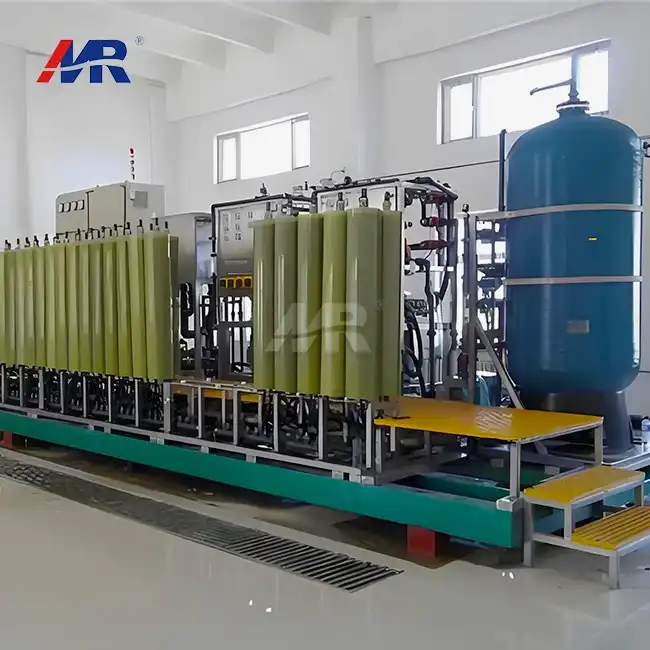
What unique flow-channel features distinguish the DTRO Technology?
The heart of DTRO Technology lies in its innovative membrane module design, which offers several key advantages:
Disc-Shaped Membrane Configuration
DTRO uses a set of stacked disc-shaped membrane sheets instead of the usual spiral-wound RO elements. This special shape makes the flow lines shorter and the fluid spread across the membrane surface more even. This leads to better mass transfer and less concentration polarization, which lets DTRO work well with higher feed concentrations.
Turbulence-Promoting Spacers
Between each membrane disc, specially engineered spacers create controlled turbulence in the feed channel. This turbulent flow regime offers two critical benefits:
- Improved mixing at the membrane surface, which reduces the buildup of rejected solutes and minimizes concentration polarization
- Enhanced shear forces that help prevent scaling and fouling by continuously sweeping away potential foulants
Optimized Channel Height
The feed channel heights in DTRO Technology systems are carefully regulated. This improvement achieves a balance between increasing turbulence (to prevent fouling) and lowering the pressure drop across the module as much as possible. The result is an operation that works well even when feeds are very concentrated.
Key properties of DTRO Technology: high pressure, turbulence, anti-fouling
DTRO Technology's unique design enables several defining characteristics that make it ideal for challenging wastewater applications:
High-Pressure Operation
DTRO systems are engineered to withstand significantly higher operating pressures compared to conventional RO:
- Typical operating range: 40-120 bar (580-1740 psi)
- Some specialized DTRO units can operate at up to 160 bar (2320 psi)
With this high-pressure ability, DTRO can get around the osmotic pressure of very concentrated brines and reclaim a lot of water very quickly.
Enhanced Turbulence
When disc shape and special gaps are put together, they make a flow regime inside DTRO modules that is very turbulent. This chaos has a number of benefits:
- Reduced concentration polarization at the membrane surface
- Improved mass transfer, enabling higher flux rates
- Continuous scouring action that mitigates scaling and fouling
Superior Anti-Fouling Properties
DTRO Technology demonstrates remarkable resistance to fouling, even when processing challenging wastewaters:
- The short flow path and turbulent conditions minimize the accumulation of foulants
- Higher crossflow velocities help maintain a cleaner membrane surface
- The disc configuration allows for easier cleaning and membrane replacement if fouling does occur
Compared to regular RO systems, these anti-fouling features mean that they can run for longer periods of time, need less cleaning, and cost less to maintain.
How does DTRO Technology achieve high recovery and a compact footprint?
DTRO Technology's unique design enables it to achieve impressive water recovery rates while maintaining a relatively compact system footprint:
Multi-Stage Configuration
DTRO systems typically employ a multi-stage configuration:
- Feed water passes through multiple membrane stages in series
- Each stage concentrates the reject stream from the previous stage
- This cascading arrangement maximizes overall system recovery
DTRO can get water recovery rates of 50–70% by using this method, even when cleaning difficult wastewaters with a lot of dissolved solids.
High Flux Operation
The turbulence-inducing design of DTRO modules allows for higher flux rates compared to conventional RO:
- Reduced concentration polarization enables sustained high flux operation
- Enhanced mass transfer efficiency across the membrane surface
- Higher operating pressures drive increased permeate production
These factors combine to allow DTRO systems to process more water per unit of membrane area, contributing to a smaller system footprint.
Modular Scalability
DTRO Technology offers excellent scalability due to its modular design:
- Individual DTRO modules can be easily added or removed
- Systems can be configured in various arrangements to optimize space utilization
- Capacity can be incrementally increased without major system redesigns
This modularity lets dtro plants clean a lot of wastewater while still having a fairly small footprint, which makes them good for places where room is limited.
FAQ
Q1: What types of wastewater are best suited for DTRO Technology?
A: Water that has a lot of salt, COD, and other contaminants can be hard to clean up. DTRO Technology is very good at doing this. This method is great for cleaning up strong brines from other water treatment methods, as well as leachate from dumps and wastewater from chemical or mining operations.
Q2: How does DTRO compare to conventional RO in terms of energy efficiency?
A: Most of the time, DTRO systems work at higher pressures than regular RO systems. However, they can recover more water and keep working even with tough feedwaters, which can save energy overall in many Cases. How energy efficient something is will depend on the type of garbage being handled and the goals of the treatment.
Q3: What is the typical lifespan of DTRO membranes?
A: DTro membranes last for a certain amount of time, depending on what they are used for and how they are run. When treating tough wastewater, however, DTRO membranes usually last longer than RO membranes since they are stronger and don't get stuck as often. If they are cleaned and cared for properly, DTRO membranes can last at least two to three years in commercial settings.
Discover Advanced DTRO Technology Solutions | Morui
Are you ready to use cutting-edge DTRO Technology to change the way you treat wastewater? Guangdong Morui Environmental Technology Co., Ltd. has cutting-edge DTRO systems that can be customized to meet the needs of your business. Our expert team can come up with a unique answer to solve your problems, whether you're in the manufacturing, food and beverage processing, or public water treatment business.
Don't let difficult wastewaters hold your operations back. Contact us today at benson@guangdongmorui.com to discuss how our DTRO Technology can help you achieve higher water recovery rates, reduce treatment costs, and meet stringent environmental regulations. With Morui's full range of services, which includes supplying the equipment, installing it, operating it, and providing ongoing support, you can be sure that we will provide a dependable and effective wastewater treatment solution.
References
1. Zhang, Y., et al. (2021). "Advances in disk tube reverse osmosis (DTRO) technology for concentrated wastewater treatment: A comprehensive review." Journal of Membrane Science, 618, 118744.
2. Li, X., et al. (2020). "Performance evaluation of a novel disk tube reverse osmosis (DTRO) system for treatment of high-salinity wastewater." Desalination, 489, 114535.
3. Wang, J., et al. (2019). "Application of disk tube reverse osmosis technology in treatment of high-salinity wastewater from shale gas exploitation." Water Science and Technology, 79(7), 1304-1311.
4. Gu, B., et al. (2022). "Recent progress in disk tube reverse osmosis technology for industrial wastewater treatment and resource recovery." Separation and Purification Technology, 278, 119570.
5. Chen, L., et al. (2018). "Treatment of high-salinity chemical wastewater by indigenous bacteria immobilized in disc-tube reverse osmosis system." Bioresource Technology, 266, 134-141.
6. Liu, Y., et al. (2023). "Comparison of disk tube reverse osmosis and conventional reverse osmosis for treatment of high-strength landfill leachate." Environmental Technology & Innovation, 29, 102980.