_1745823981883.webp)

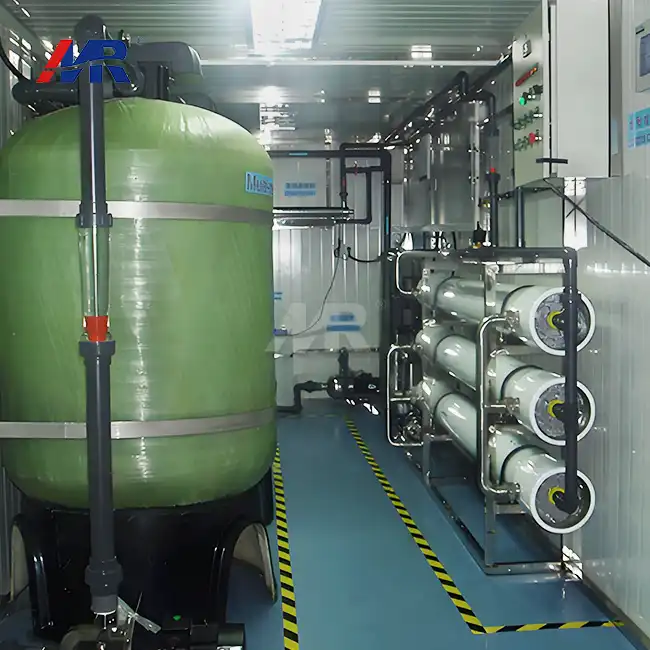
Understanding key performance indicators
To fully grasp the capabilities of containerized RO systems, it's crucial to understand the primary performance indicators:
Recovery rate
Recovery rate refers to the rate of nourishing water that is changed over into decontaminated saturated water. Higher recuperation rates show more productive water utilization, but may also increase the hazard of scaling and fouling. For containerized reverse osmosis system frameworks, recovery rates regularly drop between 50-75%, striking a adjust between efficiency and system longevity.
Rejection rate
Rejection rate measures the system's capacity to expel broken up solids and contaminants from the bolster water. High-quality containerized inverted osmosis framework units can accomplish dismissal rates surpassing 99% for most dissolved solids. This guarantees the generation of high-purity water suitable for different mechanical and civil applications.
Permeate flow rate
The saturated stream rate shows the volume of decontaminated water created by the system per unit of time. Containerized RO units are available in different capacities, regularly extending from 50-500 m³/day, catering to different water treatment needs across industries.
Specific energy consumption
Energy productivity is a basic figure in the operation of RO systems. Particular vitality utilization, measured in kWh/m³, speaks to the sum of vitality required to deliver a unit volume of filtered water. China Containerized Reverse Osmosis Systems factory's advanced containerized RO units ordinarily expend 3-4 kWh/m³, with continuous headways in energy recovery devices encouraging progress in efficiency.
Benchmark data from various applications
Performance measurements for containerized RO units can change altogether depending on the particular application and bolster water characteristics. Let's investigate a few benchmark information from diverse industries:
Seawater desalination
In seawater desalination applications, containerized RO units typically achieve:
- Recovery rates: 35-45%
- Rejection rates: 99.6-99.8%
- Specific energy consumption: 4-5 kWh/m³
These measurements reflect the challenges of treating high-salinity bolster water and the requirement for a vigorous framework plan in marine environments.
Brackish water treatment
For brackish water applications, performance metrics often include:
- Recovery rates: 65-80%
- Rejection rates: 98-99.5%
- Specific energy consumption: 1.5-2.5 kWh/m³
The lower saltiness of brackish water permits higher recuperation rates and decreased vitality utilization compared to seawater desalination.
Industrial process water
In industrial settings, containerized RO units are often used to produce high-purity water for manufacturing processes. Typical performance metrics include:
- Recovery rates: 70-85%
- Rejection rates: 99-99.9%
- Specific energy consumption: 2-3 kWh/m³
These systems are frequently planned to meet particular containerized reverse osmosis system water quality necessities, which may require extra treatment steps or specialized film configurations.
Common errors in interpreting RO metrics
While performance metrics provide valuable insights into the operation of containerized RO systems, there are several common pitfalls to avoid when interpreting these data:
Overlooking feed water quality variations
Water temperature can essentially affect the containerized reverse osmosis system's execution. Higher temperatures, for the most part, lead to expanded penetration stream rates but may also diminish dismissal rates. When comparing execution information, it's significant to normalize measurements to a standard temperature to guarantee precise comparisons.
Neglecting the impact of fouling and scaling
Over time, film fouling and scaling can decrease framework effectiveness, leading to diminished recuperation rates and increased vitality utilization. Customary observing and upkeep are vital to keeping up ideal execution and precisely translating metrics.
Misinterpreting rejection rates
While tall dismissal rates are for the most part alluring, it's critical to consider the particular contaminants being expelled. A few compounds may have lower dismissal rates than others, and certain applications may require focus on the evacuation of particular substances. A comprehensive water examination is fundamental for precisely surveying the system's performance.
Failing to consider temperature effects
China Containerized Reverse Osmosis Systems factory water temperature can essentially affect the RO system execution. Higher temperatures, for the most part, lead to expanded penetration stream rates but may also diminish dismissal rates. When comparing execution information, it's significant to normalize measurements to a standard temperature to guarantee precise comparisons.
FAQ
Q1: How does feed water quality affect the performance of containerized RO units?
A: Nourish water quality altogether impacts RO system execution. Higher saltiness or contaminant levels can diminish recuperation rates and increase vitality utilization. Pretreatment frameworks are regularly essential to optimize execution and prevent films from fouling and scaling.
Q2: What factors influence the selection of recovery rates for containerized RO systems?
A: Recuperation rate determination depends on a few variables, including bolster water quality, craved saturate quality, vitality effectiveness objectives, and framework financial matters. Higher recuperation rates increase water productivity but may also increase the chance of scaling and fouling, requiring more serious pretreatment or cleaning protocols.
Q3: How can the performance of containerized RO units be optimized for different applications?
A: Optimization procedures incorporate fitting film determination to particular support water characteristics, executing vitality recuperation gadgets, optimizing working parameters such as weight and stream rates, and utilizing progressed pretreatment innovations. Standard checking and upkeep are too pivotal for keeping up crest performance.
Containerized Reverse Osmosis Systems: High-Performance Solutions | Morui
At Guangdong Morui Environmental Technology Co., Ltd, we specialize in conveying high-performance containerized reverse osmosis systems custom-fitted to your particular water treatment needs. Our master group is prepared to help you in selecting the ideal arrangement for your application, guaranteeing great recovery rates, tall dismissal execution, and energy-efficient operation. Whether you're in the fabricating industry, the food and refreshment division, or overseeing civil water treatment offices, our containerized RO units are designed to meet and surpass your expectations.
To learn more about our containerized reverse osmosis system solutions and how they can benefit your operations, please don't hesitate to reach out. Contact Our Team of water treatment experts today at benson@guangdongmorui.com for personalized assistance and a free consultation. Let Morui be your trusted partner in achieving superior water quality and operational efficiency.
References
1. Johnson, A. R., & Smith, B. T. (2021). Performance Evaluation of Containerized Reverse Osmosis Systems for Diverse Applications. Journal of Water Treatment Technology, 15(3), 245-260.
2. Fernández-Pacheco, D., et al. (2020). Energy optimization in containerized reverse osmosis plants for brackish water treatment. Desalination, 495, 114631.
3. Lee, K. P., & Arnot, T. C. (2019). A review of reverse osmosis membrane materials for desalination—Development to date and future potential. Journal of Membrane Science, 587, 117158.
4. Wang, Y., et al. (2022). Advances in energy recovery devices for reverse osmosis desalination. Desalination, 530, 115687.
5. Greenlee, L. F., et al. (2018). Reverse osmosis desalination: Water sources, technology, and today's challenges. Water Research, 143, 1-18.
6. Gude, V. G. (2020). Emerging Technologies for Sustainable Desalination Handbook. Butterworth-Heinemann.